
By: Renae Visico
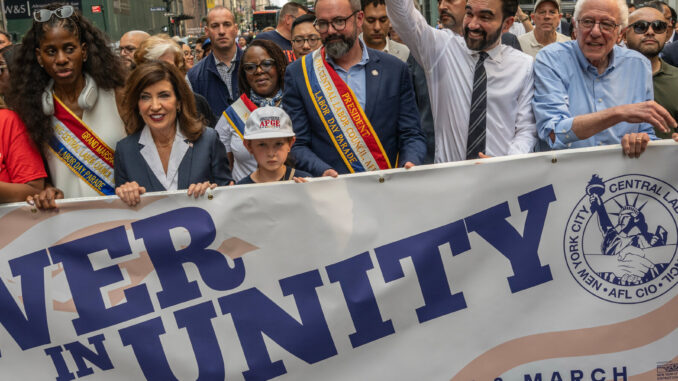
On Sept. 15, Governor Kathy Hochul released an op-ed in the New York Times titled “Opinion: Why I Am Endorsing Zohran Mamdani.” Despite this being a key endorsement for Mamdani, it has only emphasized divisions among Democratic leaders rather than unifying them.
As the title suggests, Hochul described the various reasons for her endorsement of Mamdani, such as his commitment to “making New York City affordable” and creating a city where “children can grow up safe in their neighborhoods and where opportunity is within reach for every family.”
Hochul cited the issue of affordability as the most important concern she shared with Mamdani. She wrote, “When I walk the streets, attend religious services or ride the subway, I meet New Yorkers who love their city but, despite hard work, feel they can’t afford to live and thrive here.”
Because of this, she expressed support for Mamdani’s resistance against Trump’s “abhorrent and destructive” economic policies, including the Big Beautiful Bill passed this July. The bill, which put 1.5 million New Yorkers at risk of losing health insurance and 300,000 more at risk of losing SNAP benefits, was criticized by Mamdani, who called it “one of the biggest heists in US history.”
“[Trump] gutted Medicaid and food assistance, slashed federal funding New York City relies on and threatened a federal takeover of New York,” Hochul wrote. “New York needs leaders who will put aside differences, stand up and fight back against Mr. Trump.”
Hochul also cited Mamdani’s dedication to combating antisemitism as a reason for her endorsement. While he has been accused by critics of being antisemitic due to his anti-Israel stance, Hochul challenges such criticisms by stating that she has “[seen] him meet with Jewish leaders across the city, listening and addressing their concerns directly.”
While Hochul herself was initially hesitant to endorse Mamdani, especially since his opponent, Andrew Cuomo, was her former coworker who helped her become governor, she cited her working-class background as another reason for her endorsement. In her op-ed, she described how her parents raised “six children on a tight budget” in a “trailer park outside Buffalo” where her clothes were bought “at layaway or at secondhand stores” and dinner was made “with Spam sandwiches on day-old bread pulled from the freezer.” These personal experiences have shaped her resonance with Mamdani’s commitment to affordability in New York City.
Earlier this year, in June, Mamdani shocked America by winning the primary mayoral election, securing 43.5% of the votes in contrast to Cuomo’s 36.4%. Starting as a virtually unknown candidate, Mamdani built his campaign on populist proposals such as free bus rides, rent freezing, universal childcare, and enacting higher taxes on millionaires. He also promised the formation of the civilian-led Department of Community Safety, which aims to improve public safety by implementing mental health programs for the NYPD.
Mamdani has also managed to garner support from young New Yorkers through his use of social media trends to advocate for causes popular among youth, such as stronger gun control and LGBTQ+ rights.
Despite Mamdani’s strong victory, many prominent Democrats were hesitant to fully support him. His self-referral as a socialist and his description of the situation in Gaza as a genocide have many influential Democratic leaders, including New York Senators Chuck Schumer and Kirsten Gillibrand, wary of endorsing him as Hochul did.
Both Schumer and House Representative Hakeem Jeffries have met with him and had seemingly productive discussions with the mayoral candidate, but neither have given endorsements.
“I do think some of the hesitation is because on some of the national Democrat level and some of the donor level, there is some type of fear that an association with a socialist mayor will hurt Democrats nationally,” remarked Democratic strategist Trip Yang, though he later added his disagreement with such a “traditional” view.
However, not all Democratic leaders have reflected such hesitancy to endorse Mamdani.
Most notably, progressive Senator Bernie Sanders has been a vocal supporter of his even before his victory in the mayoral primary. Recently, Sanders campaigned alongside Mamdani as they hosted their “Fighting Oligarchy” tour at the Claire Tow Theater at Brooklyn College.
“He brings out people, registers all kinds of new people, brings out non-traditional voters. Now, if you were a Democratic leader in a party which is now in the doldrums, you would be jumping for joy,” Sanders said in an interview with CNN. ”But the five major Democratic leaders have failed to endorse him. That is, to me, absurd.”
Similarly, Rep. Alexandria Ocasio-Cortez, who has also campaigned alongside Mamdani, criticized Senator Schumer and Rep. Jeffries for their refusal to endorse him: “We have a Democratic nominee. Are we a party who rallies behind our nominee or not?”
The noticeable lack of endorsements from top Democratic leaders, even after Hochul’s endorsement, further signifies a divide within the Democratic Party during this election season. After her endorsement, New York Democratic Party Chair Jay Jacobs announced his refusal to do the same.
“I strongly disagree with his views on the State of Israel, along with certain key policy positions,” Jacobs stated. “I reject the platform of the so-called ‘Democratic Socialists of America’ and do not believe that it represents the principles, values, or policies of the Democratic Party.”
Similarly, New York Rep. Tom Suozzi tweeted that he would not be endorsing Mamdani following Hochul’s endorsement: “While I share his concern about the issue of affordability, I fundamentally disagree with his proposed solutions.”
It’s clear that Hochul’s endorsement has not changed the minds of Democratic leaders who have never supported Mamdani. Those who have previously not endorsed him have either continued to stay silent on the subject matter or, like Jacobs and Suozzi, have publicly declared their disagreement with Hochul’s endorsement.
Mamdani’s extremely progressive and socialist platform has alienated centrist-leaning Democrat leaders and voters. They worry that his radical views will be used by Republicans to attach Mamdani’s far-left policies to the Democratic Party, legitimizing themselves by painting the entire party as too radical; and potentially hinder Democratic efforts to flip House seats to a blue majority, as Republicans hold a slight majority over the House by a mere six seats.
Any long-term impact that Hochul’s endorsement would have on the outcome of this year’s mayoral election is still unclear. However, what the endorsement has made clear is the Democratic Party’s persistent internal conflict as they grapple with supporting a candidate who challenges their beliefs, while dominating voting polls.
While Republicans are uniting over criticizing Mamdani, Democrats remain divided on whether or not to do the same.