
By: Emily Nixon
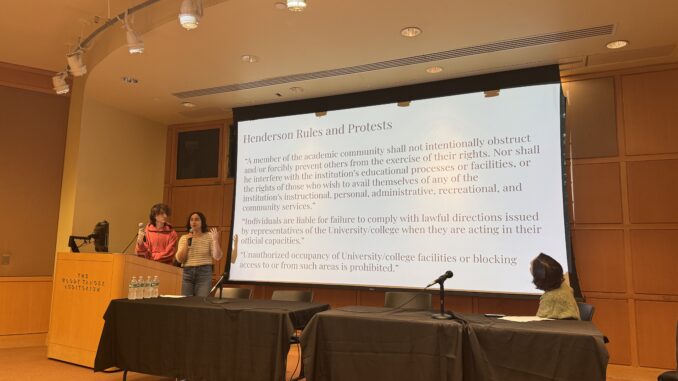
On Oct. 15, the Brooklyn College Student Union (BCSU) held a panel to teach students about the Henderson Rules, the “code of conduct” for students on campus during protests, as well as to open a conversation about their efficacy for modern student protests.
The event featured two CUNY School of Law [CUNY Law] students who are members of Students for Justice in Palestine (SJP), explaining what the Henderson Rules were and how students can protect themselves.
2nd year CUNY Law student, Owen Schalk, and 3rd year student, Marah Birnbaum, presented a slideshow explaining the Henderson Rules’ origins, which stemmed from a massive student protest in the spring of 1969 across various CUNY campuses.
“There was a very successful mass movement of students who were mobilized around these key demands that brought the university to a halt, and then actualized progressive social change,” said Schalk. “In response to the student protest, there’s this series of 200 to 300-page documents that describe the situation that took place across campuses in New York City (NYC), and then later proposes solutions based off of this, which later becomes the Henderson Rules.”
The creation of the policy was a point of suspicion to Birnbaum.
“It’s interesting how things happen in the spring, and then over summer, Admin gets to work in repressive policies,” said Birnbaum.
The Henderson Rules were created to limit the amount of power students were able to amass and exert on the universities, according to Schalk.
“There is a deliberate restriction of the means in which students are able to build and sustain power across university campuses. The Henderson Rules is one of the ways in which this occurs,” said Schalk.
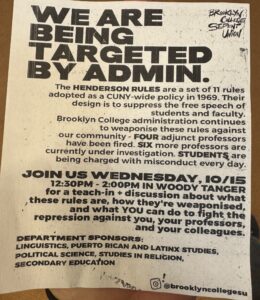
The Henderson Rules are supplemented by a CUNY-wide set of “Time, Place and Manner Regulations”, which vary by specific CUNY Universities. These regulations are supposed to guide what speech is protected on campus, as well as how it is delivered.
These restrictions can and are frequently changed by specific colleges. Birnbaum elaborated that recently, CUNY Queens College had created new regulations for protests.
“Last year, super notably, Queens College instituted a bunch of new time, place, and manner restrictions about […] if you’re wearing a mask, they can ask you to take it off. If you’re in a protest, it has to be a certain duration, other kinds of restrictions,” said Birnbaum.
Another recently changed policy that is being used to guide student disciplinary action is the CUNY Emergency Operations Plan, which was updated in January of this year. The plan contains an annex on page 117 dedicated to “Protests and Demonstrations.”
The annex authorizes public safety personnel to take action against student protestors if a structure is erected on campus.
“At the first sign of a tent or other structure being erected on the property, Public Safety will take all necessary measures to dismantle and remove such items from campus,” states the policy. “Students arrested during disruptions may be placed on emergency suspension as deemed necessary based on the conduct leading to arrest. Students may also be referred for review and action through the student conduct/disciplinary process.”
The last document that Birnbaum and Schalk presented to the event’s guests was Title VI, which mandates that schools that receive federal funding cannot discriminate against students “based on race, color, or national origin,” according to CUNY’s website on Title VI. Birnbaum explained that while this title had not been used against students historically, it had become more prevalently used against students protesting for Palestine.
“In the last year or so, across the country, we’re seeing a lot more Title VI complaints brought against students themselves,” said Birnbaum.
After presenting all the documents that were usually referenced in student disciplinary cases, Birnbaum then explained the usual process for a student disciplinary decision, while maintaining that the explanation was not legal advice.
“The school can initiate the complaint or charge […] there’s typically a preliminary investigation,” said Birnbaum. “Oftentimes, there’s an option for mediation between if it’s a specific complaining person who initiated it and the responding student, which wouldn’t result in […] formal disciplinary charges.”
Birnbaum goes on to explain that if the disciplinary process moved beyond the mediation, it would proceed to turn into a formal hearing, which is the common route for student protesters. The documentation and proceedings have strict rules, which make them function like a “mini-trial,” according to Birnbaum.
“It’s a student-faculty panel […] You should have a week’s notice of the hearing, and you can have one adjournment at the respondent’s say,” said Birnbaum. “You can bring evidence. You can bring a lawyer. You can question any witnesses or evidence brought against you.”
These rules and guidelines are not only used “against” students, but faculty and staff as well, according to Corinna Mullin, one of the four adjuncts fired over the summer, commonly denoted as the “Fired Four”, as previously covered by The Vanguard.
“We’ve [the Fired Four] been told that we’ve been fired for, under the false pretext – I would say, – for violating the Henderson Rules, similar to the singed six who are full-time faculty,” said Mullin. “And, you know, Title VI terms of its aims, at least, in stated aims, it’s not supposed to be about that [weaponizing against students]. It’s supposed to be about defending people from racism and other forms of discrimination […] I agree that Henderson should be abolished, given its origins and its uses.”
Despite the perceived injustices against students, Mullin remarked that it would be a “great exercise” for CUNY students to gather and write their own Henderson Rules to serve their interests better.
“I think it would be a great exercise to, as an across CUNY organizing project, to have some kind of conference where you think through, ‘what kind of codes would actually serve us, if any, […],’ said Mullin. “The imaginary exercise is like the first step in creating something new, and I think that would be really powerful and interesting.”
Students interested in future events by the BCSU can check out their Instagram at: @brooklyncollegesu.