
By: Rami Mansi
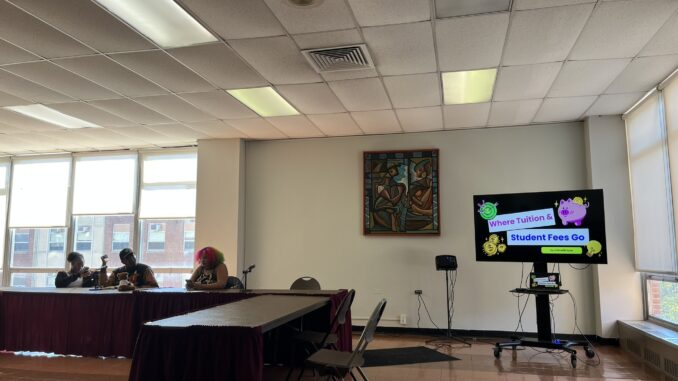
On Oct. 21, Brooklyn College’s (BC) Undergraduate Student Government (USG) held a town hall meeting aimed at informing students and club leaders on where student activity fee funds are distributed, as well as discussing other pressing topics for students.
USG President Cyle Paul shared the purpose of this town hall.
“When I ran [for presidency], I wanted the idea of bringing forth town halls to make it a bit more casual, a lot more present. Then, bringing in administration over time, that way students can see, ‘Okay, this is the part that is involved with this part.’ ”
After an audience of about fifty people took their seats, Paul took to his PowerPoint presentation and shared some statistics about BC clubs on campus.
“$118.55 is taken from your tuition, to then be allocated towards [student activities].” Paul continued, “Your money goes towards different services like the health clinic […], the Immigrant Student Success Office, a lot of different things.”
USG has a total of $178,000 allocated solely for student activities; split amongst the 150 clubs, about $1,200 is given to each club. Any financial responsibility a club takes on, USG takes from this total of $178K.
Paul began discussing information familiar to club leaders: the form all leaders must fill out when requesting to host any activity on campus — the Event Request Form (ERF). Filling out an ERF is mandatory for all activities to be hosted on campus, and it also allows students to request certain items to be purchased by USG.
Within USG, the Club Funding Council (CFC) is directly in charge of events and funding procedures for student clubs. Paul emphasized the importance of attending public CFC meetings.
“If you attend CFC [meetings], the likelihood of you getting pushed to the top, being that you’re present […] That will get you pushed up, and then you can vouch and speak up more vocally when it comes to your specific event itself.”
Paul moved forward and wrapped up his presentation by sharing USG’s end goal as student leaders.
“Our goal is to make sure every club has the support and resources they need to thrive. We understand that not every event funding decision feels ideal, but we always aim to be fair, transparent, and responsible. We want to hear your concerns and work together to make campus life events better for everyone.”
After Paul’s presentation, the floor was open for all audience members to ask questions regarding student and campus life.
One of the first questions asked was regarding public safety at events, including what criteria need to be met for public safety to be present. To which Paul, with the help of the Assistant Director of Central Depository Jessica Bradley, answered that it depends on the type of event, how many people, and who is coming.
“If it’s a party, if there’s an announcer, if there’s a speaker coming, if there’s gonna be any kind of impact to the daily operations of people’s life […] that’s gonna make a big difference [in the number of school safety officers],” Bradley said.
On the topic of school safety, Paul was asked about USG’s involvement with bringing officers to politically-charged meetings, such as protests or teach-ins.
“USG does not select or does not get the ability to select if there’s public safety needed […] How many students, if [the event] is open to the public, if [the event] is CUNY-wide, if it hits two out of three […] So, it’s not exactly the event itself; it’s a matter of the amplification needed if it hits those three criteria.”
Bradley added on to Paul’s statement from an administrative point of view.
“When you look at every event, whether it’s a meeting with three people or an event with 200. Every event is kind of looked at to determine if it’s safe.”
After a question arose about buying specific soft drinks on campus outside of the reserve USG has, Paul and Bradley discussed the pouring rights BC has.
Pouring rights are defined by having an exclusive contract with a type of beverage company. After you sign this contract, you are not allowed to sell any other beverage outside of the agreed-upon brands. BC has a pouring rights contract with Pepsi; therefore, the drinks allowed on BC campus are Gatorade, Mountain Dew, Aquafina, Lipton, among others.
USG has found a way to purchase other forms of drinks outside of these contracts to distribute to clubs.
“USG has decided to purchase bulk drinks for clubs, so clubs do not have to do individual orders,” Bradley stated. “We [purchase bulk drinks] through a distributor, and then the club just needs to let USG know what they need. So [club leaders] don’t have to actually pick up orders.”
After continuing to answer questions about the pouring rights, school safety officials, and student activity fees, Paul ended the Town Hall by speaking on budget cuts and a future project USG will be heading to protect students.
“Administration has spoken regarding this becoming a work in progress, […] Something to kind of combat this in a sense where it gives more amplified opportunities for students to kind of voice this. It’s still under work, so as I get more information, I’ll be able to share with you guys.”
For more information about USG, visit their official Instagram, @bcstudentgov.