
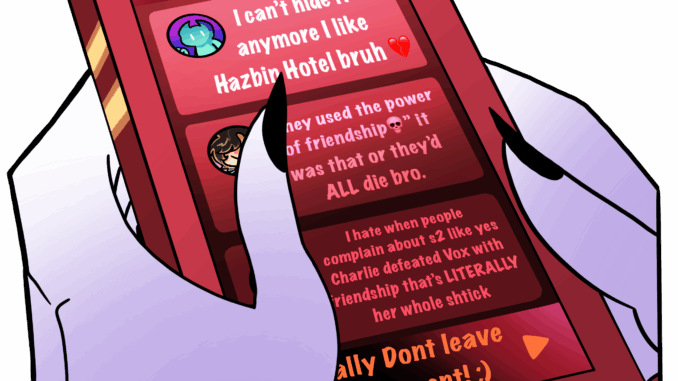
By: Jocelyn Rios
“Welcome to the Hazbin Hotel! Where sinners come to be redeemed!”: the opening line of a thematic promise following television show “Hazbin Hotel” from its viral pilot released on Oct. 28, 2019 to its full first season in early 2024, followed by its extremely ambitious second season a year after.
However, the question circling the fandom is whether the show itself is capable of redemption following the release of season two. After turbulence arose from season 1, receiving mixed reviews and creator controversy surrounding Vivienne Medrano, (also known as Vivziepop) season two arrived under significant review.
But against expectations, season two may have done what the series itself preaches: improvement, evolution, and redemption from its own narrative weaknesses.
In summary of this neo-lit version of Hell, “Hazbin Hotel” follows Charlie Morningstar, Princess of Hell, as she attempts to create a rehabilitation program for the sinners: people who’ve committed sins that lead them down to hell in their afterlives. Her aim? To prove that even the damned are worthy of redemption, a radical idea in a world built on eternal punishment.
Alongside characters such as her girlfriend Vaggie and demon Alastor, the protaginist navigates moral complexity, personal doubt, and the political structure of Hell’s power-hungry overlords.
The 2019 pilot captivated audiences with its bold character designs, musical energy, and raw passion. But as fans quickly learned in season one’s Amazon adaptation, passion alone doesn’t guarantee cohesion.
Though visually striking, the season struggled with pacing issues that left scenes very underdeveloped.
More significantly, controversies surrounding Vivziepop herself changed the positive perception of the show overall, criticism on her writing choices, character portrayals that were inconsistent from what they were made to be in the pilot, and social media behaviors that made people feel cringed by associating themselves with the show in the first place. While much of this discourse was exaggerated and misinformed, it shaped audience reception.
According to Reddit users, “Season one felt like a downgrade from the pilot. The pacing was weird, the plot felt rushed, and a lot of characters didn’t get the development they deserved.”
The show still has a large amount of support, but even fans like myself acknowledge that season one didn’t quite land the emotional and narrative goals it hoped to achieve:
“The 2019 Pilot was pretty good and pretty original. Then there were 4 years of silence. Then we finally got a HH series – and it failed pretty hard,” stated another Reddit user.
That’s why season two’s release was shocking, not just because it was smooth, but because it was significantly better.
From the release of season two, the show had a much clearer direction for the plot, as well stronger writing and pacing between events. According to Reddit users, they “like it had direction. Unlike Season 1, the buildup paid off and the final episodes finally felt like something they planned instead of scrambling to finish.”
It also had a deeper dive into a character’s motivations that the first season lacked when it came to the delivery. The absolute standout of the season, Vox, the media overlord, is only proof of that growth.
In season one, he was little more than a flashy antagonist with a digital aesthetic and an extreme grudge against Alastor.
Season two, however, elevates him into being more manipulative and calculating of those who have large influences he can use as a means to his goal of taking over heaven and hell. His actions carry weight, and his development reveals layers of corporate power, media control, and manipulation that enriches the show’s worldbuilding.
In terms of the plot, the climax, being the final battle, felt extremely impactful with deliberate storytelling and steady story-pacing rather than a rushed attempt to wrap loose threads: “Season 1 didn’t feel finished. But Season 2 finally made me care about the characters and the stakes. It actually felt like a finale this time,” one fan says under a youtube breakdown of season 2 by The Roundtable
Characters were actually given space to grow, struggle, and fight for something meaningful. Despite mildly mixed reactions, I felt “Hazbin Hotel” showed extreme improvement that was meaningful and measurable compared to its first season.
As someone who went into season two with slight disappointment and confusion from season one, I found myself much more invested in the story. The writing felt more confident and the thematic threads about redemption, loyalty, and moral conflict finally aligned with the show’s original vision.
Also, for once, I felt I was actually watching a final battle that had stakes, something that the first season never quite achieved.
The finale felt like the writers had put a lot of effort towards world building. Especially with the shift towards Vox, which not only helped the intentionality of the season, but made the show feel refreshing because it established a villain who kept his motive true to the end, and didn’t feel abrupt towards his fall in comparison to Adam.
Instead of rehashing Adam’s one-note villainy, the season emphasized a layered antagonist whose manipulative control over Hell’s media ecosystem added depth, strengthening the narrative overall.
No show is immune to flaws and “Hazbin Hotel” still has plenty of room to grow, but that growth is exactly what season two has demonstrated. Redemption isn’t about perfection; it’s about progression.
For fans seeking polished writing and airtight plotting, perhaps the series isn’t quite there yet.
For those looking for artistic growth, character depth, awesome musical songs, and an earnest attempt to refine past mistakes, season two delivered.
But in a series built entirely around the idea that the damned can be redeemed if they genuinely try, it’s fitting, almost poetic. The show itself is finally beginning to embody its own message: “Redemption is possible!”