
By: Emily Nixon
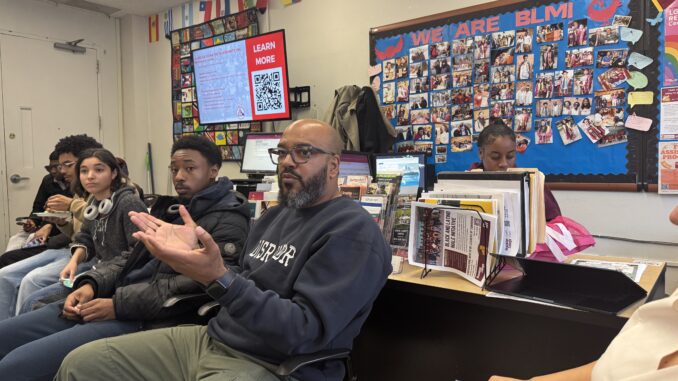
Quiet conversations filled James Hall Room 3309 as an excited buzz swept over attendees.
On Nov. 25, the Brooklyn College (BC) Black and Latino Male Initiative (BLMI) held their second Cafecito Lounge in an effort to foster community and uplift marginalized voices.
“We need more spaces where students can be vulnerable, and we need more spaces where we have creative outlets,” said Carla España, an assistant professor at the Department of Puerto Rican and Latinx Studies (PRLS). “Especially in these times where certain voices, especially marginalized voices, keep being silenced.”
The Cafecito Lounges serve as a way to support the artists of the community, offering them a safe space to work and create, according to Christopher Rodriguez, Director of BLMI.
“The ultimate goal [of the Cafecito Lounges] will be to create somewhat of a published version of student [creative] work. In the spring, there will be a lot of hands-on collaboration with faculty and authors,” said Rodriguez. “The goal is really to create spaces where we’re allowing you to develop your work, grow your work, and then hopefully, by the end, we have a way to celebrate that work and have it live on here. Our voices matter, and we want to actually live to that instead of just saying that.”
Each Cafecito Lounge has a guest speaker to help connect with and provide representation for creatives in the community.
“With the launch [of the Cafecito Lounges], we had a Puerto Rican poet […], so this time, when we thought, ‘What if we had a poet who also represents a lot of the backgrounds of the students,’” said España. “For me, it’s been so powerful to bring in that representation in here as we continue the series.”
For this lounge, the organizers invited Roberto Carlos Garcia, a poet and author with Caribbean roots, to speak with students about his writings and perspective.
“Roberto Carlos Garcia [is] at the intersection of being not only a poet, but as an Afro-Latino poet and thinking as Afro-Latino, where he talks in his writing about blackness, and the anti-blackness and latinidad,” said España.
While contested among various groups about the term’s inclusivity and accuracy, Latinidad can be “broadly defined” as “a political, social, and cultural self-identification among descendants of the Latin American and Caribbean diaspora in the United States,” according to Teachers College at Columbia University.
Garcia spoke to students about how historical figures, such as French poet, author, and politician Aimé Césaire, found power in poetry and fiction, which later influenced his work.
“Cesaire realizes […] ‘Our island is kind of being held hostage [by French Colonizers], and I can’t say this aloud because I was penalized here in France. How can we say it?’” said Garcia. “Through Poetry, through fiction, through art.”
Students like Omar Elwakil resonated with the notion that art is powerful enough to connect people.
“I think because humans, we navigate the world through narratives and conversation, the beauty of art is being able to hold conversation with people that have been dead for centuries,” said Elwakil.
Elwakil hails from Egypt and shared insight from Arabic culture surrounding poetry’s importance.
“This is actually a tradition in Arabic because of the way the language is – in the way in Arabic culture, it is believed the ears are the window to the soul, not the eyes,” said Elwakil. “So, the spoken word is very powerful.”
As the conversation continued, Elwakil shared their experience watching their family’s behavior change as they went through colonization.
“The way [my great-grandmother] holds, and carries, and moves, and navigates the world is vastly different from the generation after her,” said Elwakil. “My grandfather’s generation were the ones that were colonized.”
Garcia remarked after the event how interesting this perspective was to him, and how that change in behavior between generations was necessary to reflect on and reclaim their power as a marginalized group.
“Many [marginalized peoples] have never had the experience of meeting an elder that did not go through some type of colonialism, or whether it be a dictatorship imposed by the U.S. or whatever it might be,” said Garcia. “We have to process all of that […] to get out of that headspace of colonialism, and it’s not easy.”
During the event, Garcia and España asked attendees to share a line of advice they heard in childhood as a prompt to write poetry or a creative work, which was then shared with the group.
“I’m really pleased […] how open people were to describe their childhoods and lines that have shaped them, and questions about the way we’ve been raised,” said España. “And I think, isn’t that what the college experience should be all about?”
The organizers intended for the Cafecito Lounges to be a small, intimate affair for its attendees, to foster vulnerability and a sense of safety, despite how much they want to extend these resources to a broader audience.
“I was wrestling with that tension of ‘I want to expose [students] to these amazing speakers,’ but really the purpose of this series is for everyone to see themselves as a creator, as a creative,” said España. “and if they see themselves as a creative, then we need these intimate spaces so that they could feel that they could open up and be vulnerable […] we want everybody to feel heard.”
For students interested in further events from PRLS and BLMI, check out their respective Instagrams: @bc_prls and @bcblmi.