

By: Mars Marte
The Nuclear Family was a concept glorified by many Western countries, especially in American culture, as Merriam-Webster explains. This particular concept stemmed from the idealized way of life where two-parent households had stable income and a structured domestic life. While this may not be the end goal for all, it was considered the ideal way of life in mainstream culture.
However, this glorified way of living has proven to be nothing more than just a myth in a culture dominated by capitalism, a concept rooted in profit and productivity. The cracks created by a way of life centered on monetary gain have reshaped the family unit, leaving modern parents overworked and burnt out.
Capitalism has restructured family life around productivity rather than care, making exhaustion an inevitable outcome of parenthood.
This economic structure can be traced back to the very beginning of the nation, even before it was officially “America.” Early settlers in Jamestown, Virginia, turned to tobacco cultivation as a means of income to build what Puritan leader John Winthrop described as “a City Upon a Hill,” a community meant to demonstrate the virtues of clean Christian living, according to journalists at Harvard Business School. They further revealed that early colonial enterprises merged moral virtue with economic success. Puritans promoted what they considered “virtuous profit,” an ideology that intertwined spiritual worth with material productivity. From its earliest foundations, American economic life fused morality with profit-making, establishing a culture where productivity became closely tied to personal value.
In the contemporary era, the pursuit of private profit has come to dominate everyday life, spreading the belief that one’s worth is measured by one’s ability to produce economic growth. However, this mindset directly conflicts with the realities of raising a family. Caregiving requires time, patience, and emotional presence; qualities that are undervalued in a system that prioritizes efficiency and measurable output.
Today, two-thirds of families with children have both parents in the workforce, as Abby McCloskey and Emily Wielk examine in a piece for the Bipartisan Policy Center. This shift illustrates how the single-income model historically associated with the nuclear family is no longer economically sustainable and places immense pressure on parents to succeed simultaneously in the labor market and in the home. Yet even as families work more, compensation has failed to keep pace with productivity.
A graph made by the Economic Policy Institute analyzes how income has stagnated despite a rapid increase in labor productivity.
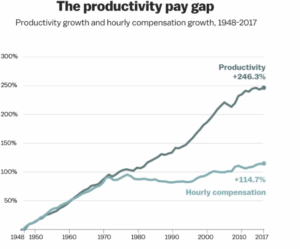
With employees producing as much as they can for as little as possible, the pressure building on parents from the workforce is further perpetrated by employers who offer “ fewer benefits and less support,” Malcolm Harris confided in Sean Illing during an interview for Vox.
Nearly half of the American workforce is not guaranteed job protection under the Family and Medical Leave Act (FMLA), granting employers protection to “legally fire many parents if they leave work to care for a newborn in the early days after birth or adoption,” said McCloskey and Welk.
This leaves parents with an impossible choice: lose their income stability or forgo the needed early weeks to recover and adjust to being a new parent.
The consequences of this lack of support extend beyond financial strain.
A study led by Kathrine Ahrens “assessed the impact of New York State’s paid family leave law on the frequency of emergency room visits or hospitalizations for respiratory tract infections (RTIs) and respiratory syncytial virus (RSV) among young infants from 2015 to 2020”.
In her findings that she published in JAMA Pediatrics, she found that infants with parents who had access to such benefits had a “18-percent reduction in RTI visits and a 27-percent reduction in RSV visits in New York”.
Ahrens attributes this reduced risk in part to parents being less reliant on early childcare services. These findings suggest that when families are given structural support, both parental well-being and child health improve.
Carrying the weight of a system designed centuries ago stretches parents far beyond sustainable limits. Caregivers today are facing extreme levels of burnout, defined by researchers at the National Institute of Health as “ prolonged physical and mental strain and exhaustion associated with the parental role.”
When this strain persists without relief, it can lead to emotional detachment between parent and child, researchers from NIH further explained.
Parental burnout is often framed as a personal failure — a lack of patience, organization, or resilience. Yet the evidence suggests otherwise. When wages stagnate despite rising productivity, when job protection is not guaranteed, and when access to paid leave determines an infant’s health outcomes, exhaustion becomes structural rather than individual.
Parents are not failing; they are navigating an economic model that demands constant productivity while offering minimal support for caregiving.
The Nuclear Family was once upheld as a symbol of stability and moral virtue, but stability cannot exist in a system that treats care as secondary to profit. Capitalism has reshaped family life around efficiency and output, forcing households to absorb economic pressures that were never meant to be managed privately. In doing so, it has transformed what was once idealized as a refuge into a site of relentless negotiation between survival and presence.
If burnout has become the defining feature of modern parenthood, the solution cannot lie solely in teaching parents to cope better. It requires reevaluating the structures that organize work, compensation, and caregiving in the first place.
Until care is treated not as a private responsibility but as essential social infrastructure, families will continue to bear the cost of a system that profits from their labor while neglecting their well-being.