
By: Serena Edwards
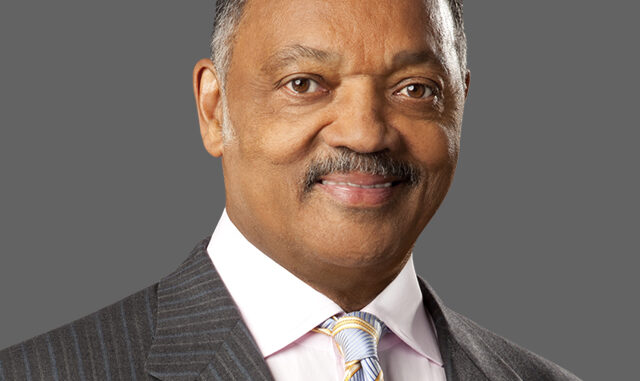
Rev. Jesse Jackson, civil rights activist, has passed away at the age of 84 after a long fight with Parkinson’s disease. He worked heavily with civil rights leaders, such as Martin Luther King Jr. and Rev. Al Sharpton.
Jackson was born in Greenville, South Carolina, on Oct. 8, 1941. Helen Burns, his mother, was a singer and high school majorette dancer. His father, Noah Luis Robinson, was not an active participant in Jackson’s life.
Despite having a tumultuous childhood, he was extremely active in school and excelled academically.
“Jackson was both an honor student and class president in high school, and he received an athletic scholarship to the University of Illinois in 1959,” according to the King Institute.
Jackson was an alumnus of North Carolina Agricultural and Technical State University (NCAT), a Historically Black College and University (HBCU), having graduated in 1964.
After graduating with a bachelor’s degree in sociology, Jackson was a part of the Selma to Montgomery March alongside King,
Jackson and King had a strained relationship, having different approaches to activism. According to the King Institute, Jackson sent King a letter before working together stating, “Dear Sir, I don’t think you’ll ever bring God to Albany, Georgia. For He’s wise enough to wait till E=MC² brings change there. Best of luck, though”. Despite their conflicts, their friendship expanded with Jackson becoming a “right-hand man” to King.
Jackson was a part of the Southern Christian Leadership Conference (SCLC) program in Chicago, where he met Dr. King. Multiple leaders within the program disliked Jackson’s approach and found him to be overly independent.
Jackson notably wrote the “I am Somebody” speech, which preached across multiple platforms, from the Democratic National Convention (DNC) to the long-running children’s television show Sesame Street, and many more.
The speech’s overall message said that you are somebody, no matter the circumstances that you are going through.
“I may be poor, but I am somebody. I may be young, but I am somebody. I may be on welfare, but I am somebody,” said Jackson.
Jackson formed a program called Operation People United to Save Humanity (PUSH), which advocated for Black self-care. Jackson also helped found the National Rainbow Coalition, a group formed by multiple civil rights leaders from diverse backgrounds, and pushed for unity. Jackson used this coalition to bring all communities together and support his political campaign.
Jackson’s advocacy and political reign did not stop there; in 1984, Jackson ran for president.
“In 1984, Jackson became the second African American, after Shirley Chisholm, to make a national run for the U.S. presidency,” according to Biography.
During his first run, he hit record numbers, placing third as a democratic nominee; however, his campaign was cut short after using a derogatory term in an interview with the Washington Post. He eventually ran again in 1988, placing second in the democratic presidential run.
In the 1990s, Jackson’s work expanded into weekly commentary on the Chicago Sun-Times, as well as writing a book called Keeping Hope Alive.
In 2000, former President Bill Clinton presented him with the Presidential Medal of Freedom for all of his work in activism.
Jackson received a diagnosis of Parkinson’s disease, a brain disorder that impacts body movement, in 2017, but that did not stop his work in activism.
He was active within the 2021 Black Lives Matter protests and made an appearance at the 2024 DNC, according to CNN. He was later diagnosed with progressive supranuclear palsy (PSP), which affected his mobility, according to The New York Times.
Many activists and political figures released statements after his passing.
“We will always be grateful for Jesse’s lifetime of service, and the friendship our families share,” former President Barack Obama posted on X . “We send our deepest condolences to the Jackson family.”
Mentee to Jackson, Sharpton, reflected on his time with Jackson in multiple social media posts.
“Today, I lost the man who first called me on purpose when I was just twelve years old,” stated Sharpton on X.
“And our nation lost one of its greatest moral voices.”