
By: Schonn Elcock
On Feb. 11, the House of Representatives voted to pass the Safeguard American Voter Eligibility (SAVE) Act, sponsored by Texas Republican Congressman Chip Roy.
On a livestream from FOX, Roy and other House Republicans discussed the bill, its importance, and the effort they put into ensuring the bill was passed. Previous efforts to enact a more narrow version of the bill into law were halted due to Senate stalls, White House opposition, and substantive objections, according to an article from the National Conference of State Legislatures (NCSL).
The bill states that individuals are required to provide documentary proof of U.S. citizenship when registering to vote in federal elections, along with state regulations to provide voter registration lists to the Department of Homeland Security (DHS). People on both sides of the political spectrum remain hesitant on this portion of the bill, as confidence in DHS has continued to diminish.
“Some Republicans have expressed concerns about the agency’s leadership,” reported The New York Times.
In a statement to FOX, Speaker of the House Mike Johnson said, “[Democrats] feel they’ve got to allow illegals to participate in elections so they can continue to win. […]We’ve got to stop that.”
Republicans have begun to cling to the voter fraud narrative, with the passing of the bill acting as a signal of progress for the party.
An article from The New York Times stated that Republicans believe “Democrats were trying to mobilize masses of undocumented voters to sway elections in their favor,” a narrative that has helped to disrupt voters in this upcoming midterm election in November.
“This is about sowing chaos and confusion,” House of Representatives Democrat Member Jim McGovern said on the House floor on Wednesday.
Democrats have continued to push back on the bill.
In a CNN interview, Chuck Schumer, the minority leader of the United States Senate, described the bill negatively.
“[The bill is] an outrageous proposal that mainly attacks the poor and people of color, preventing them from voting under this bill.”
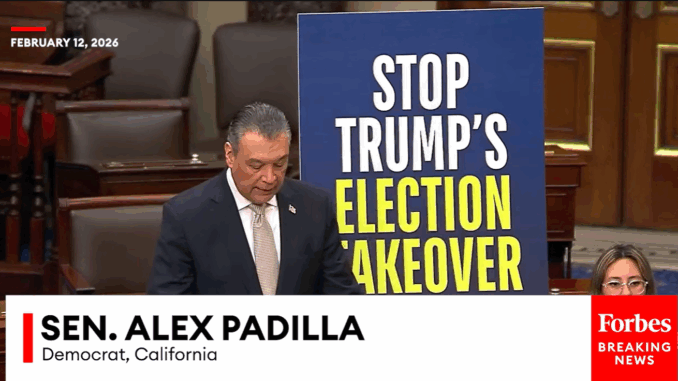
In a post on Instagram, California Senator Alex Padilla also pressed back on the voter fraud narrative. “Donald Trump and Republicans remain hellbent on having us believe voter fraud is rampant, but it’s simply not true.”
According to The Brennan Center for Justice, “incident rates range between 0.0003 percent and 0.0025 percent. Given this tiny incident rate for voter impersonation fraud, it is more likely, the report noted, that an American will be struck by lightning than that he will impersonate another voter at the polls.”
With the real percentages clear, Democrats find that the bill is disenfranchising voters.
The bill requires proof of citizenship besides simple identification, like a driver’s license, when registering to vote and every time a ballot can be cast, ostracizing communities of Americans that don’t have access to these required documents.
Research from The Brennan Center for Justice indicates that more than “9 percent of American citizens of voting age, or 21.3 million people, don’t have proof of citizenship readily available, and at least 3.8 million don’t have these documents at all, often because they were lost, destroyed, or stolen.”
In addition, according to The Brennan Center for Justice, the effects of the bill may be felt by the vast community of married people “whose married names aren’t on their birth certificates or passports,” forcing them to take extra steps to ensure their voices are heard.
Amidst the 2025 midterm election, many see the implementation of the bill as a ploy to manipulate voters in accordance with President Trump’s voter fraud narrative. It is unlikely the bill will make it past Congress due to Democrats vowing to block the bill’s passage.
In an article from The New York Times, “Senator Chuck Schumer, Democrat of New York and the minority leader, is planning to hold internal discussions to ready members of his party for whatever Republicans attempt. He has pledged to block the measure, which he derided as Jim Crow 2.0.”