
By: T’Neil Gooden
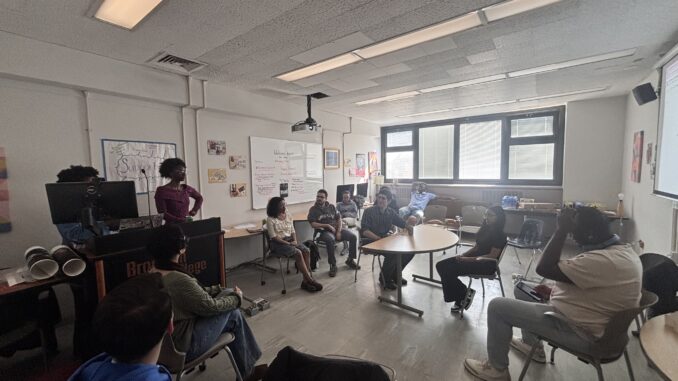
Brooklyn College’s (BC) Psychology and Sociology clubs collaborated to host a concept debate where students were able to share their opinions on topics on which they had questions, knowledge, or experiences.
Students were provided questions to guide their conversations, including: “What is power?” “Why/how do we feel fear?” “Why aren’t we doing anything about it?” Students took the floor and shared their knowledge on each topic, and explained how it led them to their answer.
“I see Marx’s take on power as extraction and imposition as a cycle where, at some point after, in between extraction and imposition, you have this ability to hold people in limbo,” said Reginald Laine, a junior at BC.
This concept debate was students continuing to add their ideas to those who spoke before them, leading to Demetrius Joseph, a senior at BC, to answer, “When we think about power, we think about how we control others in a way that we don’t expect it at the same time. Because with power, it gives one person the ability to control everyone’s expectations of what they think of society and what we feel in our minds. And a lot of people may not have the capability of controlling that power because others are using it to rule over us.”
More students shared their understanding of power until it was time for the hot seats. The hot seats allowed two students to sit in the center of the room and speak about the questions at hand. Alani Gonzalez is a junior at BC and an advisory board member of the Sociology Club, and was the first to participate in the hot seat. She was joined by Joseph in the hot seat, with the question being, “How is power expressed at Brooklyn College?”
Gonzalez spoke about the treatment of students at BC, specifically regarding the differences in religious courses in the midst of worldwide protests.
“We don’t have any classes about like Islam or Muslimality or just things of that sort, which just shows the dynamic of power within BC.”
Joseph added to Gonzalez and the question of power at BC by speaking about the security issues on campus and how students are starting to take videos on their personal phones for protection, power, and awareness. “When they [the public] see a whole protest or what the police are doing [on BC’s campus], they [students] post it on Instagram because then that’s going to spread a whole awareness around in the whole campus,” he said.
After the students shared their hot seat knowledge, the question shifted towards fear and why students feel fear.
“Fear is the reaction to the unknown,” said Laura Lopez, a senior at BC who helped start the discussion.
Students followed this understanding of fear by talking about the different types of fear: fight, flight, freeze, and fawn.
“There’s actually four ways you can react to the same fear. You can have fight or flight. You can learn to fight. You can get scared and run away. Or you can freeze. There’s freeze, and there’s fawning. A lot of people don’t know about fawning, which entails negotiation, said Kadijah Fall, senior at BC and president of the Psychology club.
Two new students made their way to the hot seat: BC junior Reginald Laine and Damir Shavkatov, a senior at BC. These students spoke about fear within public transportation and why people find it hard to help each other in public spaces.
“It’s definitely a great issue of socialization,” Laine said. “We’re taught conversations incompletely. You know, like, if you’ve ever taught a kid something, and have not been able to teach it all the way, it is because it was your first time with the material.”
Laine continued by explaining, “I think there needs to be a little more education about it [socialization]. That’s where our problem is at the core for me. Not understanding enough to be able to answer questions fully when they pop up.”
Shavkatov spoke about the bystander effect, “when we see something, but we don’t say anything,” he said. “We expect others to do that for us. And I think we do need education about that. To educate people on how to take initiative.”
The gears then shifted to two new students sitting in the hot seat, speaking about how they can start being the difference they want to see in their community. Jasmine Alleyne, a sophomore at BC, explained that people are “desensitized, because we all feel so helpless and alone that we don’t realize that sometimes the people that are around us also share the same wants and needs and desires and that we’re stronger together,” she said. “It’s easy to say it, but it’s not easy to translate it into words and actions.”
Ethan Weisberger, a junior at BC, followed Alleyne’s point by saying, “I believe that the biggest crisis that we have in our current society is a lack of empathy. We live in such large cities, we live in such large societies, where our empathy only stretches so far. But I think the solution to that is to build networks of empathy.”
Students continued to share the importance of empathy and community. Tyana Dixon, senior and president of BC’s Sociology club, closed the conversation by saying, “ Power can simply come from talking to each other.”
Students who are interested in joining the BC Sociology and BC Psychology can go to their Instagram pages, @bc.sociologyclub and @bc_psychology.