
By: Ameena Khan
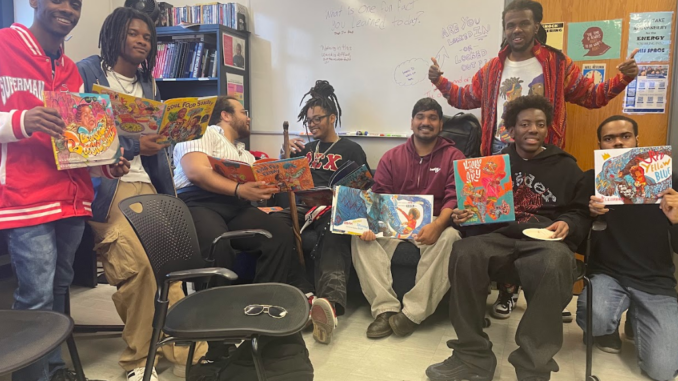
On March 10, the Brooklyn College (BC) Black and Latino Male Initiative (BLMI), in collaboration with the Puerto Rican Latin Studies (PRLS) Department in James Hall 3309, held their third Cafecito Lounge featuring Charles George (C.G) Esperanza, a Black Puerto Rican author and illustrator from the Bronx, who presented his illustrated children’s books and original artwork to encourage and uplift students with creative pursuits and aspirations.
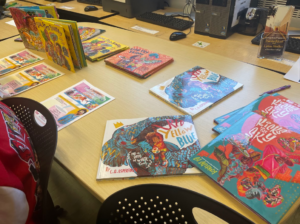
Attendees were encouraged to indulge in pastries being served at the event, as well as to take one of Esperanza’s illustrated children’s books lying on the tables for free, including titles such as “Red Yellow Blue with a Dash of White Too!,” “Kicks in the Sky,” “Boogie Boogie Y’all,” “Soul Food Sunday,” “Fish Fry Friday,” and “My Daddy is a Cowboy.”
“You know, everybody draws when they’re young, because that’s the easiest way to entertain yourself without having toys,” said Esperanza, while presenting his old artwork from childhood. “It’s a pencil and paper, and you can make whatever you want.”
The artist then displayed a series of his artworks, ranging from different time periods. From anime-themed and original comics from the fifth grade to fully rendered black & white charcoal portraits, pen illustrations from high school, and mixed media artworks throughout his college and later career.
“Just crayons, pencil, and I learned that you can publish yourself. You make copies on the copy machine, staple it together, and you’re a published artist. So that really inspired me to start taking art more seriously,” Esperanza told The Vanguard.
While attending the Fashion Institute of Technology (FIT), Esperanza would be inspired by his professor and begin publishing his own work. “[His] name is Eric Velasquez. He was my picture book teacher at FIT,” said Esperanza.
“You have to add a lot of symbolism, and Eric Velasquez, when he showed me this book, when I first came into this class, ‘The Rainstomper,’ I was like, ‘Whoa, this is like movie directing without the budget. And so his books were just like works of art and totally changed the way I saw picture books,’ ” Esperanza said.
Esperanza not only discussed how his professors’ work influenced his craft, but also brought attention to the influences that contributed to Esperanza’s core artistic theme, including his Black and Puerto Rican identity and his home borough, the Bronx, and its cultural aspects.
Esperanza discussed the racism he experienced during his first publishing experience. His debut book features a black girl as the main character; he was later told that he should consider utilizing an animal as the main character for ‘relatability’. “I had experienced racism before this here and there, but this was kind of the most blatant, like, I didn’t even know what to say,” he said.
He stated that he not only faced racism as an artist publishing his first work, but he continued to experience this as he was actively trying to publish his debut children’s book, “Red Yellow Blue with a Dash of White.”
“I went to Eric Velasquez, and I told him what [the publisher] said, and I was like, should I change her to an animal main character? And then he said, That’s up to you, what kind of artist you want to be,” said Esperanza. “That made me think. I was just like, ‘Okay, I’m gonna give her an elephant best friend.’ Because, I, you know, I’m not gonna lose my black character.”
Esperanza also played a music video of his illustrated book, “Boogie Boogie Y’all”, a “celebratory ode to graffiti and the Boogie Down Bronx,” and centers on three children exploring the art and graffiti within their community, according to the book’s description on Amazon. According to Esperanza, once his book came out, more illustrated children’s books set in the Bronx emerged, highlighting the importance of representation.
Students such as Omar Elwakil, a BC student with Egyptian roots, resonated with Esperanza’s experience as a person of color in artistic expression, recalling his own experience of Arab and Muslim representation in media.
“When I was 16, I started working on a novel out of spite. I grew up around some very powerful women. My paternal grandmother was the lady of her street. She had people come to her house and drop things off for her. Everybody knew her. I saw how women were represented and how they were shown in a lot of media, both in my country and abroad. And I was like, ‘That’s not what I see,’ and I started working on it out of spite.”
Elwakil recalled the stereotypical and orientalist depiction of Arab and Muslims in Western media, emphasizing how it has long-lasting impacts on how individuals view other ethnic groups.
“But it’s still beautiful. The streets are still gorgeous. Even just remembering what it was like. Cause even when I walked through some of the streets that have kind of become gentrified in Cairo, I still remember what they sounded like. I still remember what they smelled like.”
“I’m not saying everything you have to do has to challenge the status quo,” Esperanza concludes. “ But I think that when you do challenge the status quo, it just makes your art so much more personal to you. And if you’re actually saying something that hasn’t been said, you create a whole other audience that hasn’t existed before, and you reach people that haven’t been.”
To view more of C.G. Esperanza’s work, you can visit @https://www.cgesperanza.com/