
By: Renae Visico
On Wednesday, March 18, the Brooklyn College (BC) Ethyl R. Wolfe Institute for the Humanities hosted a panel discussing the unique mental health challenges that Asian Americans face, as part of the annual Hess Week lecture series.
Co-sponsored by the Department of Psychology, the panel was moderated by Erika Niwa, an Associate Professor of the BC Psychology and Children & Youth Studies programs.
The panelists included Asian American psychology professors from across the nation: Dr. Clarissa S. L. Cheah from the University of Maryland, Dr. Cindy H. Liu from Harvard Medical School, and 2025-2026 Hess Scholar-In-Residence Russell M. Jeung.
Hess Week is an annual event at Brooklyn College organized by the Wolfe Institute, where a “distinguished individual representative of an academic discipline at the college” is invited as a Hess Scholar-In-Residence. This year’s Scholar, Russell Jeung, is a Professor of Asian American Studies at San Francisco University who co-founded the Stop AAPI Hate organization and authored multiple books about Asian Americans’ relations to religion and faith.
“You are in for a very important, and frankly urgent, conversation on Asian American mental health,” introduced Gaston Alonso, Associate Professor of Political Science and Director of the Wolfe Institute.
The panel began with a ten-minute lecture from each professor.
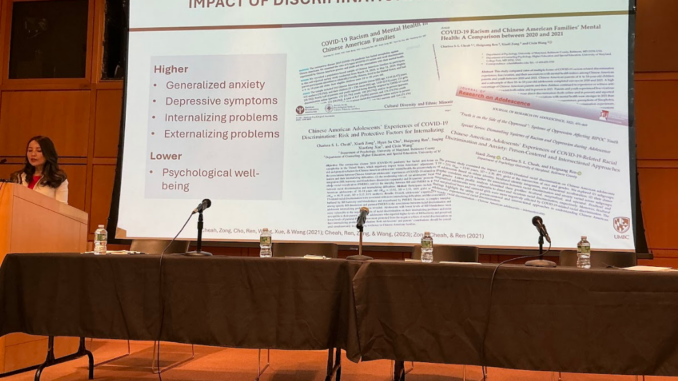
Dr. Cheah stressed the importance of racial-ethnic socialization to improve mental health in Asian Americans, which has gotten worse ever since the COVID-19 pandemic led to an increase in anti-Asian discrimination.
“In the interest of trying to protect their children from these experiences of discrimination, some parents were encouraging their children to conceal their Asian or Chinese heritage,” said Cheah. “Concealing Chinese culture, connection, practices, and messages relate to greater child difficulty at all ages.”
Dr. Liu, who affectionately referred to this panel as the “Russell Jeung fan club,” discussed the broader public health impacts of race-based trauma, including the newly researched tendencies of Asian Americans to turn to Artificial Intelligence (AI) for mental health support.
“Asian Americans are six times more likely to trust AI more than a human counselor,” said Liu. “It’s also [because of] the cultural systemic factors that limit help-seeking like stigma, model minority myth, and just not having a lot of culturally competent providers.”
Dr. Liu further expanded on this tendency during the panel discussion, saying that AI’s constant validation and availability work against the processes that make therapy effective.
“For every prompt, [AI will] validate you. They say, ‘Great point!’, ‘Good question!’, ‘Glad you asked,’” explained Liu. “The therapeutic process works because, in between talking with people, you’re sort of processing it on your own. […] That’s really regulating, and that’s sort of lost when you have AI who’s always there.”
Students found this point particularly interesting, as the perspective on AI was novel to them.
“I didn’t know before I got here how many Asian Americans are relying on AI for mental health. That really is so concerning for me,” said junior Ardita Zeqiraj. “If it’s drawing from inherently racist or old studies, then it’s just an echo chamber. And it’s not thinking for you.”
Collectivity was a major theme in Dr. Jeung’s lecture; he discussed the effects of collective empathy and racial trauma among Asian Americans and how they can address this trauma with collective care.
“I can argue that there were specifically Asian ways of responding to trauma that were really hopeful and useful,” said Jeung. “I would encourage students to realize that a lot of us experience collective racial trauma, but it’s not the first time. We do have community resources and cultural wealth from our families and ancestors on how to deal with it.”
During the panel discussion, Professor Niwa encouraged the panelists to address the invisibility that many Asian Americans feel, suggesting ways to create spaces where they can feel comfortable fully expressing themselves.
“The concept of invisibility has been used very much in relation to being the model minority,” explained Cheah. “It also perpetuates this idea that we cannot speak up when we should.”
The panelists emphasized the importance of fostering spaces for community and diversity, including racial affinity groups, among Asian Americans in healing from collective racial trauma.
“Beyond fight or flight, you can flock,” said Jeung. “One way we can keep on building freedom is to continue flocking. To not isolate yourself, but to learn that when we’re together, we’re a lot stronger.”
Many Asian Americans also bear the burden of unrealistic expectations, especially from their parents or teachers, to constantly be the best at everything they do. The panelists discussed how these expectations can further damage mental health in ways that often go unseen, as there are usually no behavioral issues present.
“Quite frankly, it’s a cultural value. We’re all students, so you all should get good grades, right? We should strive for that,” said Liu. “So there’s no disagreement there. The disagreement is actually, ‘Don’t put me in a box. Do not assume anything about me.’ And I think that is a unique sort of U.S. experience.”
Dr. Jeung continued to advocate for collective spaces where Asian Americans can share their experiences and trauma, and where everyone can learn their part to play in the fight for racial justice.
“If we don’t tell our own stories, who will?” asked Dr. Jeung. “Each individual has certain capacities for their role in fighting racism. I’m grateful that it’s not just one voice, or one data set, but it’s the community coming to share their stories and address them.”
Students took the themes of community to heart, feeling motivated to look beyond their own interests and strive towards collective change.
“The most important thing I learned is that your struggles are not your own,” said senior Kevin Zou. “Everything is interconnected, and you can take steps to learn about other people and how to also give back to the Asian American community.”
To close the panel, Professor Niwa reminded students that one of the first steps in healing is looking out for each other.
“My dad used to tell me this all the time, as a Japanese American,” said Niwa. “From flocking, to socializing, to my kids who teach me things constantly, even when I don’t want them to, we belong to each other.”
Students interested in the Wolfe Institute can visit their Instagram: @bc_wolfeinstitute.