
By: Ameena Khan
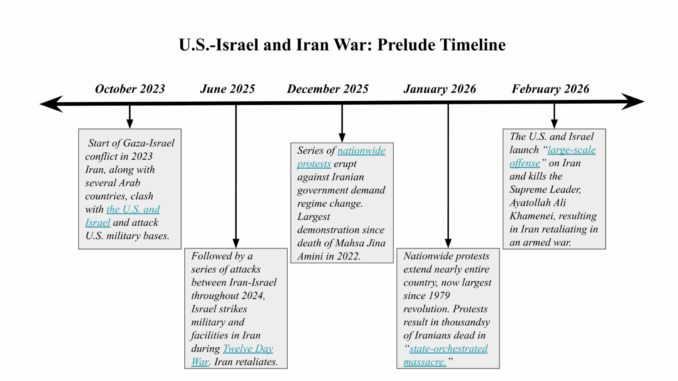
On Feb. 28, 2026, the United States (U.S.) and Israel launched a “large-scale offense” on Iran, coordinating strikes while targeting military and nuclear sites, along with killing the Supreme Leader of Iran, Ayatollah Ali Khomeini.
According to the New York Times, these strikes have had serious domestic and global effects.
“Already, six Americans have been killed. Gulf allies are under attack. The stock market wobbled. Gas prices are rising. The U.S. military is spending, by some estimates, hundreds of millions of dollars per day. In Iran, an airstrike on a girls’ elementary school killed 175 people, according to local health officials and Iranian state media, and the Trump administration says it is investigating who was responsible.”
This war’s goal is to change Iran’s regime.
But what events had led towards violent attacks and the need for regime change in the first place?
The Iranian Revolution, also known as the Islamic Revolution, took place in Iran from1978 to 1979, and united many Iranians through the goal of overthrowing the monarchy of Mohammad Reza Shah, who was in charge of modernist reform programs in Iran.
“In addition to mounting economic difficulties, sociopolitical repression by the shah’s regime increased in the 1970s […] Social and political protest was often met with censorship, surveillance, or harassment, and illegal detention and torture were common,” according to Britannica.
Ayatollah Ruhollah Khomeini gained the approval of many Iranians due to his critique of the Shah’s modernist reform programs, as well as the Pahlavi regime’s economic policies and dependence on foreign nations.
After months of protest, violence, and disorder, Khomeini officially declared that Iran would be an Islamic republic, which led to a “return to conservative values,” suppressing any Western cultural influence, establishing itself as a religious government and militia, and ending U.S.-Iran ties.
As of recent years, the start of the Gaza-Israel conflict on Oct. 7, 2023, would escalate tensions with the U.S. and Israel, along with several Arab countries, and Iran striking U.S. military bases.
“The Pentagon and U.S. officials say U.S. fighter aircraft conducted airstrikes on locations in eastern Syria involving Iranian-backed groups, likely causing casualties and destroying weapons stored at the two targets that were struck — a training facility and a safe house,” according to Associated Press (AP) News.
Following a series of attacks between Iran and Israel throughout 2024, the Twelve-Day War went from June 13 to June 24, 2025.
According to Human Rights Activists News Agency (HRANA), Israel has done more than strick military and facilities in Iran.
“[…] disrupted the daily lives of millions of civilians—ranging from prolonged internet outages by the regime and disrupted banking services to partial suspension of public transportation and reduced capacity of medical centers.”
Furthermore, HRANA predicts a total of at least 5,665 casualties as a result of these attacks, as well as 1,596 individuals arrested by Iranian security forces.
Late Dec. 2025, a series of nationwide protests erupted in downtown Tehran against the Iranian government, demanding regime change had started to occur after the nation’s currency had plummeted and had encouraged merchants to strike against the plummeting refining.
“Monday’s protests were the biggest since 2022, when the death of 22-year-old Mahsa Jina Amini in police custody triggered nationwide demonstrations. She was arrested by the country’s morality police for allegedly not wearing her hijab properly,” according to AP News.
In Jan. 2026, nationwide protests spread across nearly the entire country, now the largest demonstration since the 1979 revolution. Protests resulted in thousands of Iranians dead in a “state-orchestrated massacre,” according to The New York Times.
“On Friday, Jan. 9, Iran’s supreme leader, Ayatollah Ali Khamenei, ordered the Supreme National Security Council, the body tasked with safeguarding the country, to crush the protests by any means necessary, according to two Iranian officials briefed on the ayatollah’s directive. Security forces were deployed with orders to shoot to kill and to show no mercy, the officials said. The death toll surged,” according to The New York Times.
Armed security forces had attacked protestors “in at least 19 cities and in at least six different neighborhoods in Tehran in early January,” reaching a death toll of around 5,200.
“This is not merely a violent protest crackdown,” Raha Bahreini, a lawyer and an Iran researcher at Amnesty International, told The New York Times. “It is a state-orchestrated massacre.”
Yet, what do all these events have to do with U.S. involvement?
“ If we didn’t do what we’re doing right now, you would have had a nuclear war and [Iran] would have taken out many countries,” President Trump said in a meeting with German Chancellor Friedrich Merz on March 3, 2026.
Trump has emphasized the threat of “nuclear war” efforts being eliminated by degrading Iran’s nuclear and military capabilities and political leadership.
Protests have spread nationwide across the U.S., opposing military operations in Iran, as seen by demonstrations held in Manhattan.
“Chants of ‘Hands off the Middle East’ and many others could be heard at a protest and march Saturday that started in Times Square, as hundreds of demonstrators came together to express outrage and other concerns that stemmed from this weekend’s massive military strikes by the United States and Israel against Iran,” according to Spectrum News.
Additionally, an anti-war protestor and Marine Corps veteran, Brian McGinnis, had interrupted Montana Sen. Tim Sheehy on Capitol Hill, according to the Daily Montanan.
“No one wants to fight for Israel,” the veteran had shouted, as Sheehy and Capitol Police had attempted to remove him, breaking his arm when prying McGinnis away from the door.
“It seems pointless,” Army Veteran, Forest Gray, told NBC San Diego. “They change the reason for aggression against Iran daily.”