
By: T’Neil Gooden
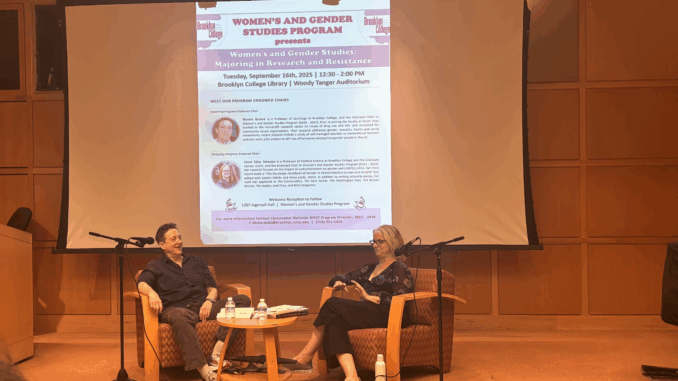
Brooklyn College (BC) professors, Naomi Braine and Janet Elise Johnson, took to the stage of the Woody Tanger Auditorium in the BC Library to share their thoughts on Research and Resistance within the study of Women and Gender. This talk was filled with knowledge, passion, and wisdom for those interested in why Women and Gender Studies is important for all communities to be educated on.
“Gender is about power,” said Johnson, a political science professor at BC. “This led me to focus on, in terms of my career, how states regulate our bodies in this really expansive way. They regulate our intimate relationships, our reproduction, our gender, our sexuality, how safe we can be to share our human experiences to be ourselves, and to really think as a scholar about how government intersects us at this really intimate level.”
The BC faculty members want students to understand that the study of Women and Gender is not linear; it is a multifaceted major that leads to many different roles with various focuses.
Naomi Braine, the Endowed Chair in the Women and Gender Studies Department, explained that they have not had a straightforward path into their career; however, their curiosity and continuous interest in public health and queer theory have led them to the career they have today.
“Most of my work these days is qualitative rather than quantitative. But some of the most wonderful movement-connected work that I have been part of has come out of it,” said Braine. “So there is absolutely a pathway to asking feminist questions and queer theory-informed questions within public health, within the natural sciences.”
Johnson and Braine shared their respective stories of mistreatment within their specific practices of Women’s and Gender studies, leaving them with extensive ideals for the future of the practice.
“I want to make sure that gender issues are understood as political issues, about power, and as fundamental to every single question that political scientists are asking,” said Johnson.
Braine and Johnson followed Johnson’s previous message of gender being a political issue with their comprehension of how Women and Gender Studies as a major is evolving our understanding of the connection between gender and political status.
“I’ve done the best I can to support the activists that I’ve worked with, which included telling their stories, translating their work, writing grants, building their reputations as much as possible,” Johnson told the audience. “Now it’s more like providing activists asylum cases. That’s what it’s been like for the last 10 years, and I have another one this month, and it’s really sad and scary what’s going on and how we have to do that.”
Johnson explained that women need protection for all the forms of information they want to spread about gender, women, power, and the political power they hold.
“What I’m working on this summer has been to provide some guidance for US women and women in local politics in the United States,” said Johnson. “What can I teach them from studying authoritarianism about how to react in response?”
Braine continued the practice of making sure that voices are heard by emphasizing that they provide resources to those who do not get them.
“I want to sort of re-emphasize that so much of what I do in my way into women’s and gender studies and LGBTQ is asking questions that are driven by gender and attention to sexuality in places that are not defined by that,” said Braine.
These educators want students to understand that they are teaching them what can happen now to preserve the history, communication, and diversity that is the study of Women and Gender Studies.
“I like to talk to my students about what things have happened, what kinds of resistance has happened. Powerful movements have changed the world,” Johnson told the audience. “The suffrage movement that got women the right to vote was the first major successful movement to expand the rights of people. It was huge. You don’t usually persuade people to give you rights. It just doesn’t happen very easily.”
Johnson followed this message by stating, “What I would say about what I’ve learned from studying Eastern Europe is that in the face of authoritarianism, we need art, literature, music, theater, all these kinds of cultural things, and the more we can bring ourselves together and create these communities, these relationships the more we can resist the authoritarianism.”
Students interested in the Women’s and Gender Studies Department at BC can visit their website at https://www.brooklyn.edu/wgst/.