
By: Mars Marte
In July 1979, a young writer by the name of Richard Bachman, who later revealed his true identity to be Stephen King, published a somber story titled “The Long Walk”.
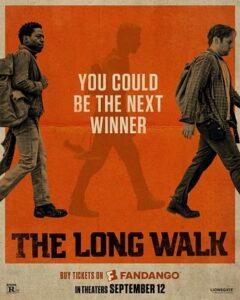
46 years later, King’s work finds itself being retold on screen, its warning now a blaring siren that screams for a reevaluation of our own lottery system. On Sept. 12, The Long Walk movie adaptation directed by Francis Lawrence marched its way into theaters, and spins a story of a society dominated by the dollar and dictatorship.
This tale takes place in an alternate reality where a brutal war ravaged the states, leading to The Major, the film’s antagonist, forcefully taking charge of the United States.
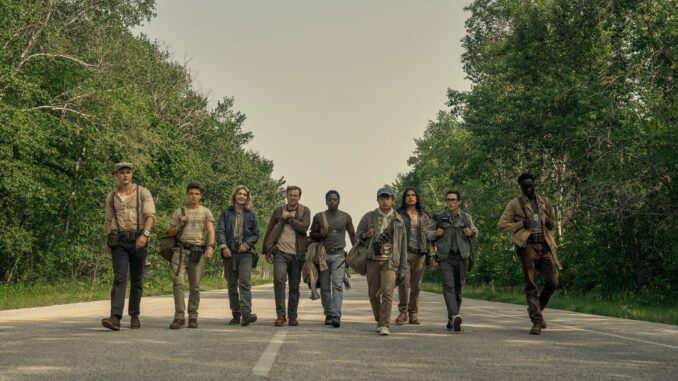
In the wake of his rule, he established a yearly tradition called The Long Walk, a televised event that consists of 50 boys aged 13-18. The walker’s only task is to maintain a speed of 3 miles per hour as they hike through the states, without stopping once, until only one boy remains.
The boys are given three strikes; if they fall below the walking speed three times, the boy receives ‘their ticket’, a deadly shot eliminating them from the competition.
The last boy standing receives a cash prize and is given the opportunity to make one wish that’ll be followed, no questions asked.
Despite such extreme stakes, each year, hundreds of the nation’s naive boys enter their names into the lottery system, all in the hopes of having their money woes wiped away.
The boys walk along roads cutting through crumbling towns with decaying buildings that house the eager spectators. Bruised and beaten cars that have long been forgotten rest eternally along the roads, painting this new nation as one in desperation.
It comes as no shock, upon seeing the state of affairs, that the young boys feel the need to sign their lives away in the hopes of pulling themselves out of their dying cities. Across the rotting cities, crowds form, inspired and entertained by the boys who signed their lives away, making their suffering into a spectacle.
Turning the struggles of others into a means of consumption for the masses is a concept King had borrowed from our contemporary world. In our modern world, there is no shortage of media to consume derived from the misfortune of others.
A prevalent example is our very own lottery system, which was originally created in 1616 Virginia Company of London as a means to fund the ventures of King Charles. The contemporary lottery system is one predatory in nature and thrives off the dwindling dollars in low-income communities.
A nationwide investigation of state lotteries conducted by researchers at the Howard Center for Investigative Journalism at the University of Maryland revealed that stores that sell tickets are disportantly gathered in impoverished neighborhoods, a trend noticed in nearly all states. The research conducted by those at Howard Center further reveals that those who play the lottery come from predominantly poor backgrounds.
With these data points, a concerning cycle begins to take form that is systematically supported by the government. Those who come from less are coaxed into spending more for a false dream. It has been the long-standing belief that the money made from the lottery was being funneled back into the people through funding of systems such as education.
This stands to be true, but the communities that spend their resources on the tickets often fail to see it return, with the money going towards “ wealthier school districts,” according to the researchers at Howard Center. Much like “The Long Walk,” the lottery disguises despair as opportunity.
Both systems promise salvation but only deliver suffering to those already burdened by inequality. King’s story exaggerates this cruel logic to a deadly degree, yet the same manipulation plays out discreetly in our world, where hope is sold to those least able to afford it. What King presents as a televised death march mirrors the slow, everyday march of people chasing a dream that was never built for them to reach.
Dystopia doesn’t always arrive with violence or war. Sometimes, it comes disguised as entertainment, dressed up as luck, convincing us that maybe this time, we’ll win.
“The Long Walk” is a grim and dark film that pushes viewers to confront the quiet dystopia we’ve come to accept. It demands that the viewer question the price of survival in a system built on spectacle and suffering, and whether we, too, have learned to cheer from the sidelines as others walk themselves to exhaustion.
King’s vision, now realized on screen, reminds us that when desperation becomes entertainment and poverty becomes profit, the real horror is not in fiction; it’s in what we choose to ignore.