

By: Eddy Prince
How much do we put online? What is digital and what is real? Why have we become so comfortable sharing every aspect of our lives with the world?
These questions were all addressed at “Protocols for Opacity”, a brand new exhibition on display at Brooklyn College’s (BC) Art Gallery in Boylan Hall. The exhibition, featuring works from nearly 15 different artists and masterfully organized by curator Seung Kim Hee, explores how a majority of people’s lives wind up online, where anyone can access it.
“We’re giving so much information to the ether but not really thinking about who the audience might be,” said Kim. “Being on the digital realm is something that connects us, but it also separates us.”
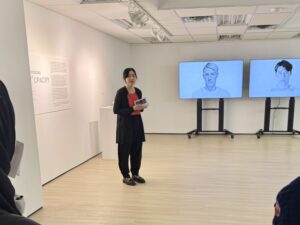
“[Recently] I saw an article about how there was a meetup at Tompkins Square Park, for teenagers who just wanted to be off social media. I thought, ‘that is such a beautiful idea’, but it also confirmed for me that this is something on all our minds.”
In an age of digital information, everything is online, and the world cannot function without an internet connection. Influencers lord over social media, and data is collected by every webpage. Every move someone makes online is tracked. “Protocols for Opacity” seeks to disrupt this visibility and return some autonomy and anonymity to the individual.
“In its simplest terms, opacity refers to how transparent or solid an object appears. If we expand this term, it can also refer to a lack of intelligibility or knowability,” said Paula Massood, the dean of the School of Visual, Media, and Performing Arts (VMPA).
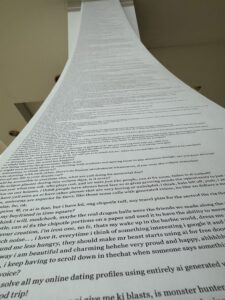
“The works featured here seek to reclaim the radical power of invisibility, [something] that has been stripped from our day-to-day lives by social media and digital surveillance,” Massood said.
The works on display aimed to elicit a response towards just how much is shared online, whether accidentally or on purpose. Max Brown, a visitor to the Art Gallery, was drawn to “The Others”, a collection of over 10,000 pictures and songs pulled from unsecured computers, made possible through an error in the legal system.
“It really forces you to look at the world through a lens that’s human, that shows you the world that we live in. The world is so digitized, technology is evolving and advancing every single day,” said Brown. “Sometimes we forget to appreciate and cherish the little moments in our lives.
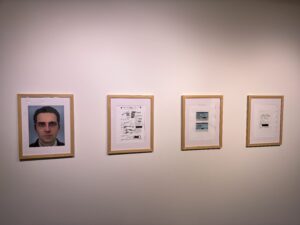
One of the standouts of the exhibition was Raphaël Fabre’s CNI, where Fabre obtained a legal ID using a photorealistic 3D rendering of his own face.
“The document validating my French identity in the most official way thus presents today an image of me which is practically virtual, a version of video game, fiction,” said Fabre on his site. This statement by Fabre shows how “hyperreal simulations can pass as authentic while the actual body remains withheld,” as stated in BC’s gallery guide.
In today’s digital climate, online platforms entice the surrender of personal information voluntarily under the guise of convenience. When a webpage blocks viewing access with an “accept cookies” pop-up, this is collecting data for the website, and it’s a way companies track their online visitors. “Protocols for Opacity” serves as a cautionary tale to bring to light just how much people share about their lives, consciously or subconsciously. The exhibit also examines how deliberately repressing information can function as a statement of resistance, and how opacity is a fundamental right.
“The works [featured in “Protocols for Opacity”] suggest that being invisible, opaque, or unreadable is a radical act,” said Massood. “It’s an act of protest.”
“Protocols for Opacity” will be on display in the Art Gallery in Boylan Hall from Oct. 17, 2025, to Jan.23, 2026.