
By: Elianna Tsigler
The tradition of Halloween has evolved greatly over the years, its meaning completely shifting from a sacred ritual to a commercialized celebration based on nightmares and fear, which have long haunted Halloween. But, where did it all begin? Halloween is an intricate holiday with a fascinating history.
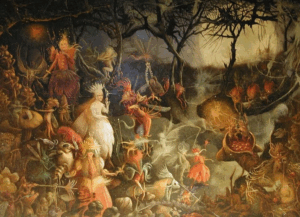
It began with Samhain, a Celtic ceremony practiced by one of Europe’s early tribes. Held on the night of Oct. 31, the harvest festival marked the end of the harvest and a transition to the new year, as well as the beginning of the cold season. However, this harvest was a matter of life or death; the days became shorter as the nights became longer, and scarce amounts of food were left as winter rations.
In this liminal moment between seasons, there was also one between light and space; it was thought to become permeable. This means that on that day, spirits, both dead and of other realities, can make their way into our world, while humans can accidentally make their way out and get lost. During this celebration, the veil of life and death is at its thinnest.
Many things that are associated with Halloween today came from the Samhain festivals. The firelight drew a thing familiar to today’s Halloween–the bat. Before there was electricity, this was the only way you could see a bat.
Other ancient cultures also looked to the dead by setting aside days to ritually celebrate the dead. What’s interesting about this is that they all occur within the same time period. It all revolves around the harvest: in the spring, plants grow, you harvest them towards the middle of summer, and towards the end of fall, during that transition to winter, things die.
But how did this tradition endure and make its way into the present day? Christians upheld it through what we now know as “All Saints’ Day”, though in earlier times, it was known as “Lemuria”. During Lemuria, Pagan Romans made offerings of milk and cake to appease restless spirits and avoid being haunted. In 609 AD, the church transformed Lemuria into All Saints’ Day, redirecting the focus of its haunted spirits to remembering the deaths of holy Christians.
The attempt to Christianize the Samhain festival and Lemuria day was, in turn, what gave rise to Halloween. The day was moved from May 13 to Nov. 1. Since Samhain fell on Oct. 31 before All Hallows’ Day, people started calling Samhain “All Hallows’ Evening.” It was then shortened to All Hallows’ Eve, and finally to Halloween.
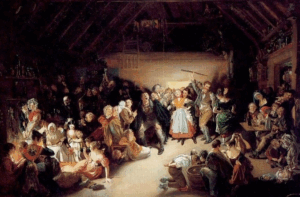
To ensure the complete erasure of Samhain, the church created another holiday on Nov. 2, “All Souls Day,” which honored not just saints, but all those who have passed. This is important because this is where Halloween gets its association with death, souls, and the supernatural.
The church also helped establish the tradition of trick-or-treating, but not in the way expected. During the Middle Ages, on All Souls Day, priests told the people to pray for souls trapped between heaven and hell in another world they called “purgatory.” The only way to help the suffering souls was to offer prayers, but they would only be freed if enough prayers were offered.
This led to a medieval custom where children would go “souling,” begging for things called soul cakes that were filled with raisins. In return, they would help others pray for the trapped souls in purgatory. Even though the concept goes back centuries, the phrase “trick-or-treating” itself is less than 100 years old.
The term derives from pranking, which was very widespread across America in the 20th century. Since it was so destructive, people decided to buy off the pranksters for a truce. Homemade treats were offered to troublesome children to avoid getting tricked.
In 1939, Doris Hudson Moss published an article in American Home magazine, “A Victim of the Window Soaping Brigade?”, about her success with having a Halloween open house, providing sweets for children, and, in turn, not getting tricked. With this new custom came new treats. Instead of homemade treats like candied apples and popcorn balls, children were given packaged store-bought candy. Reese’s cups, Mars bars, and the reliable Hershey’s chocolate.
Candy had finally killed the rowdy Halloween.
It was then brought into the main media, such as cartoons, festivals, and became heavily incorporated into pop culture.
Instead of being full of prayers and religion, it became centered around more joyful celebrations: parties, dressing up in fun costumes, watching scary movies, and celebrated by all, not just Christians. People spend this day with friends, going door to door, scurrying around, and collecting candy.
Even the symbols that once had a deeper meaning–bats, gravestones, ghosts, and so on–are now merely meant to frighten people. The main purpose of the day is to be scared, completely straying away from its original meaning.