
By: Emily Suhr
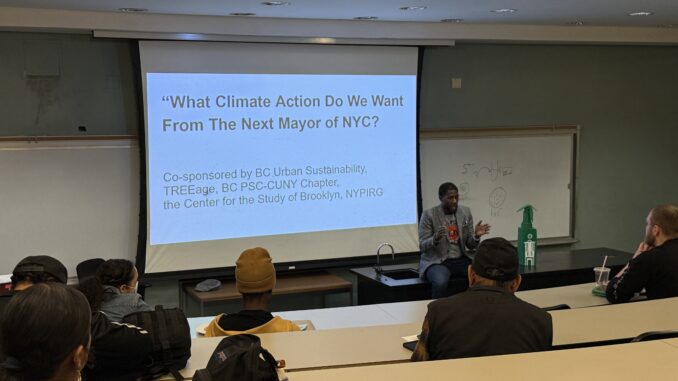
As New York City prepares for a new mayoral administration, students, faculty, and community leaders gathered to call for stronger climate action from the next mayor during a town hall discussion at Brooklyn College (BC) on Oct. 22.
The event was co-facilitated by BC Professor and director of the Urban Sustainability Program, Michael Menser, and TREEage campus organizer Leila M. Tazi. It featured speakers from across the city’s environmental and civic organizations to discuss how New York’s next leader should address the climate crisis through community-driven policy and public investment.
“Of course, many people are very excited about the way it’s looking in terms of this moment and our possibilities of this next mayor,” said Menser. “But whoever the next mayor is, there’s got to be an agenda that connects to the communities, that’s got some vision to it, and that’s our job to fuel all that.”
The evening’s first speaker was two-time BC graduate and New York City Public Advocate Jumaane Williams. Williams emphasized that the city’s ability to act on climate change is heavily dependent on funding and public investment into green infrastructure and sustainable jobs. He urged the next mayor to have the “backbone” to push through these issues and prioritize long-term environmental goals.
“We do need these trees, we do need these infrastructures. We just need people investing, and it is very, very difficult,” said Williams. “Climate change and this discussion oftentimes is not the priority that it should be. We’re trying to just get folks to see that climate change is happening now.”
The conversation continued with Alex Patterson, the Campaign Coordinator for Public Power New York, an organization that played a crucial role in passing the 2023 Build Public Renewables Act. The law authorizes the New York Power Authority (NYPA) to construct and own renewable energy projects, shifting away from private ownership, and to help meet New York State’s Climate Act goals.
“The most immediate goal is that we as a state need to be at 70% renewable energy by 2030,” said Patterson. “Currently, we are not on track to hit that. We’re on track to hit that by maybe 2033. And part of the reason, as the Public Advocate mentioned, we don’t fund these things.”
Patterson also clarified that while NYPA is part of the government, they have their own budget, which makes it the best team to work on these projects. He called on the next mayor to work with NYPA to propel renewable energy projects, create more green jobs, and bring clean power to institutions like CUNY.
Representatives from the New York Public Interest Research Group (NYPIRG) were also present, providing attendees with the opportunity to register to vote and reinforcing the importance of civic engagement in advancing climate policy. Mamadou Diallo, a recent BC graduate, spoke about how one of their current focuses is to end the 100-foot rule. The rule forces utilities to pay for new gas connections within 100 feet of an existing main instead of the property owner.
“Basically, reviewing the 100-foot rule would curb skyrocketing utility bills, reduce gas demand, make it easier for utilities to transition to a clean energy future that’s better for our health, our wallets, and our planet,” said Diallo. “While some states are backing off their climate commitments, New York needs to power forward.”
Rona Taylor, Executive Director of the Central and South East Brooklyn Community Development Corporation (CXSE BK), highlighted a recently passed bill to implement permeable pavement across Brooklyn neighborhoods.
“It’s a type of pavement where when it floods, the water can go into this material and then it absorbs the water, and then when it’s hot, the water evaporates and it cools the air,” said Taylor.
Taylor also spoke about her work with the WeAct Extreme Heat Coalition and their recent policy wins advocating for more cooling centers in central Brooklyn, which experiences some of the borough’s highest heat indexes with the lowest number of cooling centers.
Other speakers included Professor Mobina Hashmi from PSC-CUNY, Professor Alan Aja from the Puerto Rican and Latinx Studies (PRLS) department, and a representative from BC’s Undergraduate Student Government (USG), who added that upcoming career fairs would include more resources for students interested in pursuing careers in sustainability and environmental advocacy.
The town hall concluded with remarks from Nancy Romer, co-chair of the PSC-CUNY Environmental Justice Working Group and a Professor Emerita of Psychology at BC. Romer urged attendees, especially students, to remain engaged and stay hopeful amid political and environmental challenges.
“We can do these things,” said Romer. “We can have good things in our lives. All of you young people can have good jobs, have good standards of living. We have to organize for it. It’s not gonna be given to us.”
She continued, “What’s your goal? What are the activities that will bring you to that goal so that we can actually make progress? Don’t give up on your future. You have to fight for it. The only way we’ve ever gotten anything done anywhere is to fight for it.”