
By: Massimo Ranieri
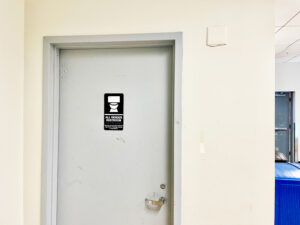
West End Building (WEB) 158 is a perfectly normal bathroom. Sure, the urinals are placed directly across from the sinks, which makes it a little awkward to check yourself out in the mirror while someone is peeing. But there’s something special about WEB 158: it’s a multi-user all-gender bathroom—one of seven on the Brooklyn College (BC) campus.
All-gender bathrooms represent an important step toward equity for transgender, non-binary, and gender non-conforming students, but BC can do better.
There’s just one problem with WEB 158 (besides the urinal placement). The bathroom does not have resources for students who menstruate. There is no tampon/pad dispenser, nor are there private waste bins for disposing of menstrual products in the two stalls.
Most of the multi-user all-gender bathrooms at BC appear to be repurposed single-sex bathrooms, with updated signage and occasional facility updates.
People of any gender can freely use any single-user bathroom at BC. Signs posted outside men’s and women’s multi-user bathrooms also remind us that “Under the law, all individuals have the right to use this single-sex facility consistent with their gender identity or expression.” However, there is no guarantee that a single-sex facility will have appropriate resources for all students. For example, multi-user men’s bathrooms on campus generally do not provide resources for students who menstruate.
Moreover, despite CUNY policy, trans and gender non-conforming students still risk harassment each time they use what others might perceive as the “wrong” bathroom.
In the US, 49% of trans and non-binary young people reported avoiding public bathrooms, according to an article published in the International Journal of Transgender Health.
But “holding it” negatively impacts mental and physical health.
All-gender bathrooms provide a way for students, faculty, and guests to handle their hygienic needs without fear. But as we have seen in WEB 158, these facilities are inconsistent in terms of their accessibility and utility for all students.
Ingersoll Extension (IE) 116 is another all-gender bathroom on campus. Walking into IE 116, it feels approximately 5 degrees warmer than the rest of the building. It is also perpetually populated by two “Wet Floor” signs, which seem to apologize for the frequent smell of urine. One of the two toilets in IE 116 has what I can only describe as a janky handle: You pull the handle up to flush, instead of down. Many users seem to miss the bit of graffiti scrawled on the wall helpfully explaining this, so the toilet is often clogged.
IE 116 does have something going for it, though: Free pads. On the other hand, like WEB 158, IE 116 is missing the private waste disposal bins inside stalls, so if you do use one of those free pads, you’ll have to carry your trash out to the main garbage can.
What’s more, IE 116 is not an accessible bathroom. Whereas WEB 158 has a wide entrance and one large stall, IE 116 only has standard-width stalls, and a sharp turn in the entryway prevents easy access.
The only multi-user all-gender bathroom I have used on campus that comes equipped with both a tampon/pad dispenser and private waste bins is William James Hall (WJH) 2402. WJH 2402 is also one of the cleaner bathrooms I’ve used, but like IE 116, WJH 2402 is not fully accessible.
Many buildings on campus, including Ingersoll/IE, WJH, and WEB, only have one all-gender bathroom available. That means students who need to relieve themselves during class may have to traverse a labyrinth of staircases and hallways to reach these facilities. Does it have to be like this?
It’s easy to take the multi-user bathroom experience for granted. You sit down in a stall with your feet exposed. “Women’s bathrooms” look one way, and “men’s bathrooms” look another way. It is possible, though, to imagine an entirely different bathroom experience.
“Stalled!” is an online resource dedicated to rethinking inclusive bathrooms, created by designer Joel Sanders, transgender historian Susan Stryker, and legal expert Terry Kogan. “Stalled!” proposes gender-inclusive, accessible restrooms with fully enclosed stalls, which are separated from washing and grooming areas.
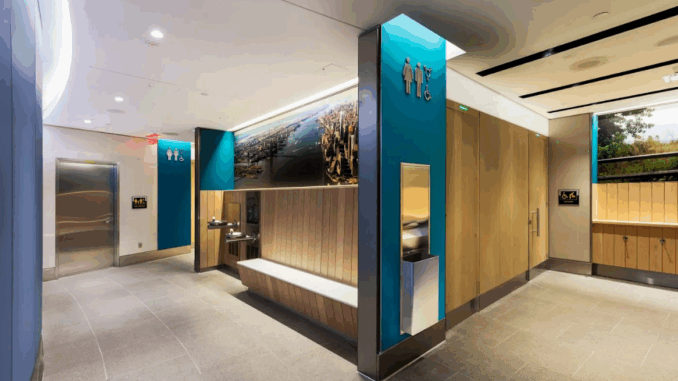
This type of bathroom isn’t just a hypothetical. In 2022, a new all-gender facility at Newark Liberty Airport was a finalist for the title of America’s Best Restroom, as reported in Patch. In this all-gender bathroom, floor-to-ceiling stall dividers provide privacy for all users, regardless of gender.
Of course, change like this doesn’t happen overnight. Updates like this require time and money, which are always in short supply.
In the meantime, I hope BC finds ways to improve existing all-gender facilities, to add more of them, and to imagine a better bathroom future for all students.