
By: Renae Visico
I was eleven when I listened to a “Hamilton” song for the first time. As a child discovering my passion for musical theater, the musical’s catchy tunes and witty lyrics immediately stuck with me. More than that, it felt like an emblem of America’s social progress. However, the America we know now has only grown more different from the America “Hamilton” introduced itself to.
My elementary school history teachers emphasized how much America has truly become the land of the free for everyone. Seeing people of color (POC) at the forefront of my favorite musical at the time felt like a representation of the optimism I’ve been taught. It felt like I was witnessing a revolution from my laptop. That was in 2018.
2018’s America was very different from the America in 2015, when “Hamilton” first debuted.
Ten years, three presidents, one pandemic, and at least three thousand shows later, the vision of America seen in “Hamilton” seems so distant from what it is today. However, that doesn’t mean we can’t learn anything from it.
If there was any time to write an optimistic musical retelling the story of slave-owning Founding Fathers through a cast of actors that represent many racial minority groups, the Obama administration was the best time. With the election of America’s first black president, one who expanded health coverage and legalized gay marriage, it felt like America was taking steps in the right direction. Steps where everyone can feel comfortable calling this country home.
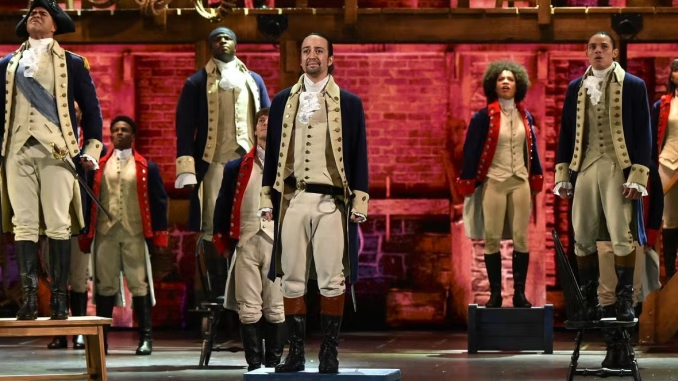
“Hamilton” reflected the optimism of the Obama administration. On paper, “Hamilton” seemed like an idea that would never work. A hip-hop musical had never been popular on Broadway, there wasn’t much mainstream interest in the Founding Fathers, and Hispanic, black, and Asian actors would be playing historical figures who would not have welcomed them into their America.
But “Hamilton” creator Lin-Manuel Miranda had perfect timing, so that wasn’t how first-time viewers saw it. For many, “Hamilton” was very refreshing on the broader scale of musical theater. Everything that made “Hamilton” seem crazy on paper became part of its charm, drawing thousands from every corner of the world to line up for overpriced tickets to the Richard Rodgers Theater.
Of course, the issues people cite with “Hamilton” now did not go over viewers’ heads ten years ago. Having people of color depict their oppressors in a glorified manner reads like wishful ignorance of these historical figures’ racist past for the sake of representation. However, any and all representation, especially for POC playing meaningful roles, seemed reflective of the hope Obama pushed for a more welcoming America.
Then Trump became president in 2016 and again in 2024. The optimism that made “Hamilton” resonate with viewers was no longer present. There’s a reason the entire cast wore black, the color of mourning, at the 2025 Tony Awards, while the monarchical King George wore red.
The empowerment in Hamilton and Lafayette’s iconic line, “Immigrants, we get the job done,” now seems dangerous in the midst of a crackdown not just on immigrants, but on anyone who isn’t white. It’s hard for immigrants to feel pride over fear under an administration that legally gives ICE the power to target people based on race, language, or accent.
The humor in King George, notably the only role played by a white actor, singing gleefully about killing families and friends of innocents to remind them of his “love” doesn’t seem so funny when we’re under the rule of a man threatening to cut food benefits of innocents under the guise of “love” shown by protecting America’s least vulnerable citizens.
Angelica, Eliza, and Peggy Schuyler singing about female independence seems like wishful thinking in the midst of an administration that exclusively praises white feminism and eugenics, shown in Sydney Sweeney’s jeans ad, while using women of color to push an agenda that only serves to harm them.
The charm that helped “Hamilton” become a blockbuster was now being seen as corny and outdated. Lin-Manuel Miranda’s signature songwriting wasn’t witty or clever anymore; it just felt out of place in a country where the fog of optimism had lifted, and more people became increasingly aware of its glaring shortcomings.
Americans wanted more meaningful change, and “Hamilton” was no longer considered reflective of the change the public wanted. But has it ever reflected the change people needed?
“Hamilton” was never meant to replace a history lesson, nor has it ever claimed to. However, as a musical that has undoubtedly sparked mainstream interest in American history, it shouldn’t be unreasonable to expect transparency regarding the figures it represents.
Positive representation of people of color has always been, and will continue to be, necessary for social progress. But so is the acknowledgement and direct confrontation of America’s ugly history. There’s no reason “Hamilton” had to choose between one or the other.
In the 2016 PBS documentary “Hamilton’s America,” Daveed Diggs, who played Marquis de Lafayette and President Jefferson, addressed this conflict, saying that viewers “don’t have to separate these things [slavery] from Jefferson. He could have written these amazing documents with things we all believe in, and he sucks.”
I’m sure Miranda meant well while writing “Hamilton” to resonate with modern Americans. But the idea of him de-emphasizing the role of slavery in American institutions because it didn’t fit his artistic vision of Alexander Hamilton as a “young, scrappy, and hungry” immigrant is in itself a form of erasure.
Now more than ever, America needs to confront its history and current applications of institutionalized racism. Pretending it doesn’t exist is the farthest from what we need for real progress.
However, “Hamilton”’s shortcomings shouldn’t stop people from enjoying it or using it as a tool for empowerment. In this time of political despair and polarization, the optimism “Hamilton” represented shouldn’t be dismissed or taken for granted.
When “Hamilton” moved to Disney+ in 2020, it received a resurgence in popularity, and more people were discovering it as I did in 2018. In the midst of a global pandemic and the rise of the BLM movement after George Floyd’s murder, “Hamilton” became increasingly used as a tool for advocacy.
Lines such as Alexander Hamilton’s “This is not a moment, it’s a movement” and John Laurens’s “We’ll never be truly free, until those in bondage have the same rights as you and me” were used to reclaim America’s history back in the hands of people it silenced.
In a way, that hasn’t changed.
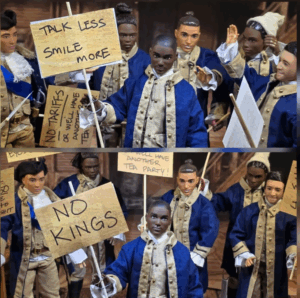
During the two No Kings Protests this year, songs like “Story of Tonight” and “History Has Its Eyes On You” were written on protest signs.
One Reddit user, Miss Anna, even made dolls representing the Hamilton cast holding up lyrics from the show as protest signs.
In an interview with Jimmy Fallon, Miranda said that “[Hamilton] always has something to say about the moment, because we’re constantly dealing with the past. […] We’re never done with the flaws, the contradictions in the founding. And so it just hits differently depending on where we are.”
I doubt that “Hamilton” would be so beloved if it came out today. But it’s clear that it will not stop being important, nor will it stop being meaningful for Americans and for all who look towards a brighter tomorrow.