
By: T’Neil Gooden
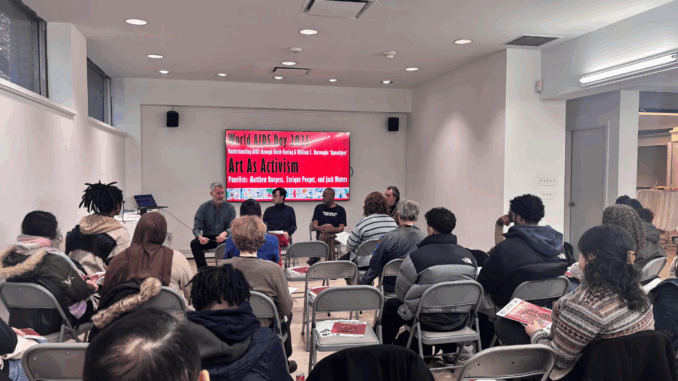
Brooklyn College’s (BC) LGBTQ+ resource center and BC’s Art Gallery, worked together to provide students with a panel of successful individuals to share their understandings of AIDS through their own internal understandings and being exposed to the works of Keith Haring, a world-renowned American artist who emerged in New York City’s art scene within the 1980s and lived with AIDS. Before this panel occurred, BC’s art gallery had Haring’s apocalypse exhibition that also brought attention to Haring’s legacy and life with AIDS.
The event started with students and faculty watching a few videos of Keith Haring to understand the importance of his art.
“I paint to stay young in a way,” Haring said in a video about his art that was shown to the attendees.
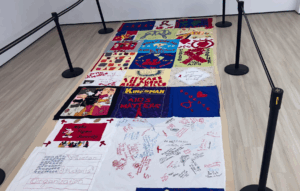
Along with learning about Keith Haring, students learned about Brooklyn College’s history of acknowledging AIDS. In October 1988, over 8,000 panels of quilt were shown at the White House during a national display. Brooklyn College created a quilt to commemorate AIDS in the year 2000.
The panelists involved in the event were Jack Waters, a choreographer, filmmaker, and performance artist; Enrique Rodriguez Pouget, a social epidemiologist; Matthew Burgess, a poet, educator, and author of Drawing on Walls: A Story of Keith Haring; and Joe Scarpetta, a programming assistant at the LGBTQ+ Resource Center at BC and host of the talk. The panel discussions revolved around the topic of AIDS and each artist’s connection to Haring.
Burgess spoke about the inspiration and teachings he learned from Haring, including where Haring would go to find inspiration for the art he created for murals, the public eye, and children.
“Keith took a lot of inspiration from the dance floor and from boys and dancing and felt that there was a connection between the spontaneity of dancing and the spontaneity of drama,” Burgess told the audience.
The panelists not only spoke about the impacts of Haring’s art, but they also spoke about the environment that surrounded the 1980s as the AIDS epidemic began to rise in New York City.
“LGBTQ people from all over the country and all over the world could come here [the East Village] and find cool people to hang out with. So it was, you know, my favorite thing about [the 1980s] was the community of it. For me, it was probably the East Village,” said Pouget.
Pouget continued by explaining, “That kind of environment brings together so many different people from different backgrounds. Keith is like that. I think of Keith as a pop artist, whatever, but he was in graffiti culture. He was a white boy in this culture, and he’s giving back to the community.”

Haring was not seen only as an artist in the 1980s, but as an activist in his own terms, who impacted many people who were in and around the AIDS crisis.
“There was a factionalization and a marginalization of people who considered themselves political artists,” said Waters. “And I think this is the breakthrough of Keith and I, where it’s [art is] not didactically political in that way. It’s very simple, it’s very easy, it’s very free-flowing as opposed to, and I’m not putting it down, but someone who puts the didactics and the detail of what a political position is in the work itself.”
Burgess joined this understanding of political activism within art and the idea that art can be a balance of both politics and fun.
“Rather than thinking I’m a singularly political artist and therefore all of the content, everything I create has this particular point of view or agenda or politics, he was making political art, and he was also making art that was less political or more joyful.”
Panelists and attendees also spoke about the importance of understanding what AIDS is and how individuals can learn more about the disease.
The first drug that was effective for AIDS was called “AZT,” said Pouget. “It was approved by the FDA in 1987. It was approved under an emergency approval, which would exist at the time, but that emergency approval made it only available to a very small number of people. So hardly anybody got the AZT notice.”
This was then changed due to the AIDS Coalition to Unleash Power (ACT UP), which “ made it more accessible to people. I should say that to be clear. The activism of ACT UP and the shame that they put on institutions, including the government, forced the government to change the approval process that allowed thousands of people to get effective NDA drugs,” Pouget told he audience.
Since this drug was the first of its kind, many people had passed due to the side effects, leading to more drugs being developed.
“10 or 15 years ago, there was an idea that we could do prevention by giving people treatment drugs before they got infected,” said Pouget. “If you give somebody a treatment drug as soon as they get infected, that infection may never take hold in the person. The concept started to be developed to give people who are sexually active, who may be exposed to HIV, this anti-age drug, pre-exposure prophylaxis, before they get infected.”
Bringing it back to present-day drugs and who is exposed most to AIDS, Pouget explained that, “mostly gay men of color are exposed these days, so it’s important in that population, especially the life stigma population, it’s an effective way to get people to prevent infection with HIV if you’re exposed.”
The event ended with students learning about how to get involved in AIDS prevention in their environments.
Scarpetta told the audience, “The best course of action could be either involving yourself in activism in one way or another, or even better, going somewhere to see key hearings in person. And then you can make your own personal reflections, and you can make your own assessments, and maybe it’ll inspire you.”
Students interested in the LGBTQ+ Resource Center can visit their website, https://www.brooklyn.edu/lgbtq-center/. Students interested in HIV testing can visit the Health Clinic located at 114 Roosevelt Hall or email bchealthclinic@brooklyn.cuny.edu to schedule an appointment.