
By: Margot Dragos
On March 5, the Solomon R. Guggenheim Museum unveiled its newest exhibition from artist and sculptor Carol Bove. It is the largest exhibition and first museum survey of Bove to date, chronicling her career of over 25 years.
Carol Bove was born in 1971 in Geneva, Switzerland, and currently lives and works in New York City. In the early 2000s, she began her career drawing soft depictions of nude models from Playboy magazines. Now, her well-known “pipe monsters,” which are sculptures of large, crumpled steel tubes, sell for upwards of $1 million.
Constructed by Frank Lloyd Wright in the 1950s, The Guggenheim is known for its non-traditional layout. Taking the shape of a spiral, the museum consists of a series of ascending ramps, culminating with a glass skylight at the top.
The museum survey, or broad overview of an artist’s work, is loosely organized in a reverse-chronological order. As guests ascend, they are brought further back in Bove’s career, beginning with her most recent work and ending with compositions from the early 2000s.
Bove also incorporated other artists’ work into her exhibition, frequently using the rotunda’s unique layout to her advantage.
In a wall on Ramp One, a diamond-shaped cutout reveals Joan Miró and Josep Llorens Artigas’s “Alicia,” a mural for Harry F. Guggenheim’s late wife, Alicia Patterson, that was hidden behind a wall for decades.
Recycled from Bove’s work for The Metropolitan Museum of Art (MET), six polished aluminum disks form a vertical line ascending ramps one through six, creating a mirror effect that draws the viewer’s attention to the rotunda’s glass ceiling.
Throughout the exhibition, Bove’s art takes on multiple mediums, such as illustrations, collages, and her celebrated pipe-like steel sculptures
“Sweet Charity,” made in 2026 for the Guggenheim exhibition, is a towering example of Bove’s signature sculptures. Located in the High Gallery, “Sweet Charity” consists of seven tall, crumpled steel tubes in lush shades of orange, green, yellow, or white urethane paint. Guests entering the gallery can walk among the tubes, getting up close and personal with Bove’s creation.

Carol Bove, March 5, 2026–August 2, 2026, Solomon R. Guggenheim Museum, New York. Photo: David Heald © Solomon R. Guggenheim Foundation, New York.
Bove’s pipe sculptures are displayed throughout the museum, such as in “Vase Face I / The Ascent to Heaven on a Dentist’s Chair” on the rotunda floor.
“I thought [Vase Face I] was inflated,” Virginia Thomas, an Upper West Side resident, told The Vanguard. “It looked like air to me– and that satin sheen, I just wanted to touch it.”
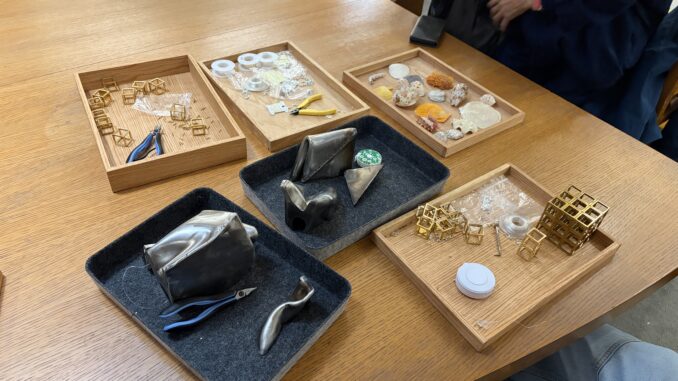
In a way, guests can. Situated in the Aye Simon Reading Room on Ramp Two, a tactile library invites guests to touch the materials used by Bove in her art. Its shelves are made of peacock feathers, steel, bronze, and anodized aluminum. The space also includes a table with trays of beads, cubes, and pliers, which guests can cut and assemble.
“To be able to walk into the tactile library, my nephew and I were like, ‘Woo-hoo!’ lifting [the materials] up,” said Thomas.
“I think a lot of Carol’s work is really mysterious,” Maddie Jewesson, a studio assistant for Bove, told The Vanguard. “I think that it’s really wonderful to be able to demystify those experiences and let people carry out their urges to touch things.”
Many of the materials Bove uses aren’t immediately recognizable. Some say the urethane paint on Bove’s crumpled steel sculptures “almost looks like fabric,” according to Jewesson.
Jewesson was stationed in the tactile library during the exhibition’s opening day. She says many guests returned to the library after walking through the museum, wanting to touch the materials used in the art they viewed.
“People will come back throughout the day, and [say] ‘I wasn’t initially interested in the peacock feathers, but now that I’ve seen the piece upstairs that has the peacock feathers in it, I want to understand more what that feels like,’” said Jewesson. “And I think that’s incredible as well.”
According to Jewesson, the idea for the tactile library came from one of Bove’s previous exhibitions.
“She did an exhibition in Geneva where she 3D printed miniature models of the sculptures that she had on display, so people can handle them and get a sense of the grooves and everything,” said Jewesson. “And she had that in mind when she was conceptualizing this space and kind of wanted to scale it up.”
Bove has incorporated spaces for rest, reflection, and play throughout her exhibition. On the rotunda floor, guests are encouraged to use chessboards with pieces made by Bove. The artist has also installed lounges in galleries usually reserved for art, allowing guests to sit or even lie down as they travel up the ramps.
“One thing I love so much about Carol’s philosophy when it comes to the museum and art is that she feels that a lot of museums ask us to just be a body that carries around a mind,” said Jewesson. “Spaces don’t consider the fact that we are human and we have bodies that need rest, that have the urge to touch, that need play.”
“She wants to make the museum a less hostile environment in that way and make space and say, it’s okay to have a body.”
Bove’s exhibit challenges what guests may expect from a museum.
“I really hope that this experience, specifically in the tactile room, can start a revolution,” said Jewesson. “I hope it inspires other museums to take that leap and implement more projects like this.”
Thomas, who was previously unfamiliar with Bove’s work, called the artist “remarkable.”
“This is just eye-opening to me. I absolutely love it,” Thomas told The Vanguard. “And I want to keep touching.”
Those interested in viewing the Carol Bove exhibition can see it at the Guggenheim through August 2, 2026.