
By: Serena Edwards
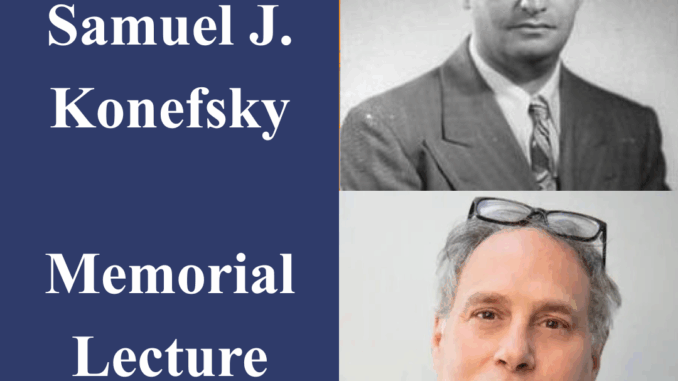
The Ethyle R. Wolfe Institute annually hosts a lecture in memoriam of Brooklyn College (BC) alum and former professor Samuel L Konefsky.
Professor Konefsky served as a constitutional law professor at BC from the 1940s to the 1970s. Every year, they award a student at BC for their hard work within the legal system and contributions to the community. This year’s recipient was BC Student Calvin Jean.
This year’s lecturer was Lee Gelernt, an American Civil Liberties Union (ACLU) lawyer working for the Immigrants Project. During his lecture, he broke down the latest actions from the Trump administration regarding immigration.
Gelernt spoke with The Vanguard before the event to provide his insights on the latest actions against immigration, what he wishes for the event, and what to expect.
“I think that we’re in a situation now where there’s a feeling that it’s okay to attack immigrants. And the Trump administration has pushed that,” stated Gelerent.
He emphasized the power of people and communities utilizing their voice when they see injustice.
“It’s important to be in the courts, but the courts can’t do everything, and we can’t accomplish everything we want to accomplish through the courts, and that the most critical aspect in any movement is the public speaking out, and that the importance of young people in particular speaking out, and resisting, and not feeling like things are hopeless,” stated Gelernt.
Speaking to his intentions for this speech, Gelernt hopes the audience will gain greater awareness of the policies affecting immigrant populations today.
“I’m hoping to give people a sense of the work that I’m doing in the ACLU […] as well as all of our colleagues out there who are working on immigrants’ rights and broaden the discussion a little bit to what it means for the values of our country,” said Gelernt.
Gelernt acknowledges the overwhelming amount of information that is given on a day-to-day basis.
“There’s a ton of different policies, and I think maybe we’ll talk about that later, but that is one of the Trump administration strategies, it’s just to overwhelm us with a new policy every day, “ said Gelernt.
The beginning of the lecture dissected the Trump administration’s use of the Alien Enemy Act (AEA) and its effect within the Immigration and Customs Enforcement (ICE) raids.
Gelernt is actively working with the ACLU on the case against the Trump administration for their use of the Alien Enemies Act of 1798. He argues that President Trump’s use of this act is unconstitutional and attacks immigrants and their right to due process.
The AEA was a war crime act that was invoked during the War of 1812.
“The Alien Enemies Act of 1798 is a wartime authority that allows the president to detain or deport the natives and citizens of an enemy nation. The law permits the president to target these immigrants without a hearing and based only on their country of birth or citizenship,” according to the Brennan Justice Center.
This act, however, is only permitted under war circumstances and has been invoked three times in history.
Gelernt talks about the process of the ACLU building a case against President Trump’s use of the AEA.
“The minute he started talking about it on the campaign trail, the ACLU began digging into the law and doing enormous historical research, talking to as many people as we put it to be ready for it […] all of a sudden, we heard, on March 11, March 12, March 13, that Venezuelan men, were being rounded up from all over the country and brought to a detention center in southern Texas,” stated Gelernt.
Through his work, Gelernt has worked closely with the courts and even went to the Supreme Court of the United States (SCOTUS) to present and expedite their case. Since March 11, 2025, Gelerent and the ACLU have filed a case with the local courts.
Issues arise from the Trump administration’s actions that Gelernt suggested would affect the future of America’s legal system.
“The Trump administration is trying to eliminate due process, in any way they can, so that they can detain as many as possible without due process. So they can afford as many immigrants as possible without due process,” says Gelernt.
He also focuses on “understanding human dimensions” and bringing personal stories to the forefront. “We need to continue doing is getting these stories out there, getting the human dimension of it out there. So people can really understand, you know, concrete way, what are these policy means, so they can say, ‘What, you’re not going after the worst or the worst?’” said Gelernt.
Gelerent highlights the power of people through history and now as his last point.
“Lasting systemic change can’t come strictly through the course; it takes the public pushing back, and that’s very absolutely critical, right? It was critical in the 60s, the civil rights open, and it’s, I think, critical now.”
Throughout the lecture, Gelernt reassures students that they still have the power. He urges students not to be fearful but instead to utilize the voice and power they have to advocate, no matter how small it may be.
Gelernt said, “What I hear a lot of people saying is, ‘Well, these problems are so big, what can I do?’ Yes. Do it, no matter how small, it really matters.”