
By: Raven Santos
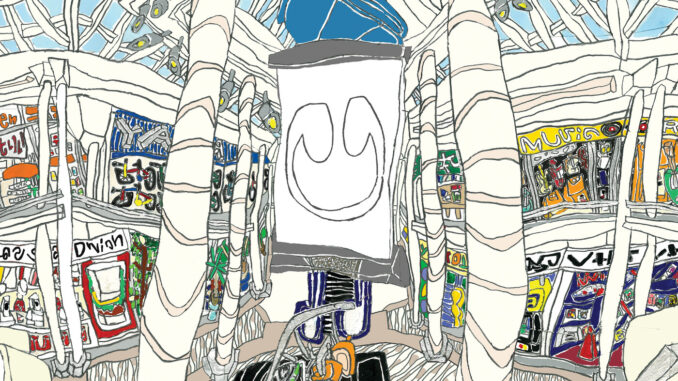
Stores and restaurants line the space. Chairs and tables strewn about. Lights and signage are buzzing with life. But it’s an empty mall, no one in sight except singer-songwriter-producer April Harper Grey, better known by her stage name “underscores”, dancing through this liminal space. This was the live listening party for her new album, “U”, released on March 20, which encompasses the kind of listening experience she set out. It may initially seem like a throwback to early 2000s club EDM, but it hides nuanced genre-blending production paired with deeply personal lyrics – similar to albums such as “Brat” by electronic-pop singer Charli xcx and “I Love My Computer” by DJ and singer Ninajirachi.
Underscores is typically known for her hyperpop sound, which prioritizes manipulated vocals, distorted synthesizers, and heavily layered instrumentals. Whereas her previous album, “Wallsockets,” added indie rock sounds, this new album puts an emphasis on electronic subgenres such as EDM, making this her catchiest album to date. The new album adds four-on-the-floor rhythms, which adds a pulsing kick drum common in much dance music. She also adds hyperpop staples, including bitcrushed bass, rhythmic vocal samples, and distorted synthesizers, and uses them minimally to create instrumentals focused on the rhythm of the song.
Sonically, the album is not a simple club record played on speakers, but rather underscores was inspired by the noises of public spaces such as malls, airports, hotels, and supermarkets, as discussed in NME. “U” is headphone music meant to accompany the transitional periods of moving between important places in life.
This is exemplified by instrumentals that create sonic environments filled with a variety of synthesized instruments and modulated vocals. On the contrary, the lyrics are highly personal to Grey, describing a complicated romance and her relationship to the creative process of making music.
The album’s opener, “Tell Me (I Want U)”, immediately confronts the listener with an ambiguous phrase, “It’s U”. The “U” in question could be describing a lover, whom Grey would change her image for to want her just as bad as she wants them. The “U” could also refer to the listener directly, asking if they’ll want and appreciate the more EDM and “mainstream” approach she’s directed her music to.
This new approach is reflected through the instrumentals, such as jungle-like percussions with exhaled gasps, plucked guitar-like synth pads under whispered vocals, dubstep bass drops, and reverse-tape sound that stops the song, ending with radio-com sounding vocals.
All these sonic elements create a diverse song that reflects her constant metamorphosis, wanting to become someone the listener or “U” will still desire. Her relationship to music is more explicitly narrativized in “Music” and “Hollywood Forever”.
The former has her feeling a musical connection to a perfect song that is personified as her lover, whom she can feel the lyrics, the rhythm, and the feeling. The feelings come to her through tachycardic pulsing of bass and swelling of harmonic synths. These dubstep-inspired instrumentals reflect her processing of emotions through music and finding that perfect song.
The latter song shows her grappling with the dichotomy of her growing fame: both the luxuries she can acquire and a growing critical audience that judges her for this indulgent behavior. She says everyone is simply “so Hollywood” that anyone in a position of fame would indulge in massage chairs and dining out. Yet she also grapples with the reality that her time with fame could end at any moment, with a final drop that fades from the high-tempo lifestyle to personal doubts about her talents and whether she deserves the fame.
These thoughts continue to echo the song’s closing, that she shouldn’t be buried in “Hollywood Forever” amongst the other movie stars who live on in name and prominence.
These themes of her artistic process and music continue to pair in other romantic encounters, while underlining, bolding, and italicizing her lyrics with infectiously catchy melodies and dense instrumental layering. It exemplifies that, beyond the thematic aspect, this album is a celebration of a new style for underscores.
On her previous album, she had a small concept narrative revolving around three girls in the fictional Midwestern small town of Wallsocket, Michigan. While the new album is based more on urban cities and malls, like Stonestown Galleria in California, it still retains the nostalgic yet critical look at the environment that she had grown to surround herself with. The visual world of “U” includes this digital core: people playing DDR charted to “Music” in the corners of an arcade, a choreography of “Do It” which she performs with dancers in front of a screen, and a chase scene playing alongside “Tell Me (U Want It)”.
It’s a visual aesthetic that harkens back to times of Frutiger Aero, the iPod shuffle commercial, and a time when malls used to be the prime social gathering spots. While the sounds of EDM, dubstep, and dance-pop wouldn’t be seen as out of context for artists like M.I.A., Skrillex, and Timbaland, underscores’s “U” unique post-hyperpop sound makes a wholly new sonic fusion of past and future. This combination of romantic experiences with her music-making process culminates in the underground scene with the mainstream.
The title “U” symbolizes both “you,” the listener, and the first letter in underscores, serving as an ultimatum fusion of the artist and the audience. For new listeners new to hyperpop, this album is a gateway drug into the genre, with a catchiness and musical densities that are versatile in headphones or blown-out speakers. To people deep in the online music forums of RYM and AOTY, the album will be less experimental than other hyperpop-adjacent works, but it still serves as a fusion with more obscure genres that serve as a foundation to make the familiar sound fresh.