
By: Samuel Mortel
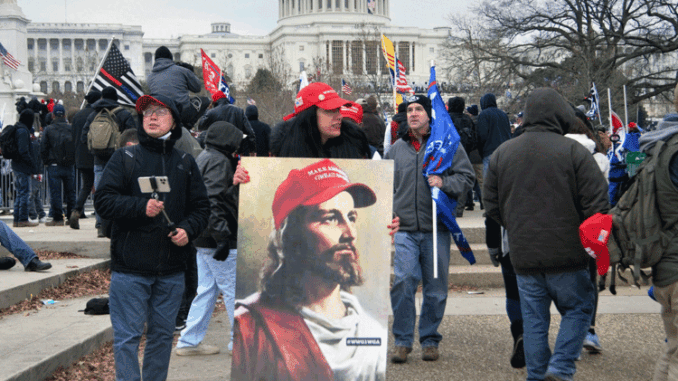
There’s a certain fraction of the country that is fully committed to the United States (U.S.) President Donald Trump, who will justify his actions, without question, no matter what. For a man whose business career and political career have been marred with controversy, the MAGA fanbase has been willing and able to brush every single one of them aside. However, there was one controversy recently that was proven to be too far for even some of his most ardent supporters. We’re witnessing an all-out conflict between Christianity and Trumpism. To the uninitiated, it may seem sudden, but this war was inevitable.
On April 12, Trump posted on Truth Social an AI image depicting himself in a robe, seemingly using magical powers to heal a sick man while surrounded by adoring onlookers. To anyone even remotely familiar with Christian imagery and iconography, it’s clear that this image depicts Trump as Jesus. The post was met with a wave of confusion and disappointment from the president’s fanbase, which largely consists of devout Christians, leading to the deletion of the post. The administration attempted to defend President Trump, saying that he thought the image was portraying him as a doctor.
The post comes in the wake of a public feud between President Trump and Pope Leo XIV, with the pope making several statements critical of the Trump administration, especially regarding the war in Iran. This schism has led Christian GOP loyalists to seriously consider whether they prioritize the head of their religion or the head of their political party.
Several conservative politicians like Senator Ted Cruz, Representative Troy Nehls, and Border Czar Tom Homan, and Vice President JD Vance have been pressed on which side of the pope/president feud they fall on, with Cruz refusing to take either side. Homan, Nehls, and Vance fell in line with the president, urging Pope Leo to stay out of politics.
This conflict between the Trump administration and the church has been brewing since his first term. One of the most underrated, yet interesting, characters in Trump’s network is Paula White-Cain, a pastor, televangelist, and spiritual advisor to Trump since his first term. White-Cain may be best known for a 2019 video where she stated, “To say no to President Trump would be saying no to God.”
White-Cain made headlines recently for yet another statement concerning Trump and religion. The spiritual advisor was asked to deliver a speech at the White House on April 1 for an Easter lunch. She used the platform to praise Trump, even going so far as to compare the president to Jesus.
“And Mr. President, no one has paid the price like you have paid the price. It almost cost you your life. You were betrayed, and arrested, and falsely accused. It’s a familiar pattern that our lord and savior showed us. But it didn’t end there for him, and it didn’t end there for you.”
With people like White-Cain in his circle, it’s no surprise that Trump would end up posting an image of himself as Jesus just two weeks later.
While Trump himself doesn’t seem to care much for religion, infamously not being able to recall a single Bible verse despite claiming it’s his favorite book, he still aims to portray himself as a religious figure. In fact, he even sold his own version of the Bible during his 2024 campaign, a move met with pushback from conservative figures but largely went unnoticed.
It seems many aspects of Trump’s second term have been more intense than his first, including his complicated relationship with religion. Cracks first started to show around this time last year, when the previous head of the Catholic church, Pope Francis, drew the ire of conservatives by making statements against the Trump administration’s deportation policy.
In April, the pope had a private meeting with Vice President JD Vance, in which there was an “exchange of opinions”, according to the Vatican.
Shortly after attending Pope Francis’ funeral, President Trump joked that he would like to be the next pope. Later that week, Trump posted an AI image depicting himself as the pope to his Truth Social account, which received mixed reactions from his base. Many were able to brush it off as a joke, but some viewed religion as a sore spot and felt uncomfortable with the post.
After a conclave, American cardinal Robert Prevost was chosen as the next head of the Catholic church and took the name Leo XIV. Like his predecessor, Leo was immediately critical of the Trump administration. Like Francis, Pope Leo has come out against Trump’s immigration policy, while also sharing concerns about his foreign policy. Leo ramped up the criticism in the wake of Trump’s war on Iran, an ongoing struggle which has resulted in a death toll said to be over 3,000.
The pope has made numerous statements against those who perpetuate and support the war, notably proclaiming that Jesus “does not listen to the prayers of those who wage war, but rejects them, saying: ‘Even though you make many prayers, I will not listen: your hands are full of blood.’”
Following the pope’s criticism of the Trump administration, the president has taken to Truth Social to assure his supporters that he is indeed aligned with God’s mission. His approach has been divisive, as shown by the many negative reactions to his AI posts; reactions coming from people who’ve stood by him through his numerous controversies and may have voted for him numerous times.
One notable person who spoke against the president was Riley Gaines, a conservative activist who is a leading figure for anti-transgender legislation in the United States. She took the stage alongside Trump during the Conservative Political Action Conference (CPAC) in 2022 and was invited to speak at a Trump rally for his 2024 campaign. She was also invited to the White House last February to attend President Trump’s signing of an executive order that banned “biological males” from women’s sports.
Gaines took issue with Trump’s post, tweeting, “Why? Seriously, I cannot understand why he’d post this. Is he looking for a response? Does he actually think this? Either way, two things are true: 1) a little humility would serve him well 2) God shall not be mocked.”
When asked if backlash from conservatives like Gaines led Trump to take down the post, the president responded, “I didn’t listen to Riley Gaines. I’m not a big fan of Riley, actually.”
Gaines responded to Trump’s rather harsh dismissal with kind words.
“…The truth social post missed the mark. It’s now deleted. Amazing! We’re imperfect people. I know I am. I don’t get my feelings hurt easy and I know with the President it’s really not personal.”
It seems Trump’s still fixated on religion, posting an image of himself embraced by Jesus on April 15. The post includes a caption that claims Trump is an instrument of God’s will.
Over the past decade, the MAGA movement has been compared to a cult, with Trump as the cult leader, countless times. It seems only natural that this cult-like movement would brush up against the Christian Nationalism of the American right. It seems impossible to worship a man—especially someone as narcissistic as Donald Trump—as if he is a god, and also hold space for the God of your actual religion. This has proven to be especially difficult considering the fact that Trump’s cruel and inhumane policies are directly contradictory to the very religion that he and his supporters claim to follow.
This is the natural conclusion of these conflicting beliefs within the right wing of the country, and undoubtedly won’t be the last time MAGA will have to choose whether they prioritize their faith in their god or their faith in their president.