
By: Massimo Ranieri
Amichai Lau-Lavie is a thirty-ninth-generation rabbi. He is the first in that long lineage to be openly queer. He is also the first to become a drag queen.
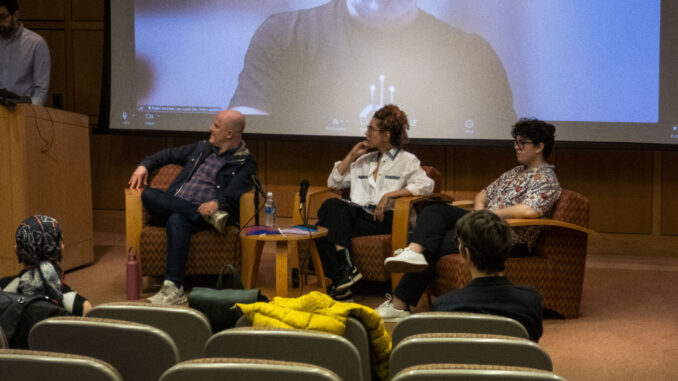
On Monday, April 13, the LGBTQ+ Resource Center and Judaic Studies Department at Brooklyn College (BC) co-hosted a screening of “Sabbath Queen”, a documentary that follows 21 years of Lau-Lavie’s life. The screening was followed by a Q&A with Lau-Lavie and director Sandi DuBowski, moderated by Professor Fernanda Faya and Samer Cohen, President of the BC Women in Film club.
Throughout Lau-Lavie’s life, he has wrestled with faith and identity. Descending from Holocaust survivors, Lau-Lavie was born in Israel. After being outed in the Israeli press, he relocated to New York City, where he would eventually co-found Lab/Shul: “ [An] everybody-friendly, artist-driven, God-optional, experimental community for sacred Jewish gatherings.”
In addition to advocating for the LGBTQ+ community in Jewish spaces, Lau-Lavie has campaigned for immigration reform, interfaith relations, and a ceasefire between Israel and Palestine.
Lau-Lavie has dedicated his life to crafting “a new Jewish narrative, one which is queer and expansive.” Still, he frames the story of “Sabbath Queen” as a series of open questions rather than predetermined answers: “How do we get Jewish diversity and wealth of wisdom out there in ways that are compatible with our more liberal progressive values?” Lau-Lavie asked. “And how do we evolve, how can we be more helpful in being a Judaism of change and peace, and not devolve into a tribal Judaism of triumphalism and supremacy, as is the case right now?”
One of Lau-Lavie’s answers to these questions has been his drag persona, Rebbetzin Hadassah Gross. The widow of six prominent rabbis, Gross gave Lau-Lavie an opportunity to inject femininity into patriarchal aspects of Judaism. She also offered a satirical view of Jewish life that was more accessible to modern audiences.
Alongside these performances, though, Lau-Lavie has also strived to connect to more traditional Jewish forms of teaching and learning. He studied for years to become a Conservative rabbi, poring over texts and approaching his religion academically. Only by approaching Judaism from both sides could Lau-Lavie begin to bridge the divide between progressive values and spiritual tradition.
Within Judaism, there are several diverging branches. In North America, the largest denomination is Reform Judaism, which holds that Jewish texts and laws are “divinely inspired, but humanly constructed, meaning they should be adapted based on contemporary moral ideals,” Jewish Studies scholar Joshua Shanes wrote in “The Conversation.” Reconstructionist Jews tend to have an even more progressive interpretation of Judaism.
Orthodox Judaism, on the other hand, adheres more strictly to Jewish law and customs, according to Shanes, which can lead to narrow norms around gender and sexuality. Conservative Judaism lies somewhere in the middle, accepting some of the modern interpretations of Reform Judaism around sexuality and gender, but maintaining a strong commitment to tradition. Of course, within each of these branches, there is further diversity of thought; part of Lau-Lavie’s mission is to help advance the conversation around his progressive values within Conservative and Orthodox communities.
During the Q&A, DuBowski explained that he initially imagined that the documentary would come to a close when Lau-Lavie was ordained as a Conservative rabbi. During filming, however, he realized there was more to the story. What would Lau-Lavie do with his new title?
Soon after being ordained, Lau-Lavie caused controversy by officiating a Conservative interfaith wedding between a Jewish man and his non-Jewish husband. Although many Reform and Reconstructionist rabbis are willing to officiate interfaith unions, they are prohibited in the Conservative and Orthodox traditions.
Lau-Lavie knew that this wedding would cause a stir. In fact, that was the cherry on top of the wedding cake.
As an ordained rabbi, Lau-Lavie wanted to leverage his authority and careful study of Jewish law to open conversations, disrupting traditional practices that had become outdated.
The tensions in those conversations hit home for many audience members.
During the Q&A, several audience members spoke about their own experiences navigating Jewish faith and queer identity. Lau-Lavie offered his own guidance and reflections.
“If there’s any place that there’s gonna be Jewish queer people, it’s gonna be in Brooklyn,” said Libby Treitel, a BC student in the audience who identifies as queer and formerly Orthodox. Treitel connected to Lau-Lavie’s position of being “in the middle, on the precipice of two worlds.”
DuBowski first met Lau-Lavie while making his first feature documentary, “Trembling Before G-d”, which told the stories of gay and lesbian Orthodox and Hasidic Jews. While Lau-Lavie didn’t quite fit into that film, the two kept in touch and became close friends.
“Amichai is a rabbi to me,” DuBowski said, adding that Lau-Lavie officiated his queer, interfaith wedding and helped perform last rites for DuBowski’s father.
For co-moderator Samer Cohen, DuBowski’s earlier work has had personal significance. “When I came out to my family,” Cohen said, “everyone ignored me for the last two weeks that I was home, except for my dad, whose first response was to show me ‘Trembling Before G-d.’”
Finding compromises and ways to move forward isn’t always easy. Lau-Lavie had some advice. “Judaism is a baby in a 3,000-year-old tub,” he said, to laughter.
“I think what brought me back [to Judaism] is differentiating between the baby and the bath water. Some of the gems that are inside my tradition are long-lasting and eternal. But some of the layers are socio-political layers that don’t serve human dignity, justice, freedom.”
Jewish religious texts condone slavery and capital punishment; they can be homophobic, misogynistic, and bigoted. “But they also gave us permission to keep changing,” Lau-Lavie said.
“I am somebody who believes in ‘both/and’, not ‘either/or’, when it comes to Jewish and Gentile, when it comes to queer and straight, when it comes to Israel and Palestine. There’s a ‘both/and’ premise that is built into our tradition. But ‘either/or’ forces that are fear-based or trauma-laden or separatist forces have defined Judaism for many of us. That, for me, is bath water.”
Following the Q&A, DuBowski joined BC students for lunch, where storytelling, conversation, and open questions continued over a shared kosher meal.
Lau-Lavie offered one last piece of wisdom as the Q&A session drew to a close: “May memories lead us to a better world.”
For more information about upcoming screenings of “Sabbath Queen,” including showings in Manhattan and Brooklyn, visit https://www.sabbathqueen.com/