
By: Margot Dragos
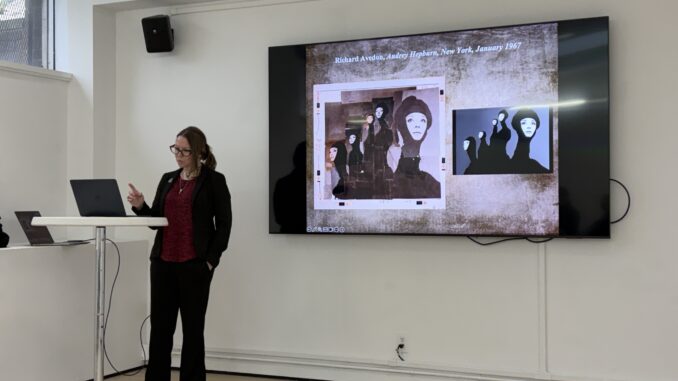
History Professor, JR Pepper, answered this question with her lecture “Lies of the Lens: The Myth of Truth in the History of Photography” on April 30. The lecture was hosted in Boylan Hall’s Art Gallery as part of an Art History Lecture Series.
Professor Pepper discussed the expansive history of image manipulation and how the concept has evolved with the advent of new technology. From surrealism to spiritualism, she touched on notable photographers from the 19th to the 21st century.
While it is now common to use Photoshop to edit photos, people used to believe everything seen in a photograph was real.
“The idea that photography has never lied is probably the biggest lie that photography actually tells,” said Pepper at the beginning of her lecture.
Professor Pepper has lectured both within and outside of BC. She previously gave this lecture through Lectures on Tap, a group that hosts thought-provoking lectures in bars.
“She’s really good at presenting things and explaining them in an articulate and interesting manner,” Max Castoec, a BC junior pursuing a BFA in Art, told The Vanguard.
He says Pepper’s course is his “best class” this semester.
Prior to working at BC, Pepper worked for 17 years in photography and image restoration.
“It’s a unique way to tie in my background with what I do, which is teaching, which I adore,” Pepper said when asked why she gave this lecture. “And if I can share that with my students, that’s a big part of it. Why do you work for 17 years if you can’t share your experience?”
Pepper went into detail about how early photographs were manipulated. Calvert Richard Jones produced the first known manipulated negative, or inverted version of the image, on a transparent base. Although his photo displays four monks, the negative reveals the shape of a fifth monk that was blocked out with India ink.
“It was fascinating to see how much of a craft it really was,” said Richard Gonzalez, BC junior and studio art major. “Because I feel like nowadays, even photography and AI, those things are so immediate and quick. But to see the level of time it took and the level of care it took to create an image– I think that is lost in society nowadays.”
Her lecture also discussed modern, controversial uses of Photoshop, such as in a 2009 Ralph Lauren ad that depicted a digitally altered image of model Fillipa Hamilton’s figure.
Pepper herself used to work in fashion and advertising photography, but left after seeing “the effect of what we were doing in real time.”
“Having young cousins and my goddaughter referring to magazines with these clearly photoshopped women and thinking ‘That’s what I’m supposed to look like,’’ said Pepper. “At a certain point, it became too overwhelming to ignore.”
The lecture ended in the present at a time when AI images are more prevalent than ever. Pepper argues that it should be mandated to disclose if an image is AI-manipulated, which some countries have already done, and that this is “desperately needed as quickly as possible.”
“The original point of photography is to document what was designed as truth or thought of as truth,” Pepper said. “And if you can’t trust your own eyes, then it becomes very Orwellian.”
Attendees learned not only how images were manipulated throughout the years, but also the effects of these images on society.
“My biggest takeaway [from the lecture] is considering all aspects of photography, especially the ethics of it and the implications and replications,” Gonzalez told The Vanguard. “In this day and age, an image can be so powerful and can change how you think and how you see the world.”
Students interested in BC’s Art Gallery can follow their Instagram @bcartgallery.
For more information on Professor JR Pepper’s work, visit pepperart.com