
By: Michelle Zhen
On Sep. 17, students, faculty, and staff of Brooklyn College (BC) gathered in the LGBTQ+ Resource Center in 211 Student Center to discuss “Roaming”, a graphic novel written by Mariko Tamaki and illustrated by Jillian Tamaki.
As a long-running collaboration between the center and the Women’s and Gender Studies (WSGT) Department, the book club meets every third Thursday during common hours. With their copies of “Roaming” in one hand and light refreshments in the other, each attendee settled into chairs and sofas arranged into a semblance of a circle, preparing to contribute to the upcoming conversation.
“There was a lot of people this time around, which was cool to see,” BC student and book club regular LB Primm told the Vanguard. “I liked how everyone got to share a bit about what they were thinking, and it was sort of like an open dialogue between everyone. Cool being in a community, you know?”
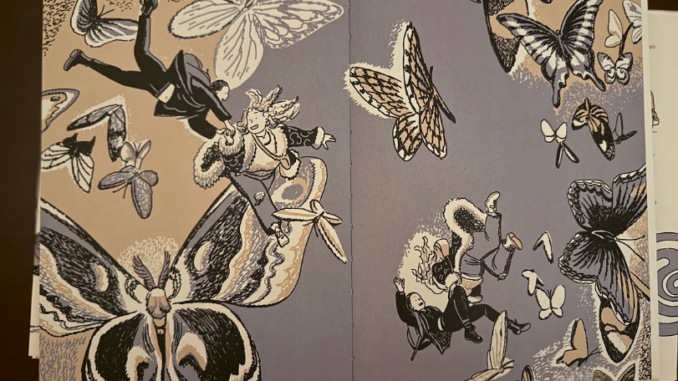
“Roaming” depicts three Canadian college students enjoying their spring break in New York City. Readers follow Zoe “Zee” Kitagawa and Danielle “Dani” Kim, who have been friends since high school, as they take a five-day trip to New York City over spring break. Dani’s classmate Fiona joins them as they pack various tourist attractions into their schedule such as folded pizza, St. Mark’s Place, the Met, the Natural Museum of History, Central Park, the M&M’s store, and finally Coney Island. Though Zee finds herself inexplicably drawn to Fiona, or “Fi”, tensions rise as the three’s wants and needs stray further and further from one another.
“I feel like everyone, to some degree, knows [someone like] Fiona,” said fellow student Sebastian Torres, who has never attended the LGBTQIA+ Book Club before. “I think that’s a sign of good writing when anyone, even cishet people, can relate in some degree to your story.”
The book club immediately opened the floor for discussion, though everyone participated at one point or another. Some were encouraged, while others opened up on their own. Fellow readers took care not to speak over one another, some even providing guided questions for others to tackle alongside their individual insights of the story. When the free copies of “Roaming” were all successfully distributed, other readers happily shared their copies with those who could not receive personal ones.
“I love to read in general,” BC student and attendee Cesar Zapata added. “I’m also interested in these types of stories that focus on queer spaces. […] I like to see the creativity that people put [into written media].”
The visual aspects of the novel were highlighted as various readers showcased their favorite spreads, which are illustrations that span beyond one page, at the end of the meeting. From Zoe and Dani depicted in the foreground of a planet to a surrealist display of as many pieces from the Met as could reasonably fit within two pages and an illustration of a blue-and-yellow butterfly, the scenes came to life specifically to reach the hearts of the readers, such that they could express their feelings for the novel to one another.
“I wanted a space where I could feel safe and stuff. And the book club provides a lot of that. […] In a way, I can’t feel that in a lot of other spaces,” Torres admitted.
Though the book club meets monthly, some attendees quickly confirmed their attendance for its next event and received copies of the next meeting’s book, “The Out Side”, a comic anthology featuring 29 different artists’ works depicting a wide range of trans and nonbinary experiences in full color. The Kao, Min Christensen, and David Daneman curated and edited the anthology.
“I don’t come across much queer literature in my day-to-day life,” Primm said. “Knowing that the books are […] going to involve things and themes that I’m currently exploring both with myself and broadly, it’s really good. It makes me feel seen.”
Following the event, Torres, an attendee who obtained a copy of “The Out Side”, shared a message to all.
“Please go to your queer center. Please go to your community. Life will get so much better. You know, find mentors and stuff. Older people in your community. They will help you. They will make your life so much easier and better.”
For more information on the LGBTQ+ Resource Center, visit @lgbtqcenter_bc or 211 Student Center.