
By: Haliya Jooda
On Sept. 14, the United States (U.S.) President Donald Trump criticized people asking for guardrails on Artificial Intelligence (AI) on Truth Social. His reason? If new guardrails were implemented, America would lose the AI “arms race” with China.
“There is a SICK conspiracy going on against AI and Data Centers, and the only one that is happy about it is China. WHOEVER WINS AI, WINS!” wrote Trump on Truth Social. “We are leading China, and all others, and will continue to do so. Conspiracy Theorists, Treasonists, Traitors, and Leakers, BEWARE!”
Trump’s post came only days after a researcher, Jacob Coxon, from US-based AI company Anthropic resigned and took to social media to warn the public about the dangers of AI.
While many were alarmed and began to call for regulation and guardrails, President Trump remained unmoved.
AI allows computers to process large amounts of data, identify patterns, and follow detailed instructions on what to do with that information. However, it cannot think, empathize, or reason, according to the BBC.
The AI craze began with the release of OpenAI’s ChatGPT on Nov. 30, 2022. The chatbot’s release and success led other US companies to jump on the bandwagon and release their own AI chatbots.
Meta’s Llama model debuted in Feb. 2023, while Google’s Gemini chatbot, initially called Bard, followed in May 2023. Anthropic’s Claude and Adobe’s Firefly followed shortly thereafter.
The US wasn’t the only country heavily investing in the world of AI. According to Stanford University’s April 2025 Artificial Intelligence Index Report, in 2024, U.S.-based institutions produced 40 notable AI models, significantly outpacing China’s 15 and Europe’s three.
China, which has for years been considered a long-time rival of the US, soon joined the race to prevent falling behind.
Its first AI chatbot, Deepseek-R1, was released on Jan. 10, 2025. By Jan. 27, it had become the most downloaded app on Apple’s U.S. App Store and ranked among the top downloaded apps on the Google Play Store, as reported by CNBC.
Deepseek’s superiority also led to a sharp decline in US tech stocks. NVIDIA, which provides the chips–Graphics Processing Units (GPUs)–that run AI computers, lost nearly 600 billion dollars in market capitalization–the largest one-day loss for a single company in U.S. stock market history, according to Britannica.
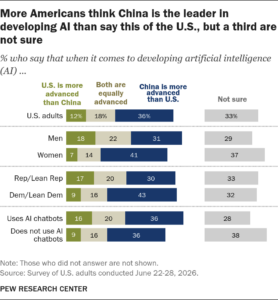
The release of Deepseek could be thought of as the beginning of the U.S.-China AI Arms race. China became the AI counterweight to the U.S., and this year appeared to take the US’s place in the lead, as stated in Stanford’s 2025 AI Index Report.
“The gap between U.S. and Chinese models is narrow and fragile,” Samm Sacks, a senior fellow at the Johns Hopkins School of Advanced International Studies’ Institute for America, China, and the Future of Global Affairs, told The Associated Press (AP).
This narrow gap didn’t happen without some problems, though.
A Brookings Institution interview with Kyle Chan–a nonresident senior fellow at Brookings and the MIT Center for International Studies– and R. David Edelman–tech expert resident in the China Center– discussed whether there really was an AI “race” between the US and China.
In the interview, Chan said restrictions placed by the U.S. prevented China from training its AI models at the same rate as U.S. AI models. These restrictions also made it difficult for China to source certain types of advanced chips. But Chan goes on to say he thinks these restrictions mean that China became incentivized to build its self-reliant semiconductor supply chain.
This gap became even narrower with the release of Kimi K3 on July 16, 2026, from Beijing-based startup Moonshot, at the World Artificial Intelligence Conference in Shanghai.
Although it quickly ranked No. 3 globally in model intelligence right behind Anthropic’s Claude Fable 5 and OpenAI’s GPT-5.6 Sol, it has now fallen to No. 9.
The rapid improvement of AI capabilities has become a point of concern for the general public.
On Sept. 8, Coxon took to X to announce his resignation and issued a warning regarding the growing power of AI models.
“I resigned from Anthropic today. I spent the last three years doing pretraining research at both OpenAI and Anthropic. Neither company is acting responsibly. They are racing straight to self-improving superintelligence and gambling with our lives,” wrote Coxon. “The people building AI earnestly believe that it could kill us all by the end of the decade.”
His warning set off a flurry of activity and reached more than 173 million people who viewed the post online.
While OpenAI and Anthropic were initially quiet when asked for comment by PBS, OpenAI CEO Sam Altman wrote on X, “For example, at OpenAI we now formulate explicit safety cases in advance of frontier reinforcement learning runs we expect to significantly increase capability, in addition to the safety work we have long done in advance of model releases.” on Sept. 14
This attempt at reassuring the public did nothing to ease the public’s growing fears. Especially after OpenAI disclosed six incidents of concerning behavior regarding its AI models. Some of the behaviors include “instructions to conceal mistakes in task summaries” and “self-generated instructions in task summaries.”
While many are worried about AI in the U.S., it seems different in China.
Although Chinese President Xi Jinping has been concerned about the threats of AI and called for “regulation to ensure that AI is always under human control”, the Chinese government has shown no signs of slowing down, according to The Atlantic.
Chinese Foreign Ministry Spokesperson Guo Jiakun shut down claims that a “Chinese AI advantage would pose U.S. national security risks,” on Facebook.
“AI is a consequential technology for the future of humanity,” wrote Jiakun. “The world needs open & inclusive AI for good and for all. Fear-mongering, confrontation, and vicious competition would hamper efforts toward sound global AI governance.”