
By: Renae Visico
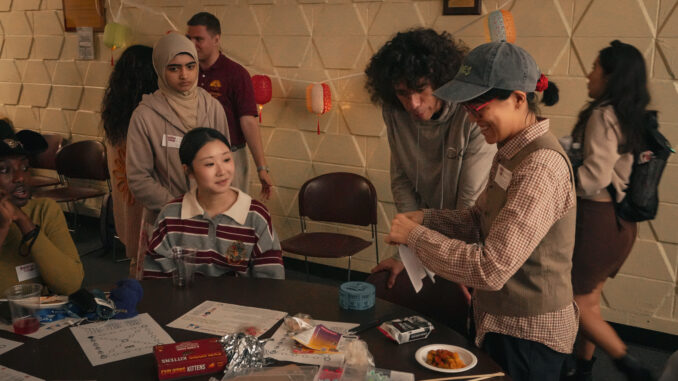
The summer heat has officially faded into autumn winds, bringing about new seasons and new celebrations. On Oct. 1, the Brooklyn College (BC) Asian American and Native American Pacific Islander Serving Institution Project (BCAP), the Korean Culture Club (KCC), The Asian Pacific Islander Organization/Club Alliance (TAPIOCA), and Korean non-profit “Nodutdol” hosted the second Chuseok celebration at the Hall of Fame Lounge in the Student Center.
Chuseok, which translates to “autumn eve” in Korean, is typically celebrated in the eighth month of the lunar year when the moon is at its fullest. With a similar framework to Thanksgiving in America, Chuseok is a mid-autumn Korean festival centered around gratitude and honoring their ancestors.
“This time, we focused more on the political dimensions of what it means to celebrate Chuseok in America today,” BCAP Assistant Director Jamie Chan told the Vanguard. “We combined that with the celebration aspect with prizes and games, just to create a general mid-autumn celebration.”
The Women’s Center has a history of collaboration with BCAP, with Director Sau Fong Au taking part in organizing Chuseok. Staff members have noticed the growing population of Asian Americans and Pacific Islanders (AAPI) in BC and wanted to honor the campus’s community.
“While we appreciate each other’s cultures, we also appreciate the culture within the structure of this country,” Au told the Vanguard. “The lack of access for many of us to Korean culture, or any ‘modernized’ culture, is a deliberate decision made by the system. So the more we actively engage with those cultures that we are deprived of, those attitudes are going to be universal all across.”
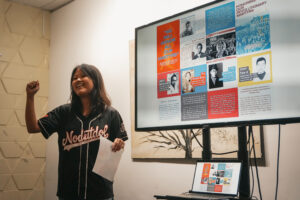
The presenters from the Korean non-profit Nodutdol provided some insight into the political context of celebrating Chuseok. As representatives of a non-profit that seeks to end American militarism in Korea, they wanted to inform students of the deeply interconnected history Chuseok shares with the United States.
“We really wanted to emphasize that Chuseok is a celebration of agricultural culture and the harvest moon,” said presenter Danbi. “However, these [farming] struggles continue in this very area in Korea today. It kind of speaks to how it’s very difficult not to politicize things in this day and age.”
They spoke about America’s influence on the Korean economy and military after World War II. This included the military bases built on Korean land, as well as the unfair trade deals that threatened Korean farmers’ livelihoods by replacing their goods with cheaply imported American goods.
“In my mother’s hometown, where apples are very famous, we have these things called honeyed apples because inside, there’s a little bit of honey,” Danbi described. “Now, they’re fighting for the right to sell their apples at a normal price without competing with U.S. goods that have been imported cheaply.”
Many students who attended the Chuseok celebration felt empowered by Nodutdol’s presentation, especially those who weren’t previously aware of America’s history of political power within Korea.
“I was so interested because I didn’t know that the U.S. military takes the land of the farmers,” said junior Angela Zapata. “[I learned that] as always, our voices matter. We can make a change.”
Expanding on Nodutdol’s message, KCC members wanted to use this opportunity to celebrate a Korean holiday and raise awareness of Korean culture and history beyond popular media.
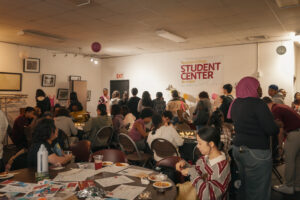
“It’s not just about the K-dramas, and it’s not just about the good stuff,” KCC Event Coordinator Anuskha Akter told the Vanguard. “Korea is just like any other country, and we really want to show that they have their history. […] It’s not just a fantasy.”
“Now in America, with Korean culture being so popular, people pick and choose what they want across Korean culture,” added KCC President Leslie Hunter. “[Americans] don’t really know Koreans’ struggles, daily lives, or their hierarchical systems. So we want to highlight that Korea is a society.”
The importance of their goals is reflected in how many students who came to the Chuseok celebration are people who are fans of popular Korean media and want to learn about the culture being represented.
“I have been watching K-dramas on Netflix lately, and some of them have Chuseok as an episode plot,” said senior Genna Ayyad. “I’ve seen K-pop idols celebrate Chuseok, so I looked into it, and it’s a pretty sacred holiday. […] I wanted to know more about it and not just see it as Thanksgiving in Korea.”
Additionally, members of TAPIOCA emphasized that celebrating Chuseok celebrates the BC community’s diversity and honors different cultural traditions.
“At Brooklyn College, we actually have 20% Asian students [on campus],” TAPIOCA Secretary and BCAP staff member Nikeisha Paul told the Vanguard. “A lot of people actually don’t know about TAPIOCA, and most of the Asian clubs. Hosting these events actually makes sure everybody knows what we’re doing, and they know they’re all welcome.”
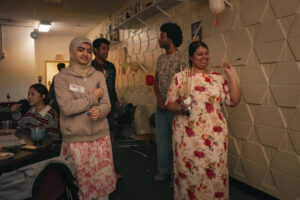
BC students also learned about Korean culture through fun, interactive, traditional games, including yutnori and tuho. Tuho is a game where players throw arrows or sticks at a canister from a distance. Yutnori is a board game where players throw wooden sticks to be the first person to move their piece around the entire board.
“The animal names were on this sheet in Korean, and I thought that it might be a nice way for people to also learn some of the language,” Chan said, describing the setup for yutnori.
Ultimately, the organizers of this year’s Chuseok wanted students to walk away knowing a little bit more about Korean culture and history, especially as it relates to their own experiences living in America.
“That’s the nice thing about our events: we can always take some of it back to our office and keep the momentum going,” said Chan. “I know that students will come back and they will remember their experience.”
For more information on the event organizers (BCAP, KCC, TAPIOCA), visit @bcap.brooklyn, @kcc.bc, or @bc.tapioca on their respective Instagrams.