
By: Dima Ponomorenko
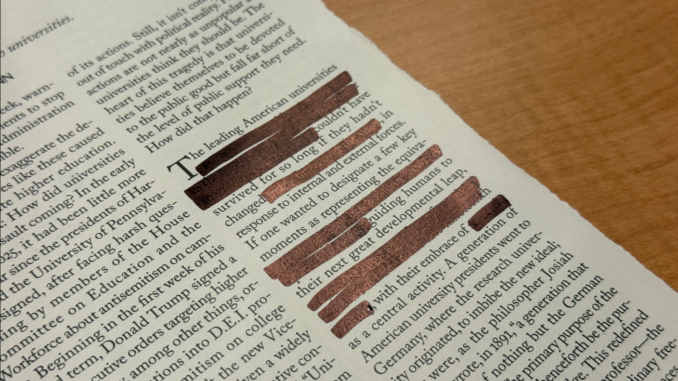
On Oct. 27, the Brooklyn College (BC) Women’s Center hosted a blackout poetry workshop for the college community.
Blackout poetry, also known as erasure poetry, is a form of poetry created by taking an existing piece of writing and erasing certain words to arrange a new poem. Damien Niesewand, a current graduate student and the workshop’s organizer, believes that bringing art opportunities to the community provides a meaningful outlet for emotional expression.
“Blackout poetry especially is really great for people who have never considered themselves to be a poet,” Niesewand told The Vanguard. “[…] All of the words are here for you; you just decide which ones you want to keep and which ones you don’t.”
The Women’s Center began hosting community art workshops in the Spring of 2025, going through many mediums over the years. In the past, the center hosted workshops for painting, zine-making, collaging, and more.
Niesewand quickly noticed how much these events resonated with the community.
“It’s really hard for people to know, ‘Does my voice matter? What do I care about? What do I want to speak up about? How do I speak up?’”
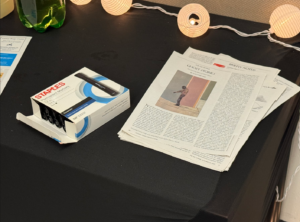
The workshop lasted for two hours, allowing participants to take the projects at their own pace. As students entered the room at various times, they independently picked up the necessary supplies, later sharing their work with each other.
“We’re all making something together, then we’re all inviting each other into our shared little world,” Niesewald said.
Attendees found blackout poetry to be a particularly accessible medium.
“The idea of having to generate everything on your own can be really intimidating and a really big roadblock for people,” stated Niesewand, “and [blackout poetry] can be a really good starting area.”
Having had previous unpleasant experiences with poetry in academic settings, Cody Chen a first-year undergraduate student and frequent visitor of the Women’s Center, found the workshop to be a lot more peaceful and welcoming, “I think [blackout poetry] is pretty fire, and I probably should do more of it some other time.”
Attendees created blackout poetry with wide Sharpies and individual pages of The New Yorker magazine. Niesewand found power in that particular medium, describing how many poets use blackout poetry to comment on specific political issues. She emphasized that regardless of students approaching the project with a particular idea, they may still find great empowerment in it.
“These words do not hold any more value than yours just because they are written in a magazine,” said Nieswand. “All of this [writing] can be used by you to say what you have to say.”
According to the Brooklyn College website, the Women’s Center “is committed to adopting a wide range of multidimensional needs-driven program activities that address the emotional, intellectual, physical and financial well-being of the whole person.”
Alongside community events, the center provides drop-in hours, crisis intervention services, and hosts clubs such as The Exchange and the Women’s History Month Committee, all housed at 227 New Ingersoll.
“I do like the vibe and seeing what’s going on,” said Chen. They enjoy using the Women’s Center as a spot to rest in between classes because of its convenient location and calm environment, “It’s very peaceful.”
Iqra Munir , a fourth-year undergraduate student, said that her employment at the Women’s Center provided her with many opportunities to grow as a student and as a person. Munir’s time at the center allowed her to “explore different things” and get the “chance to talk with different people,” expanding her world in a safe and supportive manner.
Amidst current attacks on women’s health and safety, Chen believes the center’s work remains critical.
“Places like the Women’s Center do give certain resources that I think a lot of people do desperately need in these times, including support.”
The Women’s Center continuously provides a safe and welcoming environment for students on the Brooklyn College campus. In hosting these arts workshops, the Women’s Center ensures that students and staff can feel that their voice matters.
“People are thinking and feeling very deeply about the world around them and don’t often feel that they have the space to share that,” Niesewand emphasized. “The Women’s Center was always meant to be a space where that can happen […] [and] we are making events and spaces where that can happen.”
“Poetry is a way to say things that are too big, or too overwhelming, or too emotional to say in any other way,” Niesewald told The Vanguard. “Holding this really immense concept in this very small space […] is kind of magical to me.”
For updates on BC’s Women’s Center, follow their Instagram @womenscenterbc