
By: Ameena Khan
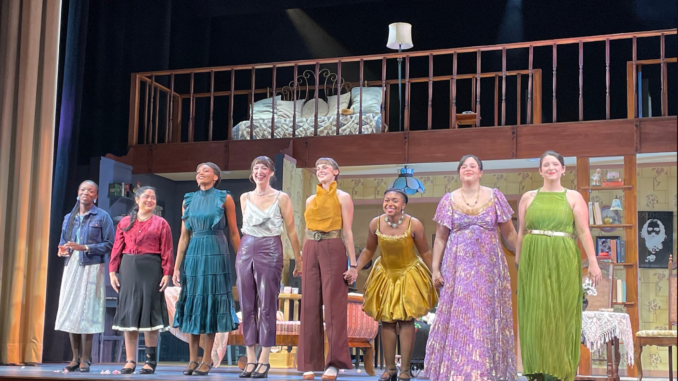
An immersive atmosphere and fourth-wall breaks filled the Don Buchwald Theater. The Brooklyn College (BC) Theater Department organized “Fefu and Her Friends,” a 1977 play written by Cuban-American playwright María Irene Fornés, combining elements of realism, surrealism, and experimental theater.
Directed by a Fairleigh Dickinson University alumna Ran Xia, the 2-hour play ran from Oct. 23 through Oct. 28 and featured an all-women cast highlighting the internal, psychological, and emotional lives of eight women outside the presence of men within a patriarchal society.

“Fefu and Her Friends” is an iconic feminist play in three parts that takes place in the spring of 1935 in New England. Eight women gather to prepare a presentation for an educational fundraiser, yet the play places a special focus regarding the women’s relationships, autonomy, frustrations regarding domestic life, and the psychological impacts they confront in the absence of men while the effects of patriarchy remain instilled.
Ran Xia described her creative process as a director when adapting the production.
“I was hired to direct the play, which is serendipitous, as I have always been really inspired by Fornés’s work,” Xia told The Vanguard.
“For me, the story always exists in the intersection of the timeless and the timely. […] There are internalised misogyny and insidious emotional handicaps that these women experience and are in a powerful chokehold that a lot of people today still experience without realizing. So I wanted to make time itself a hidden character in the play and unfold it so that the audience gradually realize how much of what the characters experience is close to home.”
“I found out about this performance through my friend, Carter, [who portrays] Christina in the play,” Leah Katz, a BC sophomore and English education major, told The Vanguard. “And then I briefly read the synopsis about this play, and I was like, ‘Oh, a feminist play. That’s totally my jam.’”
“I really like going to the Brooklyn College productions, specifically because I feel like it’s a smaller audience and a more of a very intimate feel,” Katz noted.
Many audience members reported their interest in Act 2, where multiple scenes simultaneously occurred in different locations in the theater, representing the different conversations between characters occurring in different rooms in the house. The scenes then rotated in different locations around the audience, until every attendee experienced each scene simultaneously, in a different series of events.
“I felt sort of like I was almost in the play myself […] because it was very immersive,” Katz told the Vanguard.
Xia highlights the immersive aspect of the production, working with set and lighting designers to utilize the architecture of the performance space “[…] since the design of the space itself very much lends itself to our aesthetics.”
“Similarly for costumes, my designer added line works onto the costumes for Part 1 to create the illusion of two dimensional illustrations, and muted tone, that transforms into richer, more vibrant counterparts later,” Xia emphasizes. “Transformation has always been the key here around our secret pain character, ‘time.’”
“We had a very collaborative process with the acting ensemble as well,” Xia adds, regarding the cast’s work and portrayal of the characters.
“We had a very diverse cast too, so they have also been really keen on considering the intersectionality of privileges and differences that the characters would experience from a historical standpoint, which I believe added layers to our production as well.”
Carter Marks, a theater major and cast member who played Christina, notes how despite not being initially familiar with the play’s script beforehand, she learned about “Fefu and Her Friends” through audition materials and highlights the play’s popularity in the theater industry and how Fornés, the playwright, is “eccentric and […] does not follow the traditional rules of of playwriting.”
When asked about what Marks learned about herself from playing her role as Christina, a character who is disturbed by Fefu’s actions throughout the play, Marks highlights how she learned to stand up for herself and stick true to what she believes in.
“I have learned that it’s okay to be alone in your way of thinking,” Marks reflects. “That does not mean that you are wrong. It just means that you are the only one that is expressing that thought […] I think that that’s a really important lesson of how you might not always believe in yourself. You might not always stand up for yourself. But it’s important to start. And it’s important to have that journey. I also learned to trust my intuition and my initial reaction.”
Xia hopes that the audience does not only view “Fefu and Her Friends” as a “relic of the past,” but rather “a very present, very urgent issue” regarding the emotional restraints women are met by the scrutinization of women in the real world.
“What’s equally important that we hope we could communicate is the sense of community and friendship between these women,” Xia highlights as an essential theme of the production.
“There is a strength of love between them that when present, they do become stronger, even if their own insidious belief of internalized misogyny doesn’t allow them to understand that source of strength.”
“It’s always good to consume media that’s going to make you uncomfortable,” Katz told The Vanguard, reflecting on her experience witnessing the conclusion of the performance.
“I felt very uncomfortable at various points in this play. And I think that was kind of the point.”
To learn more about BC Theater’s performances, follow their Instagram @bctheatercuny.