
By: Elianna Tsigler and Kaniz Samiha
Students, faculty, and staff alike gathered on Oct. 27 for a kimbap-making event hosted by Brooklyn College (BC) Asian American, Native American, and Pacific Islander Serving Institution (AANAPISI) Project (BCAP). Led by Sau-fong Au, the director of the BC Women’s Center, participants were taught how to prepare the Korean dish.
Upon arrival, attendees were greeted by the event hosts at the entrance, creating a warm and welcoming environment. They could relax, wait, or enjoy their kimbap while also watching K-pop music videos on the TV in the seating area, along with a nearby soda station where people could grab refreshments.
Leslie Hunter, president of the Korean Culture Club (KCC)—a club on campus dedicated to promoting awareness of both traditional and modern Korean culture—said, “It’s also a good time to meet people with similar interests. You could have the same interest in food, or you could be watching music videos.”
As guests began flooding in, numbered tickets were distributed to keep track of participants and help organize the growing crowd. This system provided a simple way to manage the turnout as more members of the BC community arrived to take part in the workshop.
The incredible turnout for the event also brought joy to the coordinators, with Hunter noting this to The Vanguard.
“The event’s going so well. It’s like a packed house; there are so many people.”
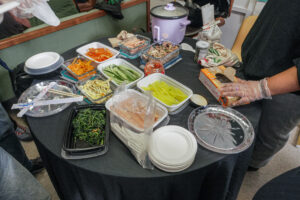
Participants then made their way to a table lined with ingredients where they could choose what to include and not to include in their kimbap.
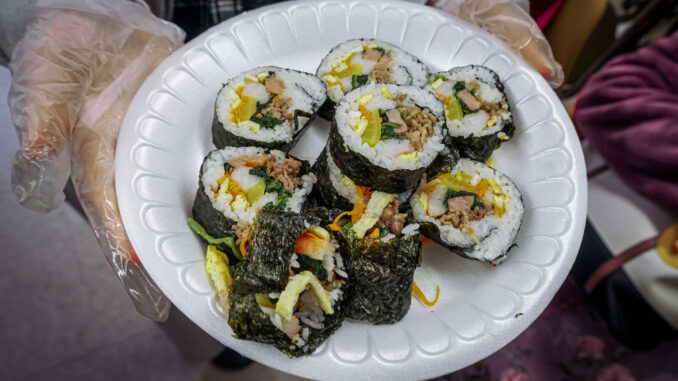
Many people confuse Kimbap and sushi, but the two differ in cultural origins and preparation. Unlike sushi, kimbap typically does not contain raw fish. Instead, it is filled with cooked ingredients such as ham, egg, kimchi, canned tuna, yukhoe, and pickled radish.
Kimbap is a popular Korean dish whose name translates to “seaweed” (kim) and “rice” (bap). It is made with cooked short-grain rice, vegetables, and various proteins all rolled in seaweed and sliced into bite-size pieces.
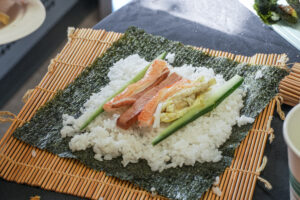
After selecting their ingredients, they moved on to the rolling station, where Sau-Fong demonstrated how to properly put together and roll the kimbap. Her step-by-step instructions were especially helpful for participants who were new to making kimbap, making the process easier to follow and understand.
When asked why people attended the event, Hunter said, “It’s Korean food, everybody’s a fiend for Korean food, especially when it’s free.”
Many other guests, when asked, admitted that they came for the free food and left with a newfound liking for the dish. As said by Khan, it was easy for people to stop by and grab a quick bite.
“[Our office is] situated in Boylan, and students could come here after or before class to grab something to eat.”
For BC junior Christian Howson, the workshop was more than just an opportunity. He initially came to the event looking for an interactive activity on campus, and he left with more than he expected, having discovered a new dish he hopes to make at home.
“I just wanted to be able to connect with my fellow BC fellows and students. I even got to see some people that I didn’t talk to in a while. So it was a really good experience,” shared Howson.
Beyond connecting with students, Howson, as well as many others, shared kimbap amongst themselves when supplies were running out.
“It was so good. And I will definitely be trying to make it at home,” Howson said. He appreciated how convenient kimbap was, noting that it could be a quick and easy snack to prepare when in a hurry.
“[This event was a] spur-of-the-moment thing, as a follow-up to the Chuseok celebration. Food insecurity is everywhere […] so it helps to have food-related events, especially ones showing people how to make their own,” shared Khan.
This event served as an opportunity to foster a closer connection between BCAP and KCC. It was also an attempt to raise awareness of events such as the Tea House Ceremony, which is an annual event held during Asian and Pacific Islander Heritage Month in May.
However, Khan states that BCAP “ became a space where students honestly from any background can come, but it [does still] primarily serves AANAPISI students.”
With BCAP entering its final year of funding, the progress it has made over the past three years makes its future more important. Hunter shares that she hopes to see BCAP continue, and for this not to be its downfall.
To learn more about the BC AANAPISI Project, visit @bcap.brooklyn on Instagram.