By: Samuel Mortel
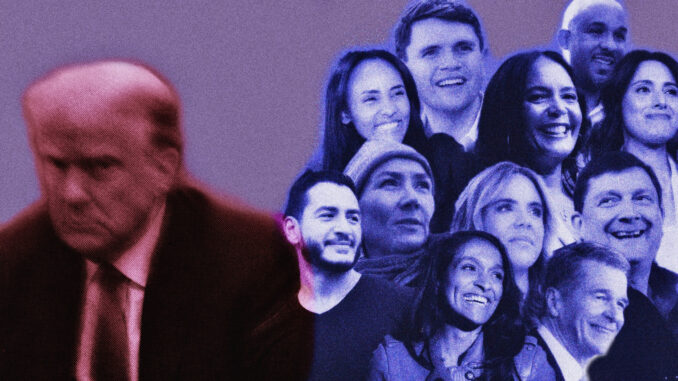
After President Donald Trump won his bid for reelection in 2024, political journalists, analysts, and experts rushed to unpack exactly what happened. When the smoke started to clear, and statistics came to light, a certain narrative materialized: a “vibe shift.”
For starters, Trump dominated his Democrat challenger Kamala Harris in not only the Electoral College, but in the popular vote. This was the first sign that something had shifted in this election, since a Republican presidential candidate hadn’t won the popular vote since George W. Bush in 2004—even when Trump beat Hillary Clinton in 2016, he did so without winning over the majority of Americans.
The data from this election painted a concerning picture; large swaths of the country seemed to be shifting toward the Republican Party. In comparison to the 2020 presidential election, basically every demographic in terms of age, race, gender, and education level saw a swing, with some of the biggest gains being amongst Hispanic voters and voters aged 18-29, both moving towards Trump by percentage points in the double digits.
To many, these shifts marked the beginning of a societal switch towards conservatism. The American people had spoken, and it was time to act accordingly. That was definitely the attitude of the Trump administration, which was very open about interpreting the election results as a “mandate,” and for the next two years, we saw the results of this mindset in full effect. The confidence displayed by Trump in his second term was due at least in part to this perceived mandate, acting under the impression that voters had given him carte blanche to do things like deploy ICE to terrorize cities, launch a sweep of costly tariffs, and start a war with Iran.
Numerous CEOs also saw the election results as a sign to desperately get on Trump’s good side, with figures like Mark Zuckerberg, Jeff Bezos, and Elon Musk attending his presidential inauguration. Other CEOs rushed to align their companies with Trump’s agenda, like Target announcing an end to its DEI goals and programs, and Paramount’s decision to appoint The Free Press founder Bari Weiss as CBS’ Editor-in-Chief—a move NPR called a step “in shaping the network’s editorial direction, at a time when it is looking to expand its appeal among right-leaning viewers.”
Countless think pieces were written speculating what this election meant about the future of American society and where our culture would be going in the long term, with an infamous article from New York Magazine titled “The Cruel Kid’s Table” becoming a foundational text in the “vibe shift” narrative.
“But a massive cultural realignment is taking place, and now this set of shitposters is in the same league as an entirely new establishment, which includes not only the tech overlords…but also a growing number of celebrities…(Meanwhile, all the progressive institutions—Hollywood, college campuses, the mainstream media — feel like they’re collapsing simultaneously.) ‘We were the underdogs for so long. Now every last foe is a friend,’ [Arynne] Wexler tells me. ‘Trump winning is the first step of the real work we have to do. It’ll culturally trickle down.’”
The concept of a cultural, societal turning of the tide became a media fascination. Articles were being written in The Los Angeles Times, Vox and The Financial Times directly addressing the “vibe shift” discourse. Journalists were citing conservative moves in industries like beauty, tech, and entertainment. For a few months, it seemed like we were witnessing the beginning of a new world. However, it didn’t take long for this new world to unravel.
Just a year into his second term, President Trump’s approval rating had already plummeted to 36% according to a Gallup poll from Nov. 28, 2025. The president had been failing in several areas where he promised he’d deliver. He pitched himself as capable of handling immigration, and his brash, violent deployments of ICE agents that resulted in the deaths of multiple American citizens resulted in just a 37% approval rating for his approach. He constantly criticized inflation under the Biden administration, and then, under Trump’s second term, inflation either persisted or worsened due to tariffs, earning him a 36% approval rating on the economy—and this was only the beginning.
After a politically disastrous 2026 for the administration, plagued by an unpopular war with Iran and high gas prices, President Trump received the lowest approval rating of his career at just 30%, according to a Pew Research Center poll from Oct. 8. Heading into the midterms, Trump was the most hated he’s ever been, and somehow his message to voters was to pretend his name was on the ballot. Unfortunately for him, it seems like they did.
Every demographic that swung toward the Republican Party in 2024 ended up swinging back to Democrats in the 2026 midterms, especially Gen Z. After Trump clinched his second term, there was a palpable fear that the left had squandered the trust of young voters. In just two years, this demographic went back to voting blue.
This leads to the question: did the vibe shift ever even exist? Well, maybe there was a vibe shift amongst the rich and powerful. As I mentioned earlier, there were multiple examples of CEOs and corporations being quick to bend the knee to Trump in an apparent effort to be at the front of a seemingly turning tide. When Target chose to dismantle DEI, they didn’t cite the president, rather crediting an “evolving external landscape.”
However, while CEOs and celebrities rushed to switch sides, civilians were more apprehensive. Biden’s term as president was unsuccessful in many ways, and many Americans were upset with the economy in particular. Rather than read the room and accept that people were tired of the status quo, the Democratic Party decided to ride with Joe Biden as their nominee for the 2024 presidential election. And then, only when it became unavoidably clear that the aging incumbent was unfit to serve another term, they quickly switched to Vice President Kamala Harris. Harris offered little to potential voters who were desperate for change, especially considering that she was already a part of the deeply unpopular administration. Then came Trump, claiming he was going to shake things up and get the economy back on track. Voters were faced with the choice of either going in the same direction that they knew wasn’t working, or taking a risk with Trump.
However, as many expected, the risk of a second Trump term did not pay off, and many of the same voters who took a chance on him in 2024 voiced their regrets at the ballot box in 2026. Because of the disasters that Republicans were inflicting on the federal level, voters chose to challenge the GOP at the state level, resulting in historic victories and surprising upsets benefiting the Democratic Party in historically red states like Texas, Mississippi, South Carolina, Alaska, and more. The brief turn towards conservatism in 2024 was not a full-on pivot; it was a trial run.
The midterms are a sign the people are having buyer’s remorse. At least, if there was ever a vibe shift, the vibes have firmly shifted back.