
By: Emily Suhr
For the first time in nearly four decades, the Brooklyn College (BC) community gathered to update the campus tree inventory, promoting sustainability and collecting data that could inform future environmental justice efforts.
The event took place on Oct. 4 and was hosted by the Urban Sustainability Program in collaboration with the BC Eats Garden and the campus sustainability coordinator, Stalin Espinal. It invited students, faculty, and community volunteers to help identify and map the trees on campus. But this inventory is about more than just counting trees; it’s about shifting how the campus understands and engages with its environment.
“It sounds like this abstract, boring thing, but it’s a very profound way of relating to the environment and building a relationship with this environment through trees, which are such keystone species in how our environment functions,” said Michael Menser, director of the Urban Sustainability Program. “We have maps of the original list of trees on the campus. The last time there was a full counting was 1987. So we need to do this.”
The three-hour event was broken into three parts: a short introduction, the field inventory work itself, and a closing gathering at the BC Eats Garden. Participants were grouped and taught how to record data on species, size, and health. Each group had a team lead, who was either a tree expert or an urban sustainability student. Some used digital tools like apps to help identify the trees, while others used books or infographics. The information gathered will be used to create a public digital map that can track the health of the campus canopy over time.
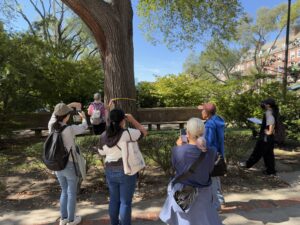
A tree canopy refers to the upper layer of leaves and branches on a tree, and it plays a critical role in regulating temperature, improving air quality, and mitigating floods.
The effort responds to both local needs and global conditions: intensifying climate change, air pollution, and invasive insect species all impact tree health and the broader campus ecosystem.
“In the short term, we want the data points of the trees first and foremost so that any further data could be found and monitored in the future, such as tree care, changes in health, and so on,” said Carina Alessandro, liaison for the Sustainability Club and senior Urban Sustainability student. “This being in a public online map could be utilized for environmental justice efforts. For example, the prevalence of trees and resilience to climate change are connected.”
BC is home to nearly 1000 trees, including pin oaks that intercept thousands of gallons of stormwater per year by absorbing it through their roots, and help lower building temperatures, services that would cost millions to replace with technology.
“We take care of the trees, the trees take care of us,” said Alessandro. “They are an investment, and we should be thinking of them as such. They’re also our assets.”
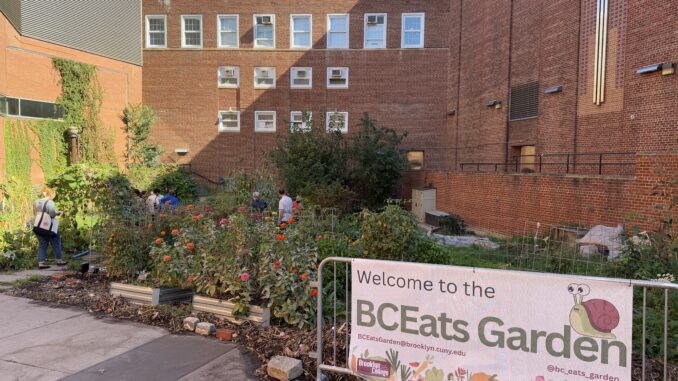
The BC Eats Garden, located between the Performing Arts Center and Whitman Hall, served as the closing site for the event, where volunteers enjoyed pizza and apple cider. The space, which was revived during the pandemic by students, now plays a central role in BC’s sustainability efforts.
“We’ve been working on it for a few years and the vision is for it to be non-hierarchical, for it to be a place where people can learn about food and agriculture,” said Pieranna Pieroni, an adjunct professor in Sustainability and founding member of the garden. “Where people can do experimental things, not just gardening, but filming things and sculptures. We want it to be a hub of community life on campus around sustainability.”
“I think it turned out great,” said Pieroni of the event. “I’m so excited. This is the most people we’ve had at the garden at one time.”
Among the participants was Natasha Herman, a junior majoring in environmental science.
“There’s not many tree or arbory-related classes, so I just wanted to broaden my horizons and learn a different field,” said Herman. “It was a great event. I actually hope they host another one because I know we didn’t get to finish the count.”
While the full inventory will take more time to complete, the event marked a milestone in both data collection and community engagement. And for Menser, the meaning of the work goes far beyond the numbers.
“In this political moment, we want community on this campus,” said Menser. “This is the people’s campus. So we’re very excited to have an event today where it’s this mutual learning thing.”
For more information about the BC Urban Sustainability Program, please visit the BC official website.