
By Massimo Ranieri
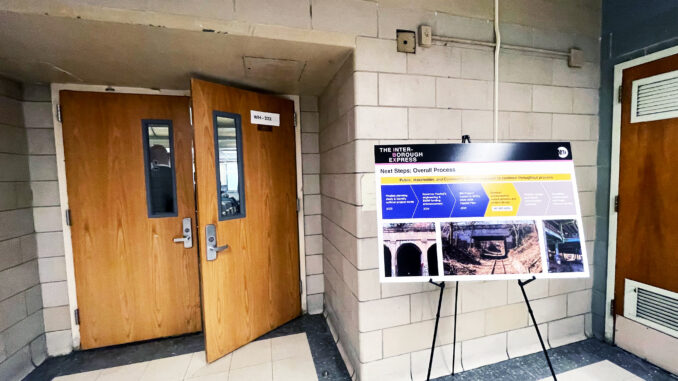
The Metropolitan Transportation Authority (MTA) is one step closer to connecting the outer boroughs. On Nov. 12, the agency held the last of three meetings to kick off its environmental review process on the Interborough Express (IBX), a proposed transit line running from Sunset Park in Brooklyn to Jackson Heights in Queens.
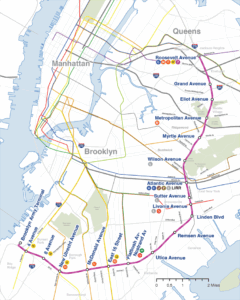
The IBX will use light rail trains, as opposed to the heavy rail that makes up the existing New York City subway system. Light rail is smaller, lighter, and has slightly lower capacity. To reduce construction time and cost, the IBX will also run along existing freight rail lines. Trains are projected to run every 5 minutes during peak times, and every 10 minutes off-peak, according to the MTA.
The MTA has already earmarked funding for the project through 2029. These environmental review meetings served to explain the scope of the project to residents of Brooklyn and Queens and to receive their feedback.
Along the proposed IBX line is a connection to the Flatbush Avenue–Brooklyn College station. Consequently, the first meeting was held in Whitehead Hall at Brooklyn College (BC). The following meetings were held in Queens and over Zoom. Each meeting began with an overview of the project, then members of the public were invited to give brief comments.
Midwood and Flatbush residents who spoke at the BC meeting were largely enthusiastic about the project, especially the transit connections and potential for new green space. Future BC students can also look forward to easier commutes from Brooklyn and Queens.
Currently, “the commute from Queens to Brooklyn is rough,” said BC student Nicolas Colon. Colon makes a 90-minute trek to campus, including a “detour” through Manhattan and two to three transfers.
“The IBX will open up access to Brooklyn College to whole neighborhoods that, right now, are so far away that it’s almost impractical to go here,” said BC sociology professor Gregory Smithsimon, who is also the director of the Center for the Study of Brooklyn.
There are current BC students who make the 1-2 hour commutes, but the travel time would become significantly shorter with the IBX, which would probably make the school more appealing to future students from these neighborhoods.
At the BC meeting, a few commenters were worried about noise pollution from construction and operations, as well as how well the stations would accommodate seniors and disabled passengers. The MTA is taking steps to minimize noise and optimize accessibility.
Professor Smithsimon, however, says that his main concern about the IBX is its potential success. “It may turn out to be far more popular than we’re able to model and predict.”
Professor Smithsimon compared the project to other “peripheral light rail” projects that have been built along the outer edges of global cities in the past decade, such as the light rail in Paris, France, which has seen heavy ridership.
“You’re not just taking the trips that people might already be taking by bus and putting them on a different mode of transit,” said Professor Smithsimon. “By creating this new pathway through the city, you’re allowing people to go on trips that they wouldn’t have done otherwise.”
Those trips may be for leisure, but they may also connect New Yorkers with jobs that were previously inaccessible.
BC student Sara Mahoney, originally from Bay Ridge, is looking forward to faster service between Brooklyn and Queens.
“I love Queens but rarely go because it is such a schlep,” said Mahoney. “The only train line that runs through Bay Ridge right now is the R, and as many Brooklynites probably know, that stands for Rarely.”
The IBX is also giving current CUNY students an opportunity to study a major new transit project as it is being developed. Students in BC’s Urban Sustainability Program have conducted independent research projects on what Smithsimon calls “the really exciting questions about how a city can work best.”
So far, students have studied the planning done by local community boards and how the IBX may integrate with new and existing bicycle infrastructure.
“It’s really exciting, as a New Yorker, to be around at a moment when the MTA is moving quickly with a project as important and transformative as the IBX,” said Professor Smithsimon. “And even more exciting to be part of Brooklyn College, which is going to benefit so much from this project.”
According to sociology professor Tammy Lewis, who directs the urban sustainability program, “The IBX will increase access to Brooklyn College by making it easier and faster for more students from Queens and Brooklyn to attend BC. The IBX has the potential to boost economic development around the college, increase transit equity, reduce car dependency, and add green space along the tracks.”
The environmental review is being conducted simultaneously with design and engineering, according to the MTA. Once the 18-month review is complete, the MTA will look to award a construction contract.
As the process advances, there will be further opportunities for public comment.
The MTA is holding public town halls on Nov. 19 in Queens and Nov. 20 in Brooklyn. Feedback and comments can also be submitted online. Further details are available on the MTA website.
Students interested in learning more about BC’s urban sustainability major can reach out to the director, Tammy Lewis, at tlewis@brooklyn.cuny.edu.