
By: Renae Visico
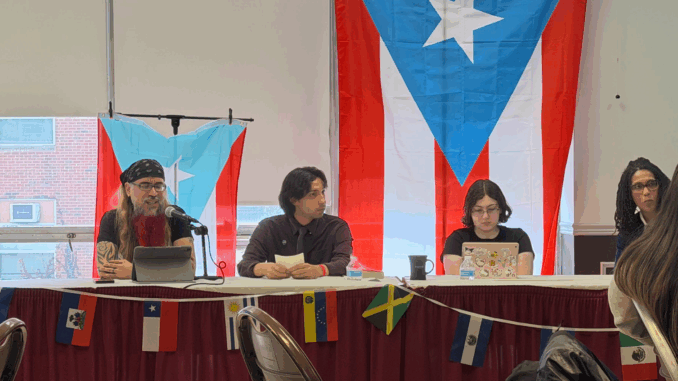
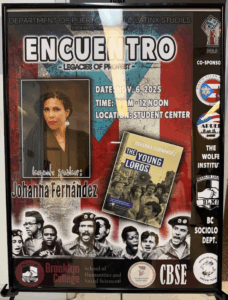
The Amersfort & Bedford Student Center was filled with chatter and joyful Spanish music. On Nov. 6, Johanna Fernandez hosted a panel about the revolutionary Young Lords during the Puerto Rican and Latinx Studies (PRLS) Department’s 19th annual “Encuentro: The Possible Dream.”
Fernandez is a current U.S. history professor at Baruch College. In 2020, she published a book titled “The Young Lords: A Radical History”, chronicling the history of The Young Lords as a revolutionary organization that fought for social justice for Puerto Ricans, similarly to the Black Panther Party during the same time.
The theme of Encuentro this year was “Legacies of Protest — Honoring the Shoulders We Stand On.” Fernandez’s speech connected the impact of the Young Lords’ protests to current applications in our evolving political climate.
“When illness laid bare human vulnerability, they learned the quiet violence of institutional racism,” Fernandez explained what drove the formation of the Young Lords. “What they felt in those waiting rooms, the fear, the shame, the sense of not belonging, was deeper than poor treatment.”
Fernandez argued that the Young Lords were not fighting for a cause that existed in a vacuum: everything they experienced could be traced back to deeply rooted classism and racism in the U.S. government.
“The Young Lords understood that injustice could not be managed from within the system,” said Fernandez. “It had to be transformed, they argue, through a revolutionary process.”
Fernandez continued to describe the various ways the Young Lords took action to revolutionize on a local scale, including blocking traffic to protest citywide lead poisoning, occupying a church and transforming it into a community hub for children, and initiating a liberation school where members taught the history of Puerto Rican independence.
“In many ways, that project at the church was a precursor for the Puerto Rican studies program here at Brooklyn College, Baruch, and elsewhere,” explained Fernandez.
Fernandez emphasized the Young Lords’ impact on citywide hospitals, since their experiences in medical settings led them to take action in the first place. She discussed how they drafted the first known “Patient Bill of Rights” and launched an addiction treatment program that marked the first stepping stone towards the Western world’s widespread use of medical acupuncture.
“They expanded the meaning of democracy and common goods. And made revolution look like community care,” said Fernandez. “The Young Lords weren’t just fighting for better hospitals, walking the streets. They were struggling to understand themselves and their history and place in the world.”
The Young Lords found some of their answers through examining just how intertwined U.S. and Latin American history really is.
“The presence of migrants from Latin America and the United States today is a direct consequence of that same history, of displacement born of U.S. economic domination, militarism, and the political instability they leave behind,” explained Fernandez.
Fernandez connected the legacy of the Young Lords’ fight for Latinx social justice to current events, including immigrant demonstrations in 2006 that demanded more rights in the U.S., and even outrage over the announcement of Bad Bunny’s 2026 Super Bowl Halftime Show performance.
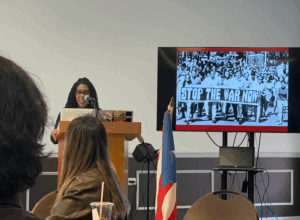
“Puerto Rico’s ongoing colonial condition, and the long history of English was imposed on the island as a tool of domination,” said Fernandez.
Fernandez concluded her speech by connecting American social justice to foreign affairs, extending to the conflict in Gaza.
“The Young Lords’ vision remains urgently relevant today, that the liberation will not be handed down from above, but built from below through solidarity,” said Fernandez. “Through struggle, through the collective imagination of ordinary people who refuse to accept the world as it is. The Young Lords remind us that resistance is not a relic, but [a] living tradition.”
Fernandez’s speech was followed by a live interview conducted by panelists PRLS professor Mike Mena, senior Ismael Bustelo, and first-year student Elianna Tsigler.
Tsigler asked Fernandez how she was inspired to write a book about the Young Lords, and Fernandez recounted how surprised she was to find that no research had been done on the group by the time she learned about them in college. She was then inspired to write the first dissertation about them, which progressed to conducting interviews with them to write her first book.
Professor Mena asked Fernandez to compare the efficiency of the Young Lords’ militaristic approach with that of modern protest groups’ democratic approach.
“In many ways, this structure of organizations like the Young Lords and Black Panthers mirror the revolutionary ethos of the period. That’s why they have a militaristic structure,” answered Fernandez. “The question of democracy in an organization has to constantly be tested and interrogated, and I think that the best antidote is the notion that we are all leaders. We are all needed in processing change to transform ourselves, society, and beyond.”
Bustelo’s question especially struck a chord with audience members when he asked Fernandez what specific methods, strategies, or ideologies she thinks BC students should study today.
“Well, the question is always, where does power lie in society? How can we leverage power to win reforms and to make issues that are usually ignored by the media front and center?” responded Fernandez. “I think that organizing locally, engaging people, and grassroots organizing has within it an enormous amount of creativity that can help us leverage power to transform society.”
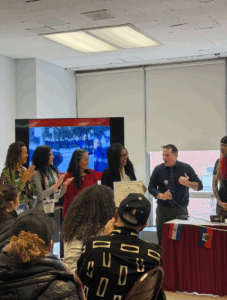
The live interview was followed by a presentation of the “Good Trouble Award” to Johanna Fernandez and Puerto Rican Association (PRA) leader Miguel Figueroa.
The “Good Trouble Award” is given to students and faculty who embody the PRLS Department’s ideas of resistance and solidarity highlighted in this year’s Encuentro.
“Where we’re at right now in campus politics, especially in Brooklyn College, there is a very large effort to fight a war on all student life and protests, all student solidarity and expressions of identity,” said Figueroa. “We need to be willing to show solidarity to one another and learn from the lessons of the past.”
After Fernandez’s panel, students felt like they had better ideas and strategies to become better allies, not just to the Latinx community, but for any marginalized community that needs their voices heard.
“I’m from the Bronx, and I live in Harlem now, so I find what they’re talking about now is still currently going on in this world,” said senior business student Briana Lopez. “It’s important to speak about it, advocate, learn, and help others as well.”
“I’ve been spending my time trying to replicate what tedious protests I was doing, but that wasn’t working,” said junior psychology student Masiel Matute. “We could always personalize our protest, but also evolve and change our tactics and approach to them.”
Students interested in the PRLS Department can visit Boylan Hall 1205, follow their Instagram: @bc_prls, or check the BC official website.