
By: Kira Ricarte
On Oct. 31, the Brooklyn College (BC) Theater Department held the opening night of “Marcus; or The Secret of Sweet”, the last play of the Brother/Sister trilogy written by Tarell Alvin McCraney, best known for writing and adapting the play that inspired the 2016 film “Moonlight”.
In the play, the 16-year-old titular character, Marcus Eshu, lives in the public housing projects within the fictional city of San Pere, Louisiana, in the early 2000s, just before Hurricane Katrina. Marcus, played by BC Student Zander Peña, seeks answers about his strange dreams about his late father Elegba, whom his mother, Oba, avoids talking about, and other traits of Marcus’s personality. This includes a recurring “sweetness”, from his closeted sexuality to his unusual dreams, which mainly feature a man in a white robe, urging Marcus to “tell” someone the things he is saying. This becomes vital as Marcus bonds with Ogun Size, portrayed by BFA Acting student Bambo Coulibaly, who was a friend of Marcus’s father.
But getting the truth about these topics becomes a struggle for Marcus. The writer employs dramatic irony with the character’s dialogue, leaving the audience in the know of many truths the characters are choosing to keep hidden. For most of the play, characters will stop themselves before revealing long-buried truths they believe are better left unsaid or merely implied through coded language.
This collective silence and refusal to discuss forbidden and stigmatized topics leave Marcus naïve and vulnerable to people who seek to take advantage of him and the people he cares about.
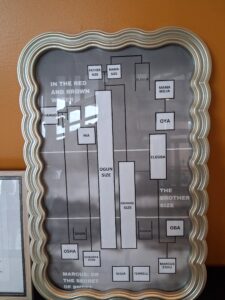
The director of this production, Irvin Mason Jr., first encountered McCraney’s plays when he was an undergraduate in college as an assistant director for the first part of the Brother/Sister trilogy, “In The Red and Brown Water”. Years later, as a Directing Fellow for the Drama League, Mason Jr. was given the opportunity to direct this play when the BC theater department faculty reached out to him.
“I thought it was hilarious […] I feel like when I first read the script, it felt like I knew Marcus really well,” said Mason Jr. “Marcus is not just a facet of myself, but the facet of every young black boy coming to terms with who they are, their sexuality, all these things […] My first reaction was that this story needs to be told.”
Mason Jr. shared he had a positive experience working with the cast and crew of Marcus at BC.
“Oh, it was amazing. Working on a show at a school or institution, or university is very special ‘cause it reminds you how much fun we find in the reading and how much fun we find in working together and doing theater,” said Mason Jr.. “I think sometimes when you get to a certain level of this profession, you kinda forget to find the joy that’s in it. And this cast has centered so much joy in it.”
The fun and joy of collaboration felt in this production was felt throughout the team. Wells Thorne, a prominent set designer for BC productions, shared how much she enjoyed working with Mason to exchange ideas about designing the play’s physical world.
“Irvin was great! From the beginning, he was a great person to work with. He always seemed so excited about my ideas, and anything he added on or thought of, it completely made sense to me,” said Thorne. “The initial version of the set was pretty different from what we wound up with, and I think that’s just what came of us [‘yes, and’-ing] each other. Like ‘how about we have this?’, and ‘Yes, and we also have that’, and this world sort of evolved between the two of us together.”
One of Thorne’s earliest ideas for the world of Marcus onstage was to add old-fashioned faux wrought-iron panels reminiscent of the historic French Quarter in New Orleans. Inspired by a housing project pre-Hurricane Katrina, it was reminiscent of many other housing projects that were destroyed by the city after the hurricane.
As Thorne dove further into her research into the Greater New Orleans area, the Louisiana bayou, and the urban housing projects that people lived in to make the world of San Pere, she also found a historical role that ironwork played in African American history, which makes the wrought iron choice all the more significant.
“The more I looked into [the ironwork], the more I learned about how the wrought iron and the art of making wrought iron has been entangled with the Black community in Louisiana and South Carolina and areas like that for generations, because it was originally something that enslaved workers would specialize in and then something that freedmen would use to support themselves,” said Thorne.
“So, the history of wrought iron in this area is hugely tied with the history of the Black community, which I did not know in the beginning when I was deciding to put it in the set. I was going off of the research images. But, that was super interesting.”
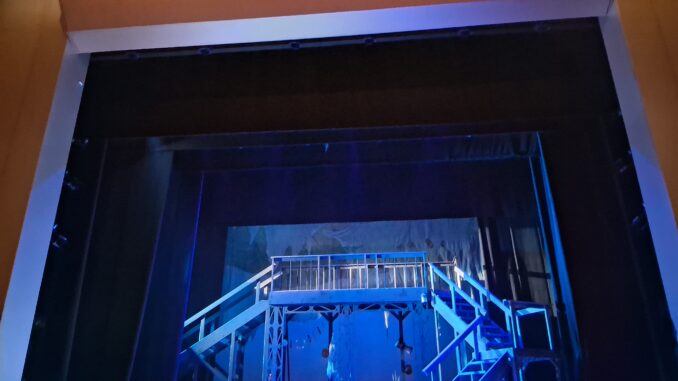
As a result of the creative collaboration of theater artists and the extensive research that went into six months of designing and producing, the cast and crew transformed the Buckwald stage. Thorne and Mason Jr. created a dynamic and dreamlike set with two wooden staircases leading up to a raised platform with a plain balcony railing. Faux wrought iron panels below the platform frame a wooden walkway that characters use to enter and exit the stage at various points of the play. Tufts of grass grow underneath the platform. Traditional African instruments hang from the wooden beams, along with a small lantern that glows green whenever Marcus dreams of the man in the white robe. A bench sits on downstage left, which Marcus uses as a bed at the beginning of the play.
Whenever Marcus enters the bayou, the set becomes completely otherworldly, with torn curtains made to resemble the environment’s dense and unusual foliage descending from the fly system; smoke hovering over the stage; and a glowing stump of a swamp cypress tree brought onstage. The wooden staircases become a kind of anchor, connecting San Pere to the bayou; the manmade and the ordinary are connected to the mystery of the unknown and what remains buried under the silence.
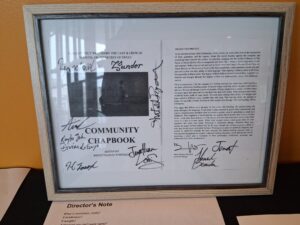
When the director was asked what he wanted audiences to take away from the play, Mason Jr. stated that he doesn’t like telling audiences exactly what to take away from his shows. He hopes that the show prompts audiences to ask questions. His director’s note in the play’s program is structured as a poem full of questions, such as “What does it mean to be sweet /in a world that asks you to harden? /…What happens when the question itself becomes the prayer?”
Mason Jr. admits in the director’s note that he doesn’t have the answers, and for the audience watching this with the most basic of context, “Marcus” can be a confusing play with localized dialects and indirect language utilized to discuss or avoid dark topics such as death and homophobia.
But asking questions and staying in the unknown, trying to find the truth, is the point of this play, and something Mason Jr. encourages. In the last two stanzas in his director’s note, he wrote, “Maybe the question isn’t what The Secret of Sweet is, / but what sweetness stirs awake in you. / May you listen. / May you wonder. / May you feel something move– / even if you don’t have a name for it.”
For more information about upcoming shows from the BC Theater Department, go to @bctheatercuny on Instagram.