
By: Eddy Prince
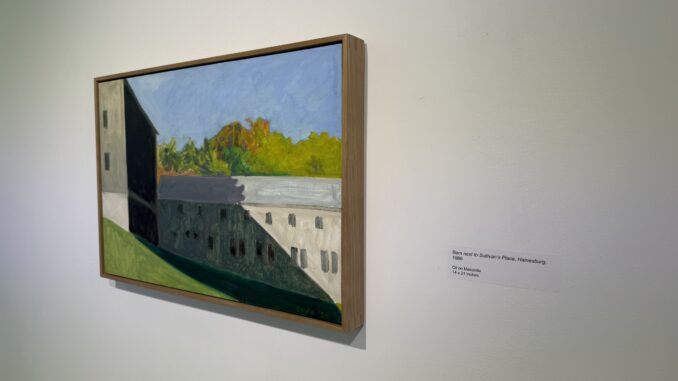
On Tuesday, Feb. 24, Lois Dodd, along with three of her former students, mentors, and friends, held a Zoom panel meeting to commemorate the opening of “A Radiant Simplicity” and celebrate Dodd’s life and career. Among the attendants were her friends and fellow artists Diana Horowitz, Elizabeth O’Reilly, and Jeff Epstein, as well as Dodd herself, and the panel discussion was moderated by Dodd’s personal friend and fellow arts professor Janet Carlile.
“When Brooklyn College (BC) was built in the ’40s, Robert Wolfe was the chairman, and he and Milton Brown were instrumental in hiring some really great American painters. Later, our new chairman Morris Dorsky […] carried this tradition of excellence forward by hiring Leigh Bontecue, Leonard Anderson, Lois Dodd, and many others,” said Carlile in her opening remarks. “I was hired at that same time. […] In the ’70s and ’80s, [the Fine Arts Department] was a powerhouse, teaching excellence, innovation, creativity, with a commitment to nurturing the next generation of artists,” Carlile continued. “Lois and I both marveled at how lucky we were […] to teach in the early 1970s.”
Elizabeth O’Reilly, one of Dodd’s guests, was a former student of Dodd. O’Reilly eventually worked alongside her at Brooklyn College in the 1990s & released 10 exhibitions with Dodd. O’Reilly shared some stories of her time with Dodd, often spending the weekends painting at Dodd’s hours in Blairstown, NJ.
“We can say amazing things about [Dodd’s] paintings, but her character is just exemplary, and she’s just, she’s kind, she’s low key. There’s no bells and whistles,” said O’Reilly.
“[Dodd] would invite the painters who wanted to paint on site to come out to her house in Blairstown on the weekends […] I would say ‘non-hierarchical’ is the word I would use for Lois. It was never, ‘she was the teacher, we were the students.’We were all equal.”
“I remember being up at Truro [Center for the Arts] at Castle Hill. [At the end of the day], [Dodd] had dinner with us, and then she brought us to the beach, and there was some kind of special moon […],” said O’Reilly. “When we got back to our house, it was 10 o’clock, and Lois pulled out her paints. She wanted to paint the moon at 10 o’clock, from what she remembered. I would have readily gone to bed, but I was ashamed. [So] I thought, ‘Okay, I have to pull out my easel too.’”
“This is a sort of pattern that Lois has,” said Jeff Epstein in agreement. “Lois does not like sloth. If you invite somebody to go paint with you […] you go paint.”
Epstein, another one of Dodd’s colleagues who has collaborated with both Dodd and O’Reilly on group exhibitions, most notably “Painting The Moon & Beyond,” was initially taken aback by Dodd and her shrewd observations.
“Lois sort of just walks in the room and starts critiquing,” said Epstein. “After about a month of this, Lois says to me, ‘You know, your work is awfully glib.’ I had to wait until I got home, and could run to my dictionary to look it up, and it meant fluent or facile, but lacking in real depth or conviction; shallow, insincere. So the next day at school, I saw Lois at the end of the hall. I went running after her, saying, Who are you calling glib?’ And she explained that initially, she was sort of impressed by the way that I dealt with the figure, but she had the feeling that I would be doing whatever it was I did, no matter what the model was doing. So I thought, ‘Oh, all right.’ So I paid a little more attention to what was going on with the model, and we got along fine after that.”
Dodd’s third guest, Diana Horowitz, studied under Dodd in the latter half of the 1980s and taught alongside Dodd for her final year before Dodd retired from teaching.
“When I was inducted to the National Academy in 2003, the National Academy was almost all white men,” said Horowitz. “Lois was one of the few women.”
Dodd is considered to be a pioneer in the world of female artists. She has been the subject of more than 50 solo exhibitions since 1954, a time when female artists didn’t receive the same opportunities and recognition as their male counterparts.
“The club was definitely a men’s club, but those were the abstract expressionists,” said Dodd about the lack of female artists. “The figgies, who opened up somewhat later, they allowed women in the group. But a little bit later in time, there were more women figurative painters.
‘The Club’, also known as ‘The 8th Street Club’, was the colloquial name of the group of postwar artists from New York City, who often blended figurative art and abstraction.
Dodd, along with names like John Ferren, Franz Kline, and Bill de Kooning, found a community within this organization.
Meanwhile, “The Figgies,” another group of artists who largely practiced figurative art, began in the twilight years of “The Club.” Alex Katz, a well-known “figgie,” has known Dodd for years, having met at the Cooper Union.
“It’s interesting about Alex’s paintings because he always was figurative, and he was kind of doing something that nobody else was doing, early, back then,” said Dodd in a 1988 interview with Barbara Shikler. “He was kind of challenged, often. The way he painted didn’t seem to—wasn’t quite serious. He wasn’t taken as being a serious painter by a lot of people.”
“The Club had been going on before we even started,” continued Dodd in the same interview. “It functioned as a place where people came in at a certain point in the afternoon, and they would run into somebody else, and conversations would take place. It was just terribly interesting. Everybody would go over to the Artist’s Club and hear the talk […] They talked their way through from five o’clock ’til midnight at the very least. If you wanted to see people and talk, you knew exactly where to go.”