
By: Renae Visico and Kaniz Samiha
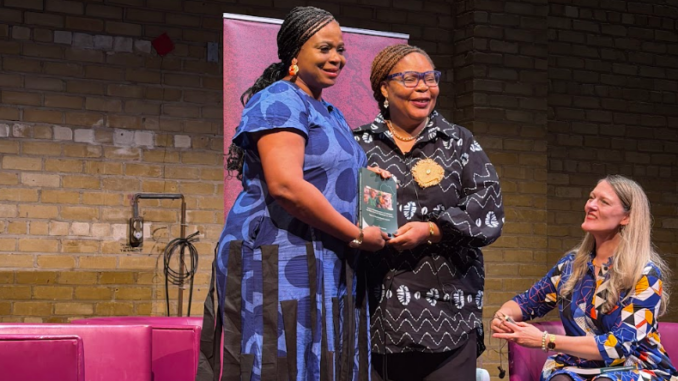
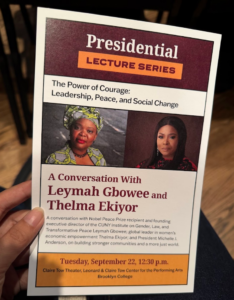
On Tuesday, Sept. 23, Brooklyn College (BC) President Michelle J. Anderson sat down with women’s rights advocates Leymah Gbowee and Thelma Ekiyor at the Claire Tow Theater commencing the first Presidential Lecture of the academic year.
During the Presidential Lecture Series, President Anderson hosts conversations with high-profile leaders throughout the academic year in order to inspire students to spark civic change in their daily lives.
Gbowee, a Nobel Peace Prize recipient, is known for the successful “Women of Liberia Mass Action for Peace” movement, which united Christian and Muslim women to advocate for an end to the Second Liberian Civil War in 2003.
Ekiyor is a lawyer and social entrepreneur who co-founded many organizations to help underprivileged women develop entrepreneurship and peace-building skills, including SME.NG, the West African Civil Society Institute, and Afrigants.
The lecture started off with Gbowee and Ekiyor discussing the inspirations behind their work. Gbowee explained how her experience organizing young women in Liberia during the 2003 Civil War influenced her current peace-building strategies.
“In Liberia, specifically, we had a saying that everything [in] politics belonged to a man,” said Gbowee. “Peace building felt like dirty politics. […] so we took the women’s building network concept back to Liberia, localized it, and we started that organization basically to empower women.”
Ekiyor was particularly inspired by the women’s peacebuilding networks she has seen in Nigeria. Although she and Gbowee have been close collaborators, they have different responsibilities in building peace networks, which she highlights to convey that activism is open to people of many different capabilities.
“If you are a brainiac or you are a nerd, don’t feel bad. There is a place for you in activism,” said Ekiyor. “I enjoy the writing, research, and the putting together. […] You have to respect everyone’s strength and what everyone brings to the table. If you are a troublemaker, make trouble, and I will write about it.”
Gbowee and Ekiyor both emphasized the importance of increasing women’s access to economic resources so they can be politically empowered. Ekiyor shared how her work co-founding and leading women’s entrepreneurship organizations was inspired by her experiences educating Nigerian women about civics.
“ [Nigerian women] were telling me about their lives and I was so emotional,” said Ekiyor. “Somehow, they knew the language of rights and equity, and they’re still poor. And I said to Leymah that this is what we have to change. That’s what made me go back and get an MBA.”
Following the lecture, students and attendees had the opportunity to stay and connect with one another over refreshments.
Rebecca Turay, the daughter of Sierra Leonean immigrants, shared that her parents came to the United States primarily to escape the civil war that began in 1989. She expressed that growing up, she witnessed the war’s effects on women in her community and recognized the need for greater empowerment.
“I had noticed that women’s rights, or I guess the need for women empowerment, was needed because of how all the women around me were so defeated because of the war,” said Turay.
After hearing Gbowee and Ekiyor speak about their experiences, Turay states that she hopes to bring what she learned back to Sierra Leone.
“I want to ignite the motivation within them,” Turay said, referring to the women she hopes to inspire one day through what she learned from the lecture.
Other audience members reflected on the lecture with totally different perspectives. For Janet Elise Johnson, a former endowed Chair for Women and Gender Studies (WGST), and now a professor of Political Science at BC , what changed was not her perspective, but the world that we live in.
“The world has changed so much. When this institute was about a decade ago, we were optimistic about the possibilities for change, and things have gotten very scary right now with a lot of major wars,” said Johnson.
Building on Professor Johnson’s reflections, Berneardita Llanos, the interim director of WGST at BC, shared broader observations about her students’ fears, especially now, when they see things as very dark.
“[For those who are] particularly uncertain regarding the future, I think the relationship of peace and building peace and how it aligns with hope was super clear,” said Llanos. “I think students don’t always realize how close we are to the UN General Assembly, and what happens there, and the community that this community has to people making real important changes.”
As the conversation came to a close, attention turned towards the message that President Anderson hoped students would carry with them.
President Michelle J. Anderson hopes students are inspired by the experience that these women have had personally and generated in the world. She emphasized that creating change does not always require taking on a huge global role; it can begin within one’s community.
She encouraged students to recognize the influence they can have in their own “backyards” and to use that to inspire others.
For the attendees, the lecture offered more than stories of the past. It left the audience with a reminder that courage, hope, and action can begin with believing in what we stand for.
“They aren’t just passive participants in the world; they are actively making things change, and they’re committed to it,” said Anderson. “It requires a kind of perseverance, commitment, and hope.”
For more information regarding the Presidential Lecture Series, visit BC’s official website.