
By: Michelle Zhen
On Oct. 7, in room 411 of the Brooklyn College (BC) Library, sixty chairs were set up for audience members to watch six panelists discuss the past, present, and future of Spanish-English bilingual learning. The Wolfe Institute collaborated with the Puerto Rico and Latinx Studies Department (PRLS) on the “Teaching Children’s Literature in Spanish: A Libros Solidarios and En Comunidad Celebration of Books,” event.
Assistant Professor Carla España led the discussion with commentary on the books “Libros Solidarios: Teaching Language and Building Community with Latine Children’s Literature in Spanish K-6” and “En Comunidad: Lessons for Centering the Voices and Experiences of Bilingual Latinx Students”. She co-authored both books with Luz Yadira Herrera, a bilingual Associate Professor at California State University, Dominguez Hills, and the book received official Spanish translations this year.
“I have Professor España, [who] published the two books,” BC student Yuryleisy Peña explained. “Half of the people there were my professors.”
Professor España noted how she first intended her book “En Comunidad” to be released in English and Spanish simultaneously, yet the uncertainty of publishing success in the gap between the English and Spanish releases prompted a six-year delay between its initial English release and its Spanish translation. The publishers offered to release the book in Spanish in 2025, and the translation became publicly available a year later.
The other panelists included author Emma Otheguy, BC undergraduate Manuel Martínez Valdez, and elementary school teachers Hortencia Portillo, Maricruz Sánchez Hernández, and Amía Soto-Carrión. While introducing themselves, some recalled limited access to Spanish books outside of translated texts from church, while others spoke of their parents frequently reading Spanish children’s books to them. All six panelists mentioned their experiences teaching Spanish to children.
Otheguy presented her writings in the context of Latin America, its diasporas, and New York City’s history. The teachers discussed how they integrated Spanish and Latino poetry, picture books, and other forms of literature into their classrooms.
“I love reading. I love bilingualism. I myself speak two languages,” explained BC student Katryna Alexis. “Even though I grew up in a monolingual home, [I always] thought [bilingualism] was the coolest thing in the world. And so, one day, I hope to inspire my students, who are already bilingual, to use that superpower and to grow it. […] This event lets me see the different options that are available for that. See what work is currently being done and how I can add to it once I graduate.”
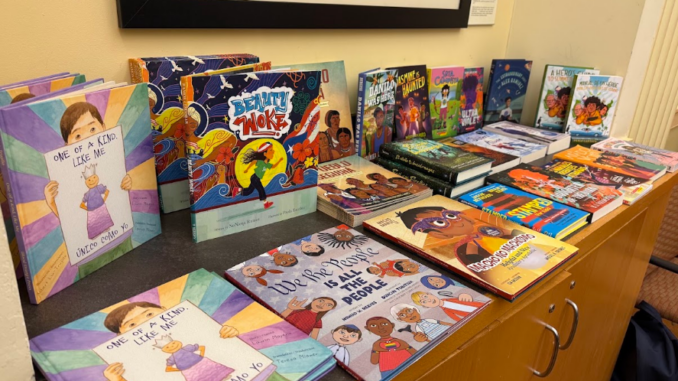
Following the conclusion of the main event, attendees spoke to the panelists who answered their questions and signed their books. Copies of “En Comunidad” were distributed in both English and Spanish, and many people who took copies obtained signatures from Professor España in person. The event also provided and distributed Spanish and English books from other Latin American authors, with a variety of target audiences and genres, to excited attendees.
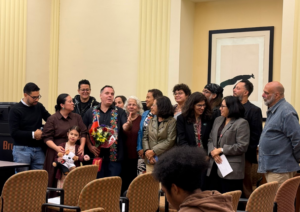
“I really liked [the event] because I was able to interact [with the panelists]. I haven’t been able to see my professors […] So it was nice to see them again and learn where they’re at now because, last time I saw them, it was, like, a year ago,” Peña said.
Atop every seat of the venue sat three papers: one describing the panelists’ backgrounds, one about the “New Books by HSS Faculty Series Fall 2026”, and one listing upcoming events in the “Series on The Global Caribbean: Deep Waters, Strong Roots” and “The Wolfe Institute’s Series on Immigration”. Events for the three series span both October and November and take place in Boylan Hall, the BC Library, or over Zoom.
Once she spoke with the panelists and took a copy of “En Comunidad”, Alexis immediately started brainstorming how she could apply the event’s information to her work and studies in early childhood education at BC and beyond.
“I felt very inspired by [this event],” Alexis told the Vanguard. “I am hoping that, after this, I’ll be able to use bilingual literature [and education as] a superpower in my future work as an educator of drama, but also in my general education degree as well. And practice as well.”
For more information about the Wolfe Institute and PRLS, visit their websites: https://www.brooklyn.edu/wolfe/ and https://www.brooklyn.edu/prls/