
By: Josiah Sanon
Advertisements are meant to receive attention and get people talking. Recently, companies have lacked consideration for whether that attention or discussion is positive or negative. We are seeing the rise of dogwhistles in the fashion industry, specifically with the latest and most controversial being the newest Converse ad.
“Dogwhistle” is a political term describing subliminal messages in media that subtly signal support for a certain group or movement. Popular shoe company Converse released an ad campaign that has been a hot topic of discussion and has been called out for being one of these dogwhistles, particularly to anti-black conservatives.
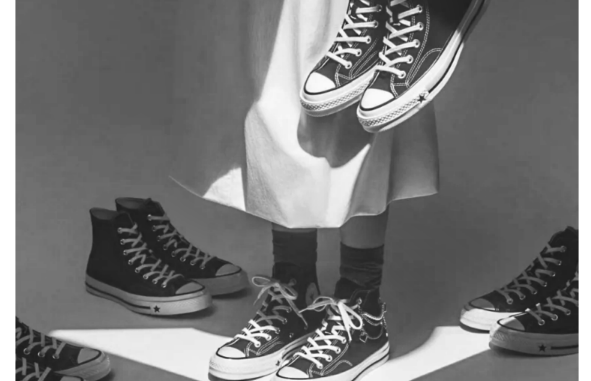
The ad was a collaboration between Chuck Taylor and Run Star Crush Sneakers, which featured a dark room with a star-shaped light illuminating the white dress of K-Pop singer Karina of Aespa holding up another pair of Converse.
One of the points of the star light falls on the model’s dress in the shape of a triangle, which people on one side of the discussion have been pointing out is reminiscent of the hood of Ku Klux Klan (KKK) members, while the pair of shoes being held are reminiscent of a suspended pair of feet in reference to the long history of lynchings in the United States.
The imagery in this ad has offended a large part of the Black community, while non-black people went on to label the criticism against Converse a giant “overreaction” and even put the fault on Black people for their reaction. The ad was eventually taken down, and Converse themselves made a formal statement to PEOPLE magazine stating,
“We’re sorry. We understand why this image was deeply upsetting and recognize that we got this wrong. We removed it from our channels and are working to remove it from our channels, and everywhere it appeared. This should not have happened, and we will do better.”
Nonetheless, the damage of a dogwhistle cannot be undone, and yet it was done the minute the imagery of the ad was brought up and called out.
When large swaths of the Black community, a group of marginalized people whose problems are already very rarely taken seriously, call out something like a dog whistle, people are all too quick to label it just a problem of sensitivity. The subliminal messaging of dog whistles has enough plausible deniability to make anyone who calls them out look like they are overreacting. This makes it less likely that bolder and more upfront messages of hate, and in this case anti-Blackness, will be taken seriously in the future.
Dogwhistles may seem minuscule, but as they become more prominent, it is important to recognize their impact rather than labeling negative reactions as a problem of sensitivity or a sign of ignorance. If we ignore the impact, racism will fully start to fly under the radar and be more normalized in our day-to-day lives, undoing what little progress Black people have made in trying to gain equality and basic respect. The anti-Black dog-whistling in the fashion industry doesn’t start or end with Converse, however, as anti-black motifs and imagery can be found in many other fashion ads or even fashion pieces themselves
“The Perfect Man” is a fashion magazine first published in 1998, and in 2023 they collaborated with photographer Ferran Casanova for their Fall Issue in a collection called “Latin Lover”. One of the first images shows a fully clothed, light-skinned, non-Black model holding a banana-shaped bag while embracing a dark-skinned Black model facing away from the camera, looking over the other model’s shoulder and wearing nothing but a yellow speedo to match the banana handbag.
Black people are often compared to or flat-out called monkeys as a way of dehumanizing them and dubbing Black features as inherently animalistic. The banana imagery, coupled with the fact that the Black model is wearing less clothing and his face isn’t put on full display like the lighter models, invokes the very racist monkey comparison as well as dehumanizes the Black model in every aspect.
This is a fashion magazine where men are made to feel and look beautiful, as the name “The Perfect Man” suggests, so why is the only Black model in this magazine not wearing an actual outfit and not having his face on display like his lighter peers?
The Black model is stripped down and isn’t given the same dignity or respect the other models are and is almost relegated to just another accessory or fashion piece rather than a person. Little messages and images like Converse’s ad or even this magazine come from the same place of ignorance that Gucci’s blackface sweater came from in 2019.
Luxury fashion brand Gucci released a sweater in 2019 that was stark black, with a mouth hole surrounded by red, and an overall shape resembling lips. This sweater was instantly called out, and Gucci promptly took the piece off its website and released an apology.
The use of anti-black imagery in fashion is a continuous cycle no matter how many apologies are issued and how many times these companies claim to want to “learn from their mistakes”. When more upfront shows of anti-blackness like Gucci’s sweater are actively called out, subtler dog whistles like Converse’s ads and Perfect Man Fall 2023 magazine are released to seemingly prepare the public for another round of bolder racist iconography.
Recently, after the Converse controversy, Target has begun releasing Halloween costumes for kids, and one of its latest costumes is called a “Blacklight Circus Clown Halloween Costume.” This costume featured a Black child in a black and orange bodysuit with a see-through black mask with a top hat and wide “clown” smile. The costume is nearly a one-to-one with old minstrel imagery that was one of America’s first and most common racist caricatures of Black people.
Seeing the fashion industry, which is one of the biggest influences on what Americans consider beautiful and socially acceptable, constantly in this cycle of showcasing subtle and not-so-subtle racism —either ignorantly or for the sake of more attention—shows how important it is to really listen to Black people and other oppressed groups when they are offended by something rather than calling them overdramatic.
That kind of response only incentivizes the industry to go even further with these images until racism becomes an integral part of fashion and goes on to reclaim its place as an integral part of our culture.