By: Samuel Mortel
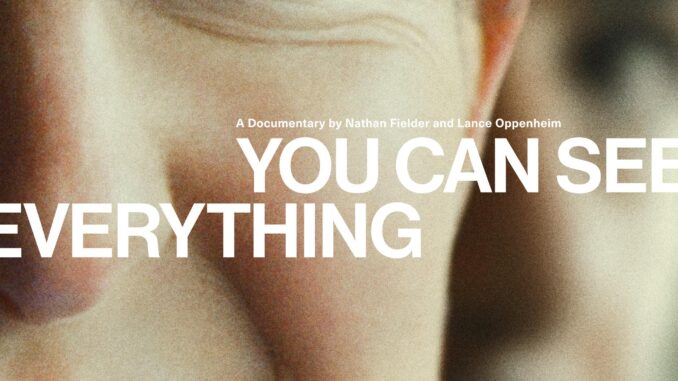
In the 98-year history of the Academy Awards, a documentary has never received a nomination for Best Picture or Best Actress. However, there’s been some speculation that A24’s latest film “You Can See Everything,” a documentary centered around Elizabeth Holmes, could be capable of making history.
“You Can See Everything” is co-directed by comedian Nathan Fielder and documentarian Lance Oppenheim—fresh off his narrative feature film debut “Primetime”. In this collaboration, Oppenheim stays behind the camera for the majority of the film, while Fielder takes the role of an interrogator, an audience surrogate, and, for some stretches, an investigative journalist.
The film’s core subject revolves around Elizabeth Holmes. Holmes was the founder and CEO of health technology company Theranos, which for a time earned her the title of the youngest self-made female billionaire in the world, according to Forbes. However, in 2015, after journalistic and regulatory investigations, it was revealed that her company defrauded investors by faking and exaggerating the success of its technology. In 2016, the former tech mogul became reclusive, refusing to talk to the media. After being found guilty on four counts of criminal fraud, she was sentenced to 11 years in federal prison, which began on May 30, 2023.
However, in the days leading up to her prison stint, Holmes invited Fielder, Oppenheim, and a film crew to live with her family in a rented San Diego beach house, breaking her 7 years of silence and giving them complete access to “see everything.”
What follows is a three-hour-long series of twists, turns, transformations, and revelations, so much so that it’s hard to delve into a majority of the events without getting into spoiler territory. If you want to know whether the documentary is worth a watch, I’ll make it brief: absolutely. Even if you don’t have a particular interest in Elizabeth Holmes, Nathan Fielder, Lance Oppenheim, or the Hulu series “Dropout,” this film will absorb you for all three hours and somehow leave you wanting more.
Despite being a co-director, Fielder himself is almost as much of a subject as Elizabeth Holmes. In fact, the documentary really has four characters that it hones in on, begging you to examine their psyche, including Holmes’ life/business partner Billy Evans, and an Emmy-winning actress whose appearance in the documentary is a bit of a spoiler in and of itself. Fans of Fielder’s HBO show “The Rehearsal” will be familiar with how she’s initially used to recreate and simulate certain scenarios, but eventually the narrative takes interest in the actress as a person. Her performance could land the film in unprecedented territory, as it was revealed that A24 will be campaigning for a Best Supporting Actress nomination, as well as an equally anomalous Best Picture nomination.
For anyone who is a fan of Oppenheim and/or Fielder, this is a generational melding of minds. For Fielder in particular, this feels like a culmination of his life’s work; a sort of reaping of seeds that he’s been planting for over a decade in his shows “Nathan For You” and “The Rehearsal”. For fans of Oppenheim, this film has all the cinematic flair you’ve come to expect from the man who made documentaries like “Spermworld” and “Ren Fair”, complete with several moments that make you wonder, “How did they get that shot?”
The film splits into two distinct parts, with Holmes driving into a federal prison camp in Bryan, Texas, about halfway through. Somehow, without access to their main subject, Oppenheim and Fielder are able to crank up the intensity, transforming “You Can See Everything” from a documentary to a buddy-cop flick, psychological thriller, investigative report, and a spiritual sequel to Orson Welles’ 1973 cult classic “F for Fake.” In the absence of Holmes, Billy Evans emerges as another impenetrable personality for Fielder to try to make sense of.
The relationship between Holmes and Evans is incredibly fascinating. In many ways they’re perfect for each other, but you can’t help but feel it might be to their detriment. They both constantly signal a sort of transparency and vulnerability, but they still seem impossible to fully figure out. This presents an interesting challenge to Fielder, who’s spent so much of his career trying to understand other people: What does he do with two people who refuse to be understood?
It’s a real “immovable force meets unstoppable object” scenario. They’re both caught in a web where they sort of “believe their own hype,” to the point you can’t tell whether they’re telling the truth, trying to deceive, or have lived in their own lie so long they’re starting to believe it. What are we supposed to think when Holmes continues to assert that, to this day, she believes she didn’t defraud anyone with Theranos, or when she even claims that she’s never told a lie in her life? What are we supposed to think when Evans says he and his partner, through a relationship that has lasted nearly a decade, have never argued?
The film raises a seemingly endless series of questions and holds many concepts up for examination: authenticity, trust, the media’s responsibility, ownership of your identity and likeness, a single word’s power to change a whole sentence, and the lack of power over what people think of you. There are several times when a person is confronted with how other people perceive them, whether it’s reading an article about themselves with quotes they don’t remember saying, watching a depiction of themselves that feels unfamiliar, or being confronted with their actions in a heated argument at a dinner table.
There are some laboriously long movies where at a certain point you start to feel the runtime, and with every passing minute you wonder, “Did this really need to be this long? Aren’t there some parts they could’ve cut out?”
“You Can See Everything” gives you the exact opposite sensation. You walk out of the theater wishing there were an extra 10 hours and fantasizing over what might’ve been cut out.
You can’t help but wish you were with the film crew in that San Diego beach house, listening in on a phone call in a New York City hotel room, or a fly on the wall in a federal prison visitation room. There are two instances where Holmes and Evans have private conversations that can only be picked up on hot mics. These conversations and interactions have to be recreated because either there was no reason to record them at the time or because they legally couldn’t be recorded. This is shown in Evans pushing to cut an interview short or even telling the directors to stop recording altogether. For a film called “You Can See Everything,” there are countless points where you’re forced to imagine what you can’t see, or believe someone else’s retelling of an interaction there’s no evidence of. On top of all of these heady concepts, the film offers insight into the mindset driving our current era of tech CEOs.
It’s an absolute achievement in filmmaking, but could it be the first documentary ever nominated for Best Picture? It’s received unprecedented acclaim; as of the writing of this review, it’s the highest-rated film ever on the film review app Letterboxd, and has a 99% approval rating on Rotten Tomatoes and Metacritic.
“You Can See Everything” ranks highly amongst the dozen films I’ve seen this year. It’s a film that changes my perspective as an audience member.