
By: Jackson Rios
Nowadays, if you’ve been around a child for at least five minutes, your ears have likely been subjected to complete nonsense: the plaque of “skibidi,” “rizz,” or the more recent “67,” that the TikTok algorithm had cooked up for the week.
For those of us who didn’t grow up with an iPad glued to our hands, keeping up with the ever-changing vocabulary of Generation Alpha feels like learning a completely new language.
Even though it’s easy to write off much of this internet culture as “brain rot”, understanding it has become increasingly important, especially to engage with the generation while growing alongside it.
Strangely enough, the television show South Park seems to understand this remarkably well.
Created by Trey Parker and Matt Stone, South Park is an American adult-animation sitcom on Comedy Central that follows the adventures of four elementary school boys: Stan Marsh, Kyle Broflovski, Eric Cartman, and Kenny McCormick, in their fictional town based in Colorado.
Since premiering in 1997, the series has become infamous for its profanity and dark humor, never shying away from making fun of just about anything.
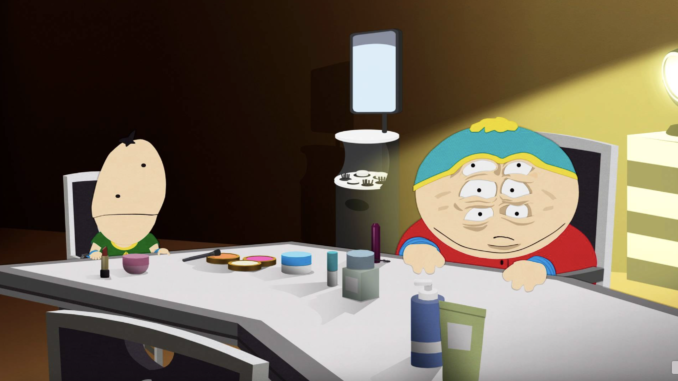
Season 29, Episode 3, “You Like That on Your Face”, which premiered on Oct. 14, 2026, satirizes one of the internet’s most controversial topics: looksmaxxing.
Looksmaxxing is the practice of maximizing one’s physical attractiveness. It originates from male-dominated online communities dating back to the late 2000s and early 2010s, and has since spread across mainstream social media.
Its vocabulary feels like a language of its own: there’s “mewing,” which refers to a tongue-positioning technique supposedly used to define the jawline; there’s “mogging,” which refers to the act of outshining someone in physical appearance; to be a “Chad” means to be the ideal masculine man; and then, of course, there’s “aura,” which describes a person’s perceived coolness or social appeal.
Looksmaxxing can range from ordinary grooming and skincare to often dangerous practices like “bone-smashing”: intentionally striking facial features to change their shape.
While there’s nothing wrong with taking pride in how you look, the culture often leaves young audiences feeling insecure, treating physical attractiveness as the sole measure of their worth.
The episode follows two connected storylines, both about the pressures to look attractive and maintain a certain level of social status. Kyle’s little brother, Ike, becomes obsessed with competing with other students on looks, eventually finding himself up against Chase Chadwick, a parody of American influencer Clavicular.
Meanwhile, Stan discovers Chadmaxx, an Artificial Intelligence (AI) I app that rates users’ attractiveness.
What began as a harmless curiosity quickly spirals into an obsession with his appearance.
After the episode aired, fans praised it online, with some calling it one of the show’s best episodes in years. One Reddit user particularly appreciated how South Park introduced them to current internet trends without having to engage with them firsthand.
I personally respect that the writers didn’t just throw in Gen-Alpha language for cheap laughs, but did the research to understand the culture well enough to make fun of how absurd it is while creating humor that longtime viewers could also enjoy.
As we move into a world where AI becomes more part of our everyday lives, it’s unsettling but not difficult to imagine AI being used to encourage people to be critical of their own appearance.
In the episode, Chadmaxx, the AI-powered rating app, evaluates Stan’s facial symmetry, rates his attractiveness, and, in other words, turns beauty into a numerical measure, making Stan feel as though there is an objective standard he’s failing to meet.
What I found particularly satirical about the inclusion of Chadmaxx is that, rather than simply poking fun at people who want to appear attractive, it exposes how easily insecurity can be turned into a business: the more flaws someone believes they have, the more products they’re recommended to buy.
While Chadmaxx is fictional, the pressures behind it are real.
A 2024 study by Common Sense Media, Harvard’s Center for Digital Thriving, and Indiana University finds that 51% of American teenagers reported feeling pressure to look their best or present a certain way. Among teenagers who experience appearance-related pressures, 79% said social media made it worse at least some of the time.
Social media is already filled with appearance-related content that encourages users to compare themselves to others, often leaving them feeling as though they need to change something about themselves.
Chadmaxx just takes that to an absurd extreme: users are told exactly what is supposedly wrong with their faces.
The episode then makes one of its best pop culture references through Stan and his girlfriend Wendy’s trip to Sephora; what starts as a simple search for skincare products turns into a nightmare when Stan gets lost and eventually finds himself roaming around the store’s seemingly endless maze.
What makes this sequence especially funny is that it draws on the internet-famous Backrooms, a horror phenomenon that eventually inspired its own film adaptation, which is then referenced throughout the episode.
But not only is this funny, but the show plays with a reference that many of its fans and non-fans, regardless of age, are likely to recognize.
However, I think there’s another reason the joke works so well: there’s something universally relatable about shopping with someone who seems to take forever to browse. And like Chadmaxx, South Park takes it to an absurd extreme.
It’s a ridiculous comparison, but that’s what makes it so funny; even if viewers don’t recognize the Backrooms reference, they can still get the humor of being stuck in a store with someone who takes their sweet time.
I also believe that the setting works perfectly alongside the episode’s criticism of beauty culture.

But what makes the episode absolutely comical comes from the storyline of Stan’s father, Randy.
As a father, Randy is initially quick to criticize Stan’s interest in Chadmaxx, arguing that looking good should come from exercise and a good diet rather than letting an app decide your attractiveness. Yet, Randy proves to be just as vulnerable to the pressures of appearance when he becomes drawn to Sephora’s anti-aging products. If anything, his storylines make the episode’s commentary more relatable to its older audience.
It’s a joy to say that viewers don’t need to understand every piece of internet slang to enjoy it. Younger viewers may recognize the trends and references, while older audiences can still laugh at the children competing over jawlines or the show continuing to satirize our political climate.
But beyond the comedy, I believe the episode offers something important: it highlights a concerning issue young people face today. When social media constantly encourages people to compare their appearance, and even AI can rate it, it’s easy to see how these trends can affect someone’s self-image.
South Park makes an otherwise uncomfortable topic easier to identify and talk about by transforming these pressures into comedy.