By: Ameena Khan
Pakistani music boomed across speakers at Rollin Studios in Greenpoint, Brooklyn, as attendees drank chai and mingled with other creatives at the inaugural Pakistani-American Artists’ Convention (PAAC) 2026 held on Nov. 14.
Presented by the American Pakistani Public Affairs Committee (APPAC), PAAC held its first-ever, one-of-a-kind convention and platform for Pakistani creatives to present their work, share their creative journeys, make connections, and to foster a community within a culture where pursuing creative passions is commonly looked down upon.
“Log kya kahenge?” is an Urdu phrase that translates to “What will the people think?” Pakistani artists across the diaspora, or artists with Pakistani descent who live outside of Pakistan, are all too familiar with the rhetorical question.
The phrase “Log kya kahenge” is commonly directed at artists in the Pakistani diaspora, asking what others would think if one chose an unconventional, creative path within the constraints and judgments of a traditional culture.
PAAC’s team included Filmmaker, Organizer, and Director Ali Malik; Creative Strategist and Head of Marketing Zak Zaidi; Event Coordinator Neha Zuberi; Panel Coordinator Aneesa Khan; Art Curator Hassan Khan; and Zayn Ahmed.
“The convention is open to anyone interested in Pakistani and Pakistani-American art, culture, film, music, entrepreneurship, and creative communities,” according to the PAAC website.
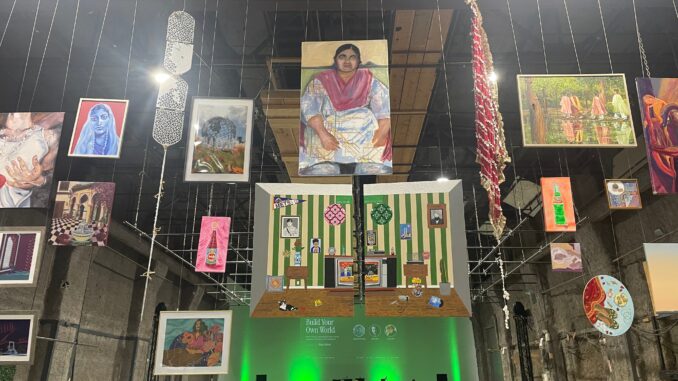
Curated by Hassan Khan, the convention began with an art gallery exhibition open throughout the event, featuring the artwork of various Pakistani artists across the diaspora, as well as a mixer.
Artists featured in the exhibition include Siara Abid, Javiera Ahmed, Aleena Ahmed Asi, Aneela Choudhary, Seema Shakti Choudhary, Hera Jhaveri, Hassan Khan, Javaid Nayyar, Laila Pathan, Simal Sami, Adam Waheed, Fatima Zaidi, and Shamya Zindani.
“This show does not try to define what Pakistani American art looks like,” Khan said in his overview of the gallery. “It makes room for the many ways it can exist.”
“Fourteen Pakistani-American artists fill the space with paint, photography, digital illustration, clay, fabric, and mirror,” Khan stated. “Connected by cultural histories, each artist brings a different practice to life, shaped by their own experiences. PAAC may be just one day, but the connections made here will outlast it.”
When asked about how he got involved with PAAC, Khan told The Vanguard how a friend connected him with the director. Initially, Malik and Zaidi, two filmmakers, had focused on the film aspect of the convention, until Malik proposed a fine arts component of the convention
and the addition of an art curator, a role which would be given to Khan.
“The hurdle of learning how to share your art is very challenging,” Khan expressed to The Vanguard. “Especially when you’re from a Pakistani family, especially when you are told to be a doctor, especially when you’re like, ‘Ugh, I’m making stuff and it’s supposed to represent who I am!’ I don’t want people to walk in and be like, ‘This is what Pakistani-American art looks like.’ I wanted people to walk in and be like, ‘This is so insane.’”
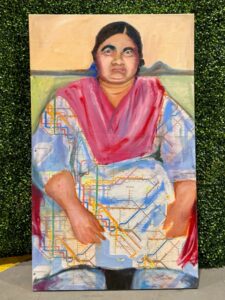
Khan referenced their own piece as part of the exhibition, titled “Nani, log kya kahenge?” (Grandma, what will people say?), an unfinished oil-on-canvas piece depicting Khan’s grandma wearing traditional Pakistani clothes known as shalwar kameez, with the New York City subway map as part of her outfit.
“It’s actually unfinished, because Nani always wore gold, and she always had henna. And what the people are saying is that it really reminds them of their grandma, that this reminds them of their cultural lineage of coming to New York,” said Khan.
“I didn’t know these things were coming through. I just felt like this is something that needed to exist. And it was one of the first pieces, I think, in a long time that I made that really feels like I was discovering something about myself and the work.”
The convention featured four panels: “Build Your Own World” featuring Jahanzeb Khwaja, Saks Afridi, and Usman Riaz, “Conquering the Machine” featuring Taurees Habib and Alisha Zafar, “Making Your Own Noise” featuring Shahjehan Khan, Natasha Noorani, and Misha Japanwala, and finally, “Finding the Frame,” featuring Saleem Nasir Gondal and Aidha Amin Ammad Shaikh.
As a panelist for “Build Your Own World,” Mano Animation Studios Founder Usman Riaz spoke on his decade-long experience directing Pakistan’s first hand-drawn 2D animated film “The Glassworker.”
Riaz said the idea for “The Glassworker” emerged from “a sense of dread growing up” in Karachi, Pakistan, due to conflict and war in neighboring countries following 9/11 and the War on Terror.
“I would draw all the time and play music all the time,” Riaz expressed to the audience, as an animator and composer.
“But I was always questioning, ‘Why am I doing this when the world is falling apart?’ I would say, [“The Glassworker”] came from that feeling, that feeling of being surrounded by conflict and being a creative person and really undervaluing it for yourself because you’re seeing all these things happen around you, and you’re saying, ‘Well, how will this help anything?’”
Yet, Riaz shared a message from Mariam Riaz Paracha, the co-founder of Mano Animation Studios and his wife: “To be an artist, one must create because without art and music, what do we have in this world full of conflict and war,” which is also a line included in “The Glassworker,” highlighting its themes of anti-war and focusing on the suffering humans must endure as a consequence.
The convention also screened three short films: “Post Term,” “Rumi,” and “Just Friends.”
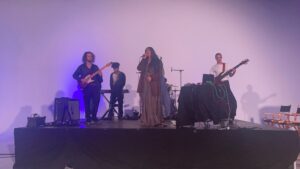
Towards the conclusion of the convention, the closing act featured a live performance by Natasha Noorani, a Pakistani musician and singer from Lahore who archives 20th-century Pakistani music in her archival project, Peshkash, and is the festival director of Lahore Music Meets.
Many attendees expressed satisfaction with how the convention surpassed their expectations, and they look forward to future conventions.
“I wanted to attend and see talented Pakistani artists because I feel like we’re super unrepresented in the media, and I told my friend so we decided to come,” Hajra Muzammal, a graduate student at Baruch College studying statistics, told The Vanguard.
“My favorite panel was getting to see Alisha Zafar. […] Her talking about how, because she’s half Pakistani and also half Irish, how difficult it was getting support from our Irish side was pretty interesting because I thought it would just be Pakistani, but just going into the entertainment industry is difficult for everyone.”
“Being a Pakistani creative, it’s very reassuring to see that people have had, if not the same journey or even similar journeys, you know what they’ve been through and how they’ve endured,” said Fatima Izzat, a wedding photographer who expressed her appreciation of panelists sharing their creative journeys and struggles that resonated with her.
“I wish people knew that Pakistani American art really transcends the game,” said Sania Ilyas, a chemist, who emphasized the importance of Pakistani artists having spaces to share their work and connect with other creatives.
“ People don’t give enough credit for how much South Asian culture, especially Pakistani culture, occupies other creative and artistic spaces in the most [unexpected] ways ever.”
For more information about “Pakistani-American Artists’ Convention,” featured artists, panelists, and upcoming events, you can visit https://paacnyc.org/