
By: Rami Mansi
Since the 1960s, the United Kingdom has solidified its role in pop culture as the home for many legendary stars and musical acts. The Beatles, Spice Girls, Girls Aloud, The Saturdays, and more have all sprung from humble British and Irish beginnings.
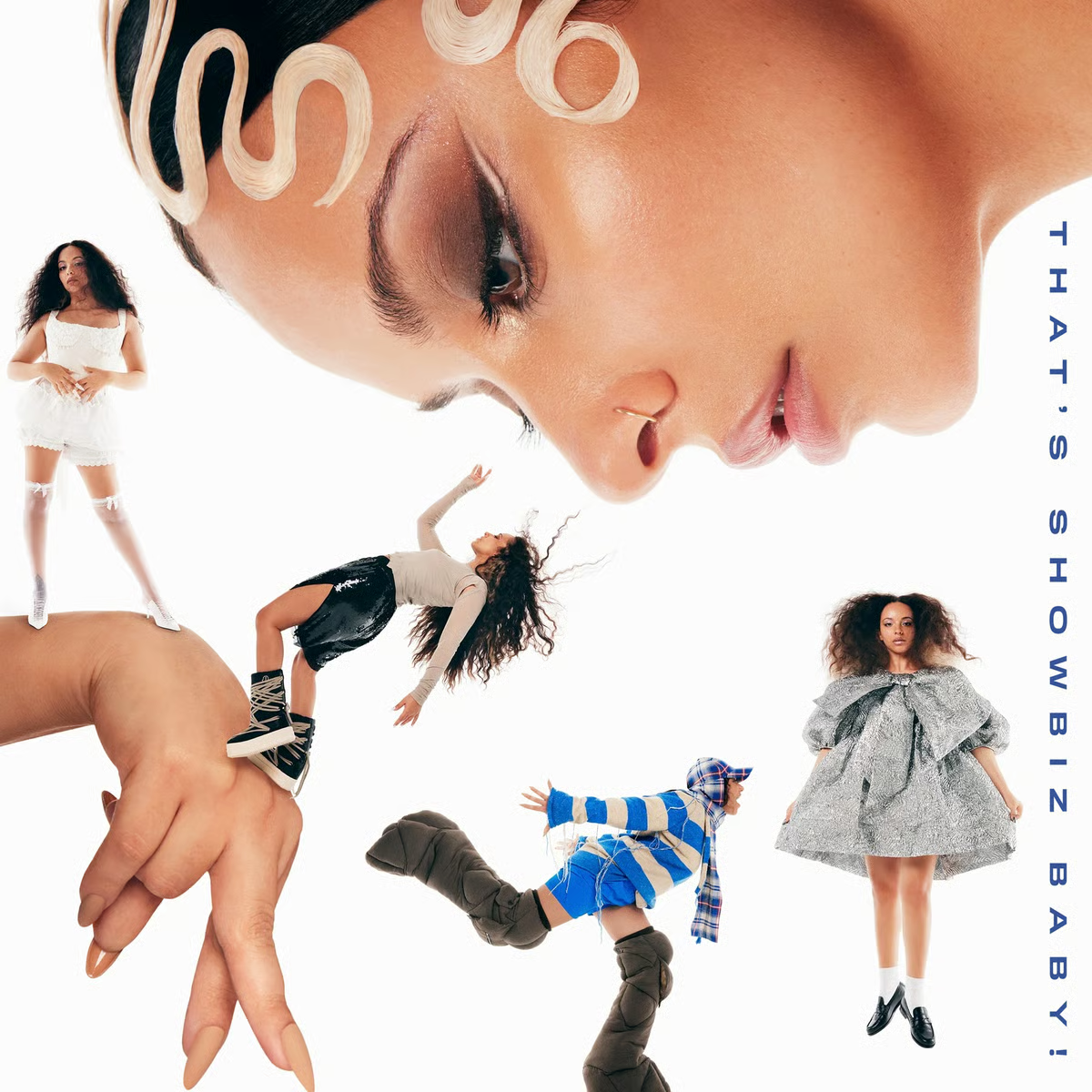
Continuing the legacy of British excellence as a member of “Little Mix,” a legendary four-member turned three-member pop music dynamo, 32-year-old Jade Thirlwall released her solo debut album, “THAT’S SHOWBIZ, BABY.”
This is Rami’s Reviews, a series where I, Rami Mansi, review anything pop culture related. Today, I’ll be reviewing Thirlwall’s album: A luxurious 14-track project that aims to please and does so with sequins, disco balls, and the secret ingredient of love.
Known mononymously as “JADE,” Thirlwall released “THAT’S SHOWBIZ BABY” on Sept. 12. The debut album details Thirlwall’s life as a teen musician turned global superstar, her love with English musician Jordan Stephans, and her relationship with her inner child.
Track one is the lead single off the album. “Angel Of My Dreams” sent shockwaves across social media and laid the groundwork for a high-class pop album. The experimental electroclash pop song details Thirlwall’s relationship to the music industry. With lyrics that hold the toxic industry accountable for both opening the door to success, yet never truly caring about her well-being.
In a continuing lyrical fashion, with her love-hate courtship with music labels. Track two, appropriately named “IT girl,” was teased months before its official release, yet was one of the most anticipated songs off the album. With a thumping bass-line and well-deserved Rihanna-level-cocky lyrics such as “I am the it girl//I am the sh*t, girl// I run the whole world,” Thirlwall knows her worth and refuses to submit to the executives before her.
In a maximalist pop wonder, track three, “FUFN (F**k You For Now),” has Thirlwall tired of arguing with her partner and chooses to leave the night off with a lingering resentment. With a bridge so handcrafted it makes you ascend and lyrics that make you question who Thirlwall is, honestly speaking to, a partner or the music industry that has overworked her since her teenagehood, “FUFN” is an underrated gem on the album.
With the next three tracks taking a romantic turn, track four is a true synth pop bliss that shares the synths of Swedish pop royalty Robyn. “Plastic Box” details how Thirlwall wishes she could hold her lover’s heart in a plastic box so it could never get hurt.
Track five takes romance to experimental lengths, both sonically and lyrically speaking, in the bedroom. “Midnight Cowboy” features a sonic landscape of experimental electronica with influences of club pop pushed through the mainstream music machine, accompanied by a spoken-word introduction from Rwandan-Scottish actor Ncuti Gatwa. Lyrically, Thirlwall owns up to her sexuality in beautiful displays of love hidden in the moonlight.
Track six is an ode to Thirlwall’s love of disco and her favorite artist, Donna Summer, whose influence can be seen over the entire album. “Fantasy” is a disco-pop song with funk influences that details Thirlwall’s sex-positive attitude towards her lover. “Fantasy” was released as the second out of four singles and two pre-release tracks, much to the dismay of fans who wanted to keep more songs as a surprise. An ask that I have always been perplexed by: why would you want more songs hidden on an album when an artist could be promoting the songs and delivering more content with said songs? But I digress, time for track seven!
“Unconditional” is a song dedicated to Thirlwall’s mother, who suffers from chronic illness. Thirlwall sings “Unconditional//I will hold your hand forever//even if my heart explodes,” over a disco-synth pop song with heavy drums and versatile vocals.
One of my personal favorite lines from the entire album is from this song, where Thirlwall lovingly states, “If only my love could be your medication // I could fix you so much better than your own prescription.”
Track eight, “Self Saboteur,” sees Thirlwall taking a therapeutic ride through lyrics as she sings about her own anxiety, causing her to mess up and run away from love, thereby being a self-saboteur. A synth-led song with inspirations of dream pop and pure pop, the track begins the second half of the album, which was kept hidden until release day.
Track nine is a tropical house-inspired and contemporary R&B song that details Thirlwall’s want for intimacy with her partner. “Lip Service” has proven to be a fan favorite amongst first-time listeners. The shortest song on the album, at 2 minutes and 27 seconds, comes to a stop, and the siren on track 10 begins to play.
“Headache” begins with a siren and funky bass that you can’t help but raise the volume on. Thirlwall is playful with her vocals; Studio 54 would’ve had this on repeat, and my favorite track on the album proves to be the reason why Thirlwall is not going anywhere: Her experimentation with pop music is as evident as her vocals are powerful.
The last four tracks on the album detail the stories that Thirlwall has not always been keen to share as a public figure.
Track 11, “Natural at Disaster”, is an electro-ballad with blasting echoes of Thirlwall’s vocals. Rumored to be about ex-Little Mix member Jesy Nelson, the lyrics depict Thirlwall’s toxic relationship with the subject as her suffering at the cost of their happiness.
The 12th track on this full-length project, “Glitch,” features an electronic R&B sound reminiscent of R&B star Tinashe. Detailing Thirlwall’s insecurities as glitches, she sings about going against her anxieties and owning up to her own individuality.
With a chorus that interpolates a recording of young Thirlwall singing “Stop! In The Name Of Love,” track 13, “Before You Break My Heart,” is a pop song with influences of 80s disco. Unlocking her inner child, Thirlwall sings to herself in this melancholic track. She sings lines that connect to anyone who has ever thought of their childhood, “On the main stage of your mind, so we can both shine? // Wish you could see me as your star.”
The last song ends like any major fashion show, with love. A ballad dedicated to her lover, “Silent Disco” is the atmosphere created whenever Thirlwall and her boyfriend are together: peaceful, loving, and safe. Shutting out the world and feeling the intimacy of one another, they celebrate each other’s hearts in this silent disco where the floor is empty and the disco ball shines its light on them and them alone. An instrumental ballad with pop influences, Thirwall’s voice springs out as the standalone instrument in this enchantment of a song. Oh, to be so in love that you create a silent disco on every dance floor you enter with your partner.
Thirlwall encapsulated love on the dancefloor, getting revenge through expose-worthy lyrics, and journeys of self-healing all within a 46-minute and 25-second debut album. To create this album, paired with a visual album available on YouTube, and opening for pop star Chappel Roan, you might think that Thirlwall is just about done with her journey in solo pop stardom.
But with a confirmed deluxe on the way, tour coming this October, and a sophomore album, Thirlwall has already begun to create, this solo artist is just getting started.
With reinventions afoot, critics waking up to the pop genius that is Thirlwall, and pop culture welcoming her with open arms and likes galore, Thirlwall is living the popstar dream on her terms.
Because when you’re Thirlwall and you’ve had almost 15 years in the music industry, and people are still finding new things to say about you, all you can honestly say is that’s showbiz, baby.