
By: Alfonso Abreu
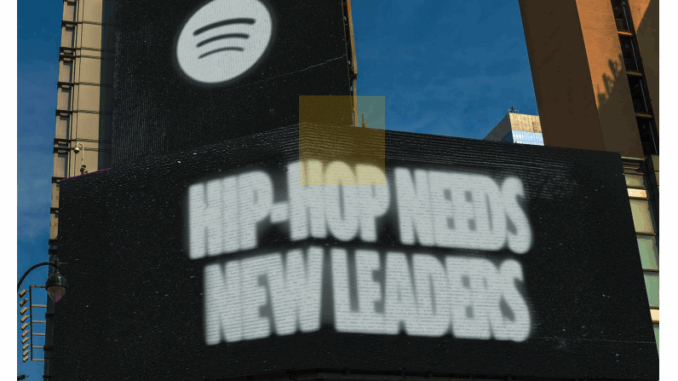
Over the past week, music streaming app Spotify has placed billboards in different cities, declaring a simple statement, “Hip-Hop needs new leaders.”
Discussions regarding the statement split in two directions: the obligatory list of rappers, whom been tossed in these conversations before COVID-19, and a sudden realization that the genre has grown past needing “leaders”.
Ironically, Spotify launched an advertising campaign and showcased what it thought were the new leaders of the genre.
This list, which should be no surprise to anyone reading this, is a strategic and out-of-touch selection that doesn’t serve to highlight rappers behind sounds defining the decade. Yet instead, features artists who will (and continue to) thrive under the company’s algorithm. It is an initiative attempting to preserve the remnants of the old rap ecosystem, solely because it benefits streaming services and the executives within the industry
From the beginning of the decade, there has been a shift in the music landscape, influenced by how accessible the internet is. Algorithms have become increasingly controlling and influential to listeners. These two factors play a huge role in how music is created, consumed, and presented. Songs are being uploaded at a frequent rate and packaged for consumers without the need for label and executive approval.
Retracing Hip-Hop’s steps demonstrates that an artist’s music will find itself in the ears of listeners, somehow and someway, without the industry’s authority.
In the 90s and early 2000s, mixtapes were sold out of trunks and from Canal Street bootleggers, converted into ready-to-be-downloaded digital files on websites, to what we have today: accessible uploading. It fundamentally captures the essence of the genre, community.
Existing simultaneously are labels and emerging streaming services, which still have power, or more accurately, leverage over the artist and listeners. The industry once maintained large control over what music reached audiences and how. Once the internet became a tool first and accessory second, this control began to transfer into the hands of the artist and the listeners. In contemporary times, audiences have more control over what is being pushed and consumed rather than a label, which in turn acts in opposition to streaming services.
In the era of retailing music, Hip-Hop’s “leaders” or “stars”, as it was once called, were used to labeling artists as money-makers. To be a star, you inherently had to be a marketable item.
Let us once again retrace the genre’s footsteps to look at the well-known story of Kanye West.
The heavily documented series of events saw Mr. West go through the troubles of securing a record deal due to an assumption that his sound would result in a lack of success in a scene dominated by artists like 50 Cent and Dipset. It’s commonly reflected back on as a motivational tale of an artist cutting through the noise with their specific frequencies. Rightfully so, as this is more relevant now than ever, yet it’s better to look at it through a lens.
The story is a label believing there was more success to be had in having their star producer (at the time) be one of the driving forces behind their other bigger successes. It’s the foreshadowing of a capitalistic loop that will be damaged in today’s landscape.
To steer back to the mixtape era, it was a time period that focused on the relationship between the artist and the listener, and with the introduction of the internet, it eventually served as the middleman. Artists had personal say in their releases, placing the music as their first priority over revenue. For decades, labels have made multiple attempts to crack down on this scene, to no avail, of course, as it simply moved to the internet.
The iconic mixtape website Datpiff is a hotbed of mixtapes that have shaken up the genre; remnants of the website now live on through the Internet Archive, among other notable sites, which had their own exclusive drops. To quickly sum it up for those who never grew up clicking through the site, Datpiff was a proto-streaming service before streaming services were everywhere.
If Apple Music and Spotify are Netflix and HBO Max, then Datpiff was Tubi.
A week before Spotify’s Billboard, the Datpiff’s X account tweeted out, “Back in 2014, I had an exec @ Apple tell me WE were their competition, little us vs a $4B company.”
Less than a year later, Drake (cause it always leads back to him) dropped “If You’re Reading This It’s Too Late” and billed it as a “commercial mixtape,” which is basically another way to say studio album, but instead of living on a free website, it’s behind a paywall for millions to access. This is mainly why this trend became the standard; it was a part of a streaming service that has the power to push out the music onto your algorithm. These free mixtape websites relied on traffic generated from word of mouth, blogs, and, of course, clicking through the website. Factors that have now become archaic due to society’s reliance on the algorithm.
Spotify’s recent push for new leaders rings as an open declaration of who the company will push forward using its algorithm.