
By: Emily Nixon and Sayles Kaliszewski
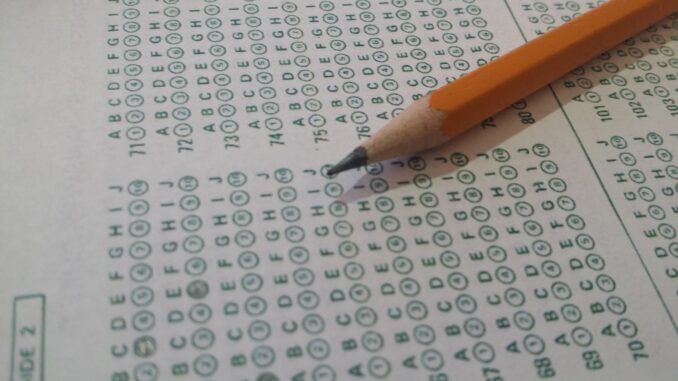
The New York Board of Regents, a sector of the New York (NY) State Education Department (NYSED), voted to remove the Regents testing as a graduation requirement for high school students across the state on Sept. 14. This decision has led to debate on campuses across New York, including Brooklyn College (BC).
The NY State Regents examinations are statewide standardized tests developed by the NYSED. Since the late 1990s, students at NY public and charter schools have been required to pass five specific Regents exams, one for each core subject, to earn their high school diploma.
This new plan will go into effect for the Class of 2028 and is part of a larger effort to reform graduation requirements and increase equity in public education.
Some students, like Marcus Malivert, a senior studying Psychology at BC, feel that the Regents are necessary to ensure students are being adequately prepared for life after high school.
“If you can’t complete the prerequisite, how are you gonna complete the advanced course? It’s not a roadblock, it’s a skill check,” said Malivert. “Things happen. Sometimes you’re not prepared for things, sometimes you’re not ready, but the point is we cannot glorify inadequacy.”
Despite his own struggles with the Regents, Malivert feels the decision will hurt students more than helping them.
“I’ll admit, I hated the Regents in high school, but it’s a necessary part to show your academic prowess,” said Malivert. “You need to have consequences in life, and if you are not capable of going to the next level, sometimes you need to stay behind and work on yourself, because we shouldn’t be glorifying incapability for the sake of sparing everyone’s feelings because that’s not gonna help anyone in the long run.”
Other students, like Ryan Eliezer, a junior studying Biomedical Informatics, feel that the Regents were helpful to review material during the year, an opportunity future students will miss out on.
“I believe that Regents are kind of like a standpoint of how you were doing throughout the school year. It’s just a great way to look back on information, make sure you understood it, and I feel like removing that only, not only takes away that, it takes away students’ ability to understand the concepts that they learned about in their class,” said Eliezer. “But, I also feel like it just makes it easier for them to graduate and move on and not actually testing their knowledge of their skills.”
Joe Scarpetta, a college assistant at the LGBTQ+ Resource Center at BC, feels that the tests are unfair to students having a “bad day.”
“I think that the Regents going away ultimately is a good thing because it’s eliminating barriers of entry for students,” said Scarpetta. “It’s allowing more students to have a fair shot, and at the end of the day, I don’t think standardized testing is a good qualifying agent to require students to achieve a certain score to have access to a classroom.”
Although the exams will no longer be mandatory, they will remain available to high school students as an option. According to the NYSED, “[the Regents examinations] will continue to serve as rigorous measures of academic achievement but will no longer be a separate diploma requirement.”
Instead, the NYSED plans to focus on alternative evaluations of student success, with the goal of creating a more well-rounded and fair system.
“The Department will move forward with the development of high school accountability assessments specifically designed to provide comparable statewide evidence of student achievement and create opportunities to better measure academic growth,” stated the NYSED.
One example of these assessments is the Performance Based Assessment Tasks (PBATs), which include “analytic essays on literature,” “social studies research papers,” and “lab reports of original science experiments or engineering designs,” among others.
The Board of Regents Chancellor, Lester W. Young, Jr., emphasized the effect this decision will have on promoting equity in public education reform.
“Advancing this work moves us closer to a more equitable system, one that upholds high expectations for all while ensuring that a student’s zip code, background, or circumstance never determines their opportunities for success,” according to Young.
Some, like Scarpetta, feel that inaccessibility is one of the main factors limiting student success on the Regents.
“Some students are better at taking tests than others, and a significant factor in a student scoring high on their Regents is access to resources, such as tutoring,” said Scarpetta. “There are plenty of parents who don’t have even a high school education. New York City is filled with immigrant families who come from different countries. Maybe English isn’t their first language. So, to have this standardized test where everyone is being tested at the same level is fundamentally unfair.”
Malivert feels the removal takes increasing accessibility too far.
“It’s important to be inclusive. It’s important to cater to everyone, but catered doesn’t mean limitation,” said Malivert. “At some point, [students] are gonna suffer for it.”
Scarpetta and Malivert agree that the money saved from removing the Regents requirement should be invested elsewhere to help support students.
For Scarpetta, this reinvestment should go into free lunch and student metrocards, among other things.
“I think that that should be invested into advanced training, into training for safe allies to ensure all students on all campuses feel that their needs are being met holistically, not just in terms of academics,” said Scarpetta.
Malivert feels that the money should be diverted to increasing resources for schools to better teach students.
“[In high school,] I think my teachers were excellent, and they did the best they could with the resources they had, but the school definitely let certain things slip for the sake of keeping the numbers high,” said Malivert.
Malivert feels this is the latest in a decline of the American education system.
“Effort is important, and we can’t just give up on our education system and just make it easier to let everyone get through it for the sake of whatever,” said Malivert. “We need to try harder.”
As the Board of Regents decides on a new plan for graduation requirements, NY City Council Officials warned The Gothamist, that without clear guidelines, schools may be stuck in “educational ‘purgatory,’” unable to clarify for future graduates.