
By: Samuel Mortel
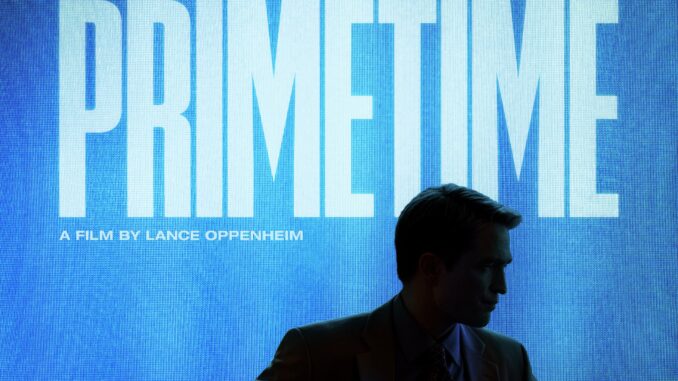
We’re now a few weeks removed from the premiere of “Primetime.” Directed by Lance Oppenheim, the film is a dramatization of the height and tragic end of the Dateline NBC series “To Catch a Predator” (TCAP), with Robert Pattinson playing the iconic host Chris Hansen, along with Skylar Gisondo and Merritt Wever co-starring as one of the show’s decoys and the show’s producer, respectively.
The film has been the center of some controversy, including from the real-life Chris Hansen, but Oppenheim uses TCAP and its host to delve into several complicated societal issues and force the viewers to have an uncomfortable conversation about ourselves.
The events of the film are based on a true story, chronicled in the 2007 Esquire article “Tonight on Dateline, This Man Will Die.” The article details an infamous botched sting operation led by TCAP’s vigilante group Perverted Justice and the police department of Murphy, Texas, resulting in the suicide of assistant district attorney Bill Conradt. After this fatal investigation, the show would only last six more episodes.
Oppenheim has had to clarify in numerous interviews that the film isn’t intended as a hit piece. Still, there’s this idea (most likely shared by people who didn’t see the film) that “Primetime” paints Hansen as some sort of villain. Even the real Chris Hansen has been vocally against the film and Pattinson’s portrayal of him.
In reality, the depiction of Hansen is not flattering, but he’s no villain. At the end of the day, he and the team at Perverted Justice were still shining a light on some of the most disturbed members of society and preventing them from committing one of the most despicable acts possible. Even if one single child was saved from being predated on because of TCAP, that’s immensely commendable. This movie shouldn’t make us hate Chris Hansen. If we want to look at him and his whole operation a bit more cynically, that’s fine, but the real subjects of interrogation should be ourselves. Hansen is only human, after all. What’s the real difference between him and the countless copycats on the internet who do their own version of TCAP?
Is it really much more than the fact that the imitators don’t have a suit, a cool voice, and the budget of a TV studio behind them? The original show is far less trashy and sensationalist than the online influencers that it gave birth to, but they come from the same compulsion: the desire of the creators to prop themselves up in the name of righteousness (even if their cause is truly righteous), along with the morbid curiosity and mob mentality of the audience to see someone face the ultimate punishment. It’s something shared by all of us, including Hansen. In the end, that compulsion is the real “villain” at the heart of the film.
This is a post-9/11 world. The era of “Friends” and “Seinfeld” is far gone. The American public has been robbed of a certain innocence. The only thing on the minds of many is vengeance. These themes are explicitly conveyed in the film, with constant allusions to the War on Terror and the hunt for Saddam Hussein. There’s one scene at a police department that features printed-out pictures of Hussein and Osama Bin Laden taped to targets in the gun range. The country is still reeling from the pain of the most devastating terrorist attack to date, and is willing to hurt anyone or sacrifice anything (including our privacy and humanity) in order to release our collective anger.
Hansen is a man who lacks a certain amount of control. There are numerous people and things in his life that he’s beholden to: his wife, his producer, NBC, the media, his own feelings of inadequacy as a journalist, the millions of people who have to pick between watching TCAP or “Lost.” But when he steps out of a door frame and sees the terror on a would-be predator’s face, that’s when he’s in control. For a brief moment, in that decoy house, Chris Hansen is god.
One of the film’s most illustrative scenes is when Hansen is on a plane and has a brief interaction with a fan. The conversation has a very dark tone, with the fan asking Hansen if he ever feels like murdering the predators he confronts. Hansen replies that what he does on the show may actually be even worse.
Oppenheim analyzed this scene in an interview with GQ.
“I do think one of the things that made [Hansen] and the show so successful is that it’s like a new form, version of the pillory or like a whipping post. And specifically in 2006, there was so much rage and anger, and there still exists that very thing in society today. The show proved to be this amazing receptacle for all of that. In a weird way, if you go back thousands of years, the pillory, there was always someone that was administering the blows to somebody that was at the whipping post. And Chris Hansen is that person. And I think like in this scene, he’s talking to someone that would’ve been in the audience of that a thousand years ago.”
Near the end of the film, Hansen pressures decoy actor Dan Plum to call Conradt. The seriousness of the situation is weighing heavily on Plum, and he’s gotten to the point where he wants to relinquish any involvement. Then, Hansen draws a line in the sand. “You’re either with me or him.”
At that moment, Plum’s mental state or personal principles are irrelevant. There are only two sides: good and evil. If you’re on the side of good, you must do whatever it takes to eliminate evil, at all costs, even if it eats away at your moral fiber or pushes you beyond what you thought you were capable of doing to another person.
It’s an incredibly uncomfortable, complex topic, but at the same time these conversations are often the most important. It must be nice and stress-free to not have to consider the complexities of life. Why not just make the world simple and put everything in black and white? There is only good and evil. It’s the responsibility of the good people to go on a rabid hunt for evil (without addressing any root problems), and if you’re not actively a part of that, you might as well be one of them. But that’s just not the way life works. We can’t allow ourselves to regress and think of things in reductive, simple ways.
We can’t allow ourselves to lose our humanity and turn into hordes of vultures. Even if we’re angry with the world and frustrated in our personal lives, we shouldn’t use that as fuel to unload onto other people, submerging ourselves in darkness that corrupts our souls and destroys our integrity.
In a way, the film is about more than Chris Hansen. It’s about me and you.