
By: Samantha Colon
The term “South Brooklyn” has historically referred to the old Italian district in the borough of Brooklyn before it was incorporated into New York City. That includes Park Slope and other neighborhoods closer to central Brooklyn.
Today, South Brooklyn is geographically defined, including the neighborhoods that line the borough’s coast. This includes: Bay Ridge, Fort Hamilton, Dyker Heights, Bath Beach, Coney Island, Sheepshead Bay, Brighton Beach, Manhattan Beach, Mill Basin, Gerritsen Beach, and Marine Park. Here, the streets resemble suburbia more than a typical city; houses with white picket fences sit on tree-lined streets. Despite its suburban detailing, transit hubs of Sheepshead Bay and Coney Island, which are served by the D, N, F, B, and Q train lines, there is a scarcity of public transportation. In fact, the neighborhoods of Mill Basin and Marine Park do not have any train stations within their boundaries.
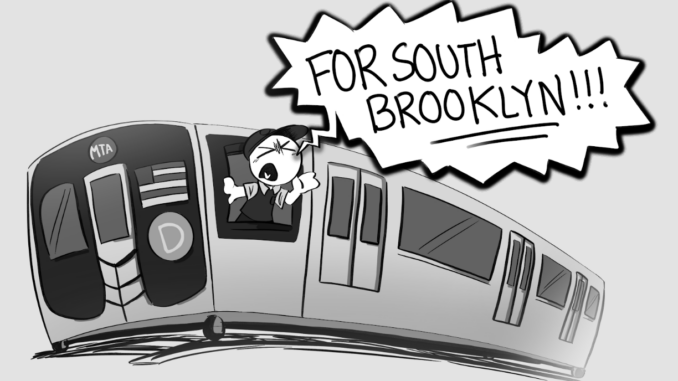
This creates an inconvenient commute for students, especially those without access to a car (including many at Brooklyn College), since available buses are often much slower than trains. To solve this, the train lines that serve Coney Island and Sheepshead Bay should be routed to underserved parts of South Brooklyn.
Shehzil Awan, a Brooklyn College student from South Brooklyn, described her daily commute on “crowded, slow buses that are subject to traffic” and remarked that she has to transfer to the
”B or Q to go [out of her neighborhood which] is insane, especially [since] the transfer from a bus to the train isn’t free!” It is clear students like Shehzil would benefit from the added train lines, both in the time and the money they would save.
Even in neighborhoods such as Bay Ridge, Dyker Heights, and Bath Beach, which already have train stations, residents are still underserved compared to the rest of the city because they have a single train line in their area. If that train is delayed or the station is closed for repairs, there is no alternative subway option for leaving the neighborhood. While there may be a shuttle bus following the train’s route, shuttle buses cannot be tracked like the subway and, in my experience, have not been reliable.
South Brooklyn’s lack of public transport is not a problem that developed overnight; it is the result of more than a century of history and innate geographic obstacles. Until the mid-20th century, South Brooklyn did not have the population to justify a subway line according to the Rapid Transit Act of 1894, and by then the city’s subway routes had mostly been solidified. Furthermore, the soft sediment making up the coastline, a tendency to flood, and continuous erosion make it difficult to build underground subway lines, according to NYC GOV.
All these factors have contributed to the experiences Shehzil and others have had with public transport. In fact, this summer, during weekend repairs, a shuttle bus replaced the R train in Bay Ridge, and at times I spent so long waiting for the bus that I chose to walk even amid the record-high temperatures this summer. If other train stations had at least one different train running through them, others like me wouldn’t have to be stranded waiting for a shuttle bus that might not even arrive.
It is still possible to build and expand subway lines despite geographic challenges. Elevated subway lines can be built to avoid unstable ground in coastal areas, which has already been done in Coney Island, proving it is possible.
South Brooklyn’s subway woes may soon be coming to an end with the MTA’s proposal for the Interborough Express line, which has proposed stops in parts of South Brooklyn. This is not the first time the MTA has proposed a subway extension to underserved parts of the city. The Utica Avenue extension, which has been repeatedly promised to bring service to transit deserts in South Brooklyn, still hasn’t been built.
The Interborough Express Line, however, seems more promising as it is progressing through the design phase. The extension’s construction might spell the end of South Brooklyn’s subway woes, but we’ll have to wait to see what happens.