By: Mars Marte
Nonprofits are groups established to serve the public via community development. After stumbling into this field nearly four years ago, I can’t imagine a career anywhere else.
However, in these passing years, a trend has begun to take shape within nonprofits: budget cuts and burnt-out employees. Community-based organizations stand as the backbone for the populace, sustaining neighborhoods in areas of need. The life nonprofits breathe into communities is increasingly being snuffed out, leaving a skeleton of dreams driven into dust.
The Center for Effective Philanthropy, CEP, conducts yearly audits analyzing the state of nonprofits. In their most recent report, 46% of nonprofit leaders who participated in their study have reported levels of extreme burnout, a rapid uptick from the 2025 score of 29%.
The report includes a graph listing common experiences organizations face among them are an increased demand for services and a reduction in staffing. These traits highlight the strenuous conditions that contributed to rising fatigue among those within the field.
With the demand for nonprofits growing, dwindling staff are tasked with bearing an unsustainable workload with no reprieve in sight as the financial environment limits hiring, a nonprofit leader explains in CEP’s report.
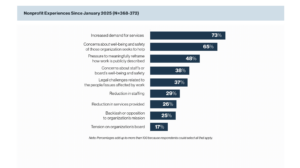
Since Jan. 2025, 57% of the directors within CEP’s study reported increased difficulty in securing grants. Interestingly, the investigation highlights program leaders reporting decreased funding from founders since Jan. 2025. As founders begin to financially pull out of their organizations, the charities are left to sustain the loss, forcing leaders to endure financial instability.
The current administration’s proposed rewrite to anti-redlining laws seeks to cap the amount of money banks can offer as a grant to nonprofits at 15%. The percentage is only applied to grants pertaining to overhead costs such as staffing, rent, and technology, with a favor of steering funds towards project-specific activities. By directing funds towards the project, current nonprofit staff will further be limited in the tools necessary to run programs. Without the means to sustain staffing or rent for a place of operations, the ability to host project-based initiatives remains a dream that’ll lie dormant if steps are made to further limit nonprofits’ means of securing subsidies.
Grants and other means of outside funding are vital, as the organizations are aimed at prioritizing people over profit. In order to cover the gap left, many sites have membership fees which help ensure a consistent source of income. However, once an organization’s tools are locked behind a paywall, their ability to directly serve the community dwindles.
Thomas DiNapoli, NYS comptroller, underlines the critical role people-centered foundations serve within New York in a report published in Jan. 2025 titled “The Critical Role of Nonprofits in New York.” The piece highlights the presence of nonprofits is the most prominent within New York State when compared to the United States as a whole, with the state holding a 5% concentration of nonprofits compared to the national average of 3.1%. Within the state, nonprofits serve as a vital service helping New Yorkers receive assistance in various industries ranging from healthcare to education.
Yet despite the indispensable role these organizations play, those who carry out these services are paid a wage that does not equal their work. In DiNapoli’s report, he discusses the findings from a 2022 U.S. Bureau of Labor Statistics survey.
“[…]average annual wages paid by nonprofits in New York were nearly 24 percent lower than in the private sector and nearly 14 percent lower than the public.” While this data dates back nearly four years ago, it underscores the fundamental financial issues plaguing these foundations.
With stress compounding, leaders within the field find themselves at a crossroads; do they continue in the field despite the demanding conditions or do they leave?
“As the executive director, I have been going through my first-ever, incredibly intense burnout. My entire holiday vacation, I could barely leave the couch or the bed. I looked into sabbatical options, but there are none available for my industry, location, or size of staff,” a nonprofit leader describes their experience within the field in CEP’s report.
Due to the nature of the job, where employees are rooted in a community, the work/life balance is often non-existent. Disconnecting from the work once you leave the office is a daunting task when the work that is done significantly impacts others. Choosing to work in a field dedicated to serving society demands that individuals in the field are continuously mentally and emotionally present; a task that is nearly impossible, as those already cemented have been suffocated by growing caseloads and a lack of support. The leader’s experience highlighted shies away from the extreme, painting an accurate picture of the repercussions of a field struggling to remain standing.
There is no ignoring the necessities of nonprofits; in doing so, we turn our backs on those in need and those committed to serving the community. Not everyone has to make this their career but we should all find ways to support the society that surrounds us. It can be as simple as volunteering at an organization that shares ideals with you or even developing and spreading awareness of issues that plague your community. Through these small tasks, we can begin to alleviate the immediate stresses on these foundations. Supporting the backbones of our society allows for the energy to be reallocated to continuing services; not drafting up a eulogy.